
Trolley
You have no items in your shopping cart

 Budgets
 Dumbers
 Discs
Discs
 Benches
 Racks and Rigs
 Weights Holders
 Isotonic machines
 Calisthenics
 Cardio
 Kettlebells
 Flooring
 Gym Set
 Accessories
 Combat
 ARTI MARZIALI
 CONTAINER GYM
 Tug-Of-War
 Used Gym Equipment
 PILATES MACCHINARI
 GINNASTICA ARTISTICA
 CAMPI DA PADEL
 Prodotti in Pronta Consegna
 Informazioni
 IRONMAN
 Gift Card
- Donatif
- Training and exercises
- 0 I like it
- 2768 Views
- 0 comments
READING TIME: 8 MINUTES ➤➤
When setting up a functional, effective, and space-efficient home gym, choosing the right equipment is essential. Among the most popular and affordable solutions are two versatile tools: the TRX (or other suspension training systems) and fitness resistance bands. Both promise excellent results, but they meet different needs and training styles.
In this article, we will clearly and thoroughly analyze the pros and cons of each piece of equipment, evaluating criteria such as workout effectiveness, value for money, space requirements, portability, and ease of use. The goal is to help you make an informed decision that truly fits your needs, avoiding unnecessary spending while optimizing your investment.
- Why compare TRX and resistance bands?
- How TRX works and its main benefits
- Resistance bands: features, benefits, and drawbacks
- Direct comparison: TRX vs resistance bands
- Which equipment should you choose based on your goals
Why compare TRX and resistance bands?
The context of home fitness today
In recent years, home workouts have experienced a significant boom, driven by the need for flexibility, cost savings, and convenience. More and more people are choosing to create a small gym at home, looking for tools that offer the right balance between performance, cost, and space efficiency. In this context, equipment such as TRX systems and fitness resistance bands represent accessible options, but with very different characteristics.
The variety of available options can sometimes create confusion and lead to decision overload. This is why comparing two widely used tools in a structured way is essential: only then can you make a well-informed choice that truly matches your lifestyle, experience level, and training goals.
Common goals and user needs
People who train at home often share clear priorities: improving their physical fitness, optimizing available space, controlling costs, and maintaining consistency. However, these needs translate into different practical choices. Some people prefer the versatility of resistance bands for quick and dynamic sessions, while others rely on the intensity and stability of suspension training to engage deeper muscle groups.
The comparison between TRX and resistance bands therefore arises from a practical need: identifying the tool that offers the best balance between results, price, and space efficiency. This article aims to guide readers toward a rational and well-informed decision, reducing doubts and uncertainty.
How TRX works and its main benefits
What suspension training is
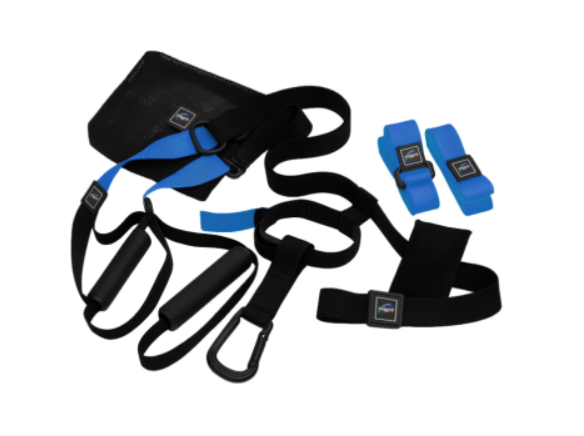
TRX is a training tool based on the principle of suspension training: a system of adjustable straps with handles that allows you to perform exercises using body weight and gravity. Originally developed for Navy SEAL training, the TRX enables highly effective full-body workouts, engaging deep muscle groups while improving stability, balance, and coordination.
All you need is a stable anchor point — such as a door, beam, or wall mount — to transform almost any space into a complete workout station. Thanks to its simple yet clever design, the TRX allows for a wide variety of exercises that can be adapted to virtually any fitness level.
Main benefits of TRX for home gyms
One of the greatest strengths of the TRX is its ability to activate multiple muscle groups simultaneously, increasing the efficiency of each workout session. This makes it particularly suitable for people with limited time who still want a high-intensity workout. Additionally, by constantly engaging stabilizing muscles, the TRX helps improve posture, balance, and functional strength.
From a practical perspective, the TRX is also easy to transport and install, making it ideal for people with limited space or for those who want to train while traveling. The ability to adjust intensity simply by changing body angle makes it suitable for both beginners and advanced athletes.
Limitations and considerations
Despite its many advantages, the TRX also has some limitations. First, it requires a certain level of body control to perform exercises correctly and achieve optimal results. Beginners may initially struggle with unstable positions, potentially leading to incorrect or less effective execution.
Additionally, although compact, the TRX requires a secure and reliable anchor point, which may not always be available in every home environment. The price is also generally higher compared to a basic resistance band set, especially when purchasing original, certified products.
Resistance bands: features, benefits, and drawbacks
Types of bands and their uses
Resistance bands are extremely versatile tools available in different shapes, resistance levels, and materials. The most common types include flat bands, loop bands, and bands with handles. Depending on the type, they can be used for strength training, stretching, mobility work, rehabilitation, or even to add resistance to traditional bodyweight exercises.
The key feature of resistance bands is progressive resistance: the more the band stretches, the greater the force required. This makes them suitable for both beginners and experienced users, allowing workout intensity to be adjusted easily and intuitively.
Advantages in terms of versatility and space
One of the biggest advantages of resistance bands is their extreme compactness and lightweight design. They can easily be stored in a drawer, carried in a small bag, and used almost anywhere: at home, in the office, outdoors, or while traveling. This makes them ideal for people with limited space or for those looking for equipment that fits into a flexible routine.
Resistance bands are also very affordable compared to many other home fitness tools. A complete kit with multiple resistance levels can cost less than 20 euros while offering a wide variety of exercises for the entire body. They are perfect for short and frequent sessions focused on toning, mobility, and muscular endurance.
Drawbacks and limitations of band training
Despite their advantages, resistance bands also have some limitations. One of the main issues is the difficulty of accurately measuring resistance. Unlike traditional weights, workout intensity can vary significantly depending on the band’s length and the user’s posture, making it harder to track progress precisely.
Over time, bands also tend to wear out and may lose elasticity or even break, especially if subjected to excessive loads or unfavorable environmental conditions. Compared to TRX training, they generally provide less activation of deep stabilizing muscles and often require more attention to maintain proper posture during exercises.
Direct comparison: TRX vs resistance bands
Workout effectiveness
In terms of effectiveness, the TRX allows for a complete functional workout, ideal for improving strength, balance, and coordination. It strongly stimulates the core and stabilizing muscles, making it perfect for those seeking overall physical development. Resistance bands, on the other hand, are particularly effective for toning, muscular endurance, and mobility, especially when used in bodyweight routines or high-intensity circuits.
If your goal is to strengthen the entire body through controlled and progressive movements, the TRX may offer more advantages. However, resistance bands are extremely useful for quick, targeted sessions and can easily be integrated into recovery or complementary training routines.
Price and accessibility
From a financial perspective, resistance bands clearly win in terms of affordability. A quality basic set typically costs between 10 and 30 euros, while an original TRX system can exceed 100 euros. Although cheaper TRX alternatives exist, their build quality and safety are often inferior. If budget is a major concern, resistance bands are the more accessible option.
However, it is also important to consider the investment-to-durability ratio: a well-maintained TRX can last for many years, whereas resistance bands tend to wear out faster and may require periodic replacement, especially with frequent use.
Space requirements and portability
Both TRX systems and resistance bands are space-saving tools, but there are some differences. Although compact, the TRX requires a secure anchor point, which may not be available in every home. Some exercises also require a minimum amount of space both vertically and horizontally.
Resistance bands, by contrast, adapt easily to almost any environment. Only a few square meters are needed to perform a full workout. They are ultra-light and easy to transport, making them ideal for people who want to train on the go or in non-structured environments.
Required experience level
The TRX demands greater body awareness and technique, as many exercises involve unstable positions. For beginners, this can initially feel challenging. However, with proper guidance, even newcomers can benefit greatly from suspension training.
Resistance bands, on the other hand, are intuitive and suitable for all levels. They offer a smoother learning curve, allowing users to start training immediately without advanced technical knowledge. For this reason, they are often recommended for people who are just starting their home fitness journey.
Durability and maintenance
A high-quality TRX system is built with durable materials designed to withstand intensive use for many years. Proper maintenance is generally enough to preserve its functionality and safety over time. Resistance bands, however, are more delicate and prone to deterioration due to stretching, environmental conditions, and repeated use.
Periodic replacement of bands is therefore an aspect to consider, especially for frequent users. Fortunately, their relatively low cost makes replacement manageable even in the medium to long term.
Which equipment should you choose based on your goals
Who should choose TRX
The TRX is the ideal choice for those seeking a functional, complete, and high-intensity workout. If your goal is to increase strength, improve stability, and develop a more responsive and toned body, the TRX can provide a professional training experience even in limited spaces. It is particularly suitable for individuals who already have a basic level of body control or who want to take their home workouts to the next level.
Thanks to its ability to engage the core during every movement, the TRX is also excellent for athletes and individuals practicing sports that require strong postural control. However, it is important to ensure that you have a suitable anchor point and enough space to perform the exercises correctly.
Who should choose resistance bands
Resistance bands are the perfect solution for people looking for a low-cost, versatile, and easy-to-use tool. They are particularly suitable for beginners, occasional exercisers, or anyone who needs equipment that can easily fit into short training sessions, even outside the home. They are also widely used in rehabilitation, stretching routines, and mobility exercises.
Their lightweight design, low price, and portability make them ideal for those with limited space, frequent travelers, or individuals who simply want to start exercising without a significant investment. Although they generally provide less intense stimulation compared to TRX systems, they are excellent for toning, maintaining fitness, and staying active safely.
Practical tips for making the right choice
There is no universal answer: choosing between TRX and resistance bands depends on your budget, preferred training style, and specific fitness goals. If you want a more intense and professional training experience, the TRX may be the best option. If you prefer flexibility and simplicity, resistance bands are the more practical choice.
One final suggestion: consider using both tools together in a complementary way. Combining suspension training with lower-intensity band exercises can create a highly effective mix of strength, mobility, and endurance. Whatever you choose, consistency is the most important factor — the best piece of equipment is the one that motivates you to move every day.
Comments (0)