
Trolley
You have no items in your shopping cart

 Budgets
 Dumbers
 Discs
Discs
 Benches
 Racks and Rigs
 Weights Holders
 Isotonic machines
 Calisthenics
 Cardio
 Kettlebells
 Flooring
 Gym Set
 Accessories
 Combat
 ARTI MARZIALI
 CONTAINER GYM
 Tug-Of-War
 Used Gym Equipment
 PILATES MACCHINARI
 GINNASTICA ARTISTICA
 CAMPI DA PADEL
 Prodotti in Pronta Consegna
 Informazioni
 IRONMAN
 Gift Card
- Donatif
- General information
- 0 I like it
- 9 Views
- 0 comments
- gym flooring, safety flooring, gym safety, shock-absorbing materials
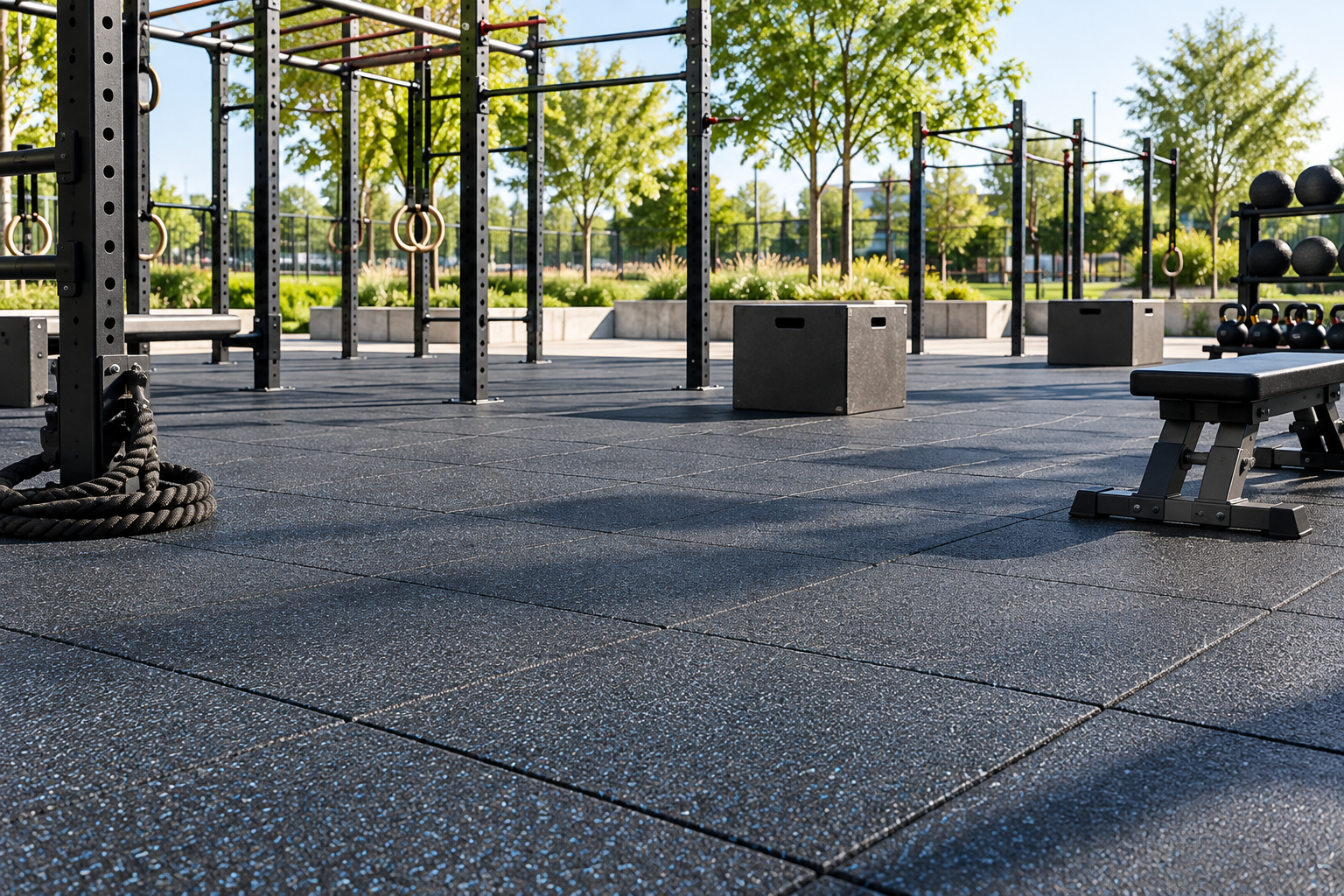
Outdoor anti-shock flooring thickness: how to choose the correct one
The outdoor anti-shock flooring thickness is one of the most important parameters in the design of an outdoor fitness area, but it should never be considered as the sole criterion for selection. The overall performance of the surface actually depends on the interaction between material, subfloor, installation system, drainage, intended use and characteristics of the installed equipment. A greater thickness does not automatically guarantee better performance if the project does not take into account the entire construction system.
The correct choice requires a preliminary analysis of the installation area, the activities that will be carried out and the environmental conditions. A facility intended for functional training, for example, has different requirements compared to an area dedicated exclusively to bodyweight exercises or passageways. Each solution must therefore be evaluated within its own operational context.
This guide explains how to choose the outdoor anti-shock flooring thickness through verifiable technical criteria, illustrating the aspects that truly impact the configuration of a professional fitness area without replacing design instructions or manufacturer specifications.
- Quick answer
- Which specifications really matter?
- How to choose the correct thickness
- Compatibility with subfloor and equipment
- Evaluation criteria table
- Purchase mistakes to avoid
- FAQ
- Why evaluate the entire system and not just the thickness
How to choose the thickness of outdoor anti-shock flooring?
The outdoor anti-shock flooring thickness must be defined by considering intended use, type of equipment, subfloor characteristics, drainage system and manufacturer instructions. Thickness represents an important parameter, but it must be evaluated together with the other elements that determine the overall performance of the surface.
Design should start from the operational needs of the facility and not just the dimensions of the tiles.
Every choice should be verified through technical documentation and design specifications.
What is the main criterion?
Analyze the type of intended use, the installed equipment and site conditions before identifying the most suitable solution.
Which references should be used?
It is advisable to consult technical datasheets, manufacturer manuals, applicable standards and design instructions to verify the compatibility of the chosen solution.
Which specifications really matter?
Thickness represents only one of the characteristics of the flooring.
Performance depends on the entire construction system.
A comprehensive evaluation allows to reduce future critical issues.
Material characteristics
In addition to thickness, it is important to verify composition, density, mechanical behavior, UV resistance and suitability for outdoor use as declared by the manufacturer.
Drainage system
Rainwater management directly affects the durability of the flooring and must be designed together with the subfloor and the installation method.
How to choose the correct thickness?
Every project has different requirements.
There is no single thickness valid for any operational context.
The evaluation must be carried out by considering the system as a whole.
Evaluate the intended use
The expected activities, the level of surface stress and the type of training stations influence the choice of the most appropriate thickness.
Analyze the overall project
The thickness must be compatible with the area configuration, land characteristics, installation methods and performance required by the structure.
How to verify compatibility?
Effective flooring results from the correct integration of all construction elements.
The subfloor plays a fundamental role.
The planned equipment also affects the final configuration.
Compatibility with the subfloor
Before installation, it is necessary to verify the stability, flatness and characteristics of the support so that the system can function correctly.
Compatibility with equipment
The surface must be consistent with the installed equipment and the expected operational spaces. To complete the outdoor area, it is possible to evaluate an anti-shock flooring compatible with the overall project.
Evaluation criteria table
An informed choice requires the simultaneous verification of multiple parameters.
| Criterion | Why it is important |
|---|---|
| Intended use | Determines the performance required of the surface. |
| Thickness | Must be evaluated together with the other elements of the system. |
| Subfloor | Affects the stability and durability of the flooring. |
| Drainage | Promotes proper water disposal. |
| Material | Impacts resistance to wear and atmospheric agents. |
| Installation method | Contributes to the overall performance of the facility. |
How to use the table?
The criteria should be analyzed as a whole during design, avoiding basing the choice on a single parameter.
What checks should be carried out?
Comparing project characteristics with the technical specifications declared by the manufacturer allows selecting the most consistent solution.
What mistakes to avoid?
Many critical issues stem from an incomplete evaluation of the flooring.
Coordinated design reduces the risk of corrective interventions.
Every choice should be documented and verifiable.
Choosing solely based on thickness
Neglecting material, drainage, subfloor and installation methods can compromise surface performance even in the presence of thicker elements.
Ignoring the design context
Each outdoor area presents different characteristics that must be considered before selecting the flooring.
FAQ
Does greater thickness always guarantee better performance?
No. Thickness represents only one of the system's parameters and must be evaluated together with material, subfloor, drainage and installation method.
What does the choice of thickness depend on?
On the intended use of the area, the installed equipment, the characteristics of the support and the technical instructions of the manufacturer.
Is it necessary to check the subfloor?
Yes. The stability and compatibility of the support constitute fundamental elements for the correct functioning of the flooring.
Why evaluate the entire system and not just the thickness?
The choice of outdoor anti-shock flooring thickness should always be included within an overall evaluation that considers materials, drainage, installation, subfloor and intended use of the facility.
A design approach based on verifiable technical criteria allows creating outdoor surfaces that are more consistent with operational needs, facilitating maintenance, management and durability of the flooring over time.
Analyzing the system in its completeness also allows planning any future developments of the structure while maintaining continuity between flooring, equipment and space organization.
Comments (0)