
Trolley
You have no items in your shopping cart

 Budgets
 Dumbers
 Discs
Discs
 Benches
 Racks and Rigs
 Weights Holders
 Isotonic machines
 Calisthenics
 Cardio
 Kettlebells
 Flooring
 Gym Set
 Accessories
 Combat
 ARTI MARZIALI
 CONTAINER GYM
 Tug-Of-War
 Used Gym Equipment
 PILATES MACCHINARI
 GINNASTICA ARTISTICA
 CAMPI DA PADEL
 Prodotti in Pronta Consegna
 Informazioni
 IRONMAN
 Gift Card
- Donatif
- Training and exercises
- 0 I like it
- 1792 Views
- 0 comments
- gym flooring, safety flooring, gym safety, shock-absorbing materials
READING TIME: 5 MINUTES ➤➤
HIIT Resistance Band Workout: 20-Minute Circuit
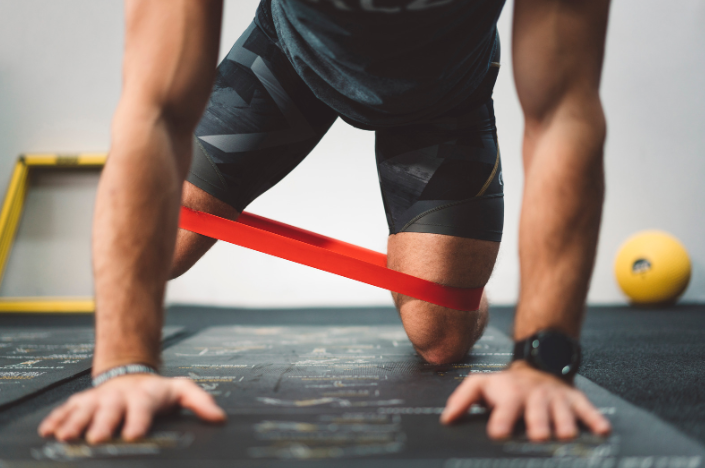
A HIIT resistance band workout can be a practical solution for people with limited time who still want to train intensely at home without bulky equipment. Resistance bands allow you to work on legs, glutes, back, shoulders, and core with progressive tension that can easily be adjusted to your personal fitness level.
The goal is not to “push through at all costs,” but to build a workout circuit that is both intense and manageable. Beginners can use lighter bands and longer recovery times, while more experienced users can increase pace, tension, and control. This keeps the workout challenging without becoming unsafe or chaotic.
Why a HIIT resistance band circuit works even with limited time
A HIIT resistance band circuit combines short bursts of high-intensity effort with controlled recovery periods. This format is ideal for anyone looking for a fast workout because it organizes effort into structured blocks and minimizes downtime between exercises.
Resistance bands add tension without requiring machines, weights, or large spaces. The resistance increases throughout the movement, forcing the body to maintain control, posture, and stability, which is especially useful for people training on their own.
Short intensity, full-body work, and movement control
A well-designed HIIT session should not be confused with a frantic sequence of random exercises. With resistance bands, every repetition requires control during both the pushing phase and the return phase, helping avoid sudden movements and poor alignment.
This makes resistance bands for training interesting even for beginner home trainers: intensity can increase while still remaining adjustable. If technique starts to decline, resistance can be reduced or recovery time extended.
When to choose resistance bands for a quick workout
Resistance bands are ideal when you want a compact workout that is easy to set up and repeat several times per week. They take up very little space, are easy to carry, and make it possible to alternate exercises for both the upper and lower body.
For people thinking, “I don’t have much time but I still want to train hard,” resistance bands offer a solid balance between energy, practicality, and safety. They do not replace every piece of equipment, but they make an effective workout circuit possible even in a small room.
How to choose the right resistance before starting
The choice of band directly affects movement quality and perceived effort. A band that is too light may make the exercise ineffective, while one that is too strong often leads to compensation patterns, incomplete movements, and unnecessary tension.
For this reason, having a set of resistance bands with different levels is useful. In the circuit, a medium band may work well for squats and rows, a lighter one for shoulders and arms, and a stronger one only when movement quality remains clean.
Light, medium, or heavy band: what really changes
A light band is ideal for warm-ups, technical exercises, and first sessions. It allows you to understand movement patterns, breathing, and control without turning every exercise into a strength challenge immediately.
A medium band is often the most balanced option for a 20-minute resistance band circuit. Heavy bands should be used carefully, especially in exercises where posture tends to collapse or where the lower back must remain stable.
Signals to pay attention to during exercises
Controlled muscle burn, increased breathing, and progressive fatigue are normal in a HIIT circuit. Joint pain, loss of balance, shortened movement range, or tension in the lower back are signs that something should be adjusted.
In these situations, there is no need to stop completely: resistance can be reduced, execution slowed down, or the exercise simplified. The goal is to maintain high but sustainable intensity without turning the workout into something you simply endure.
20-minute HIIT resistance band circuit
The circuit includes 4 minutes of warm-up, 12 minutes of main work, and 4 minutes of cooldown. During the central phase, perform 6 exercises for 40 seconds each with 20 seconds of recovery, repeating the full round twice.
Before starting, the resistance band should always be checked: no cuts, no worn sections, stable grip, and enough free space around the body. A simple setup reduces distractions and makes the workout smoother.
Workout structure and timing
The warm-up may include active marching, arm circles, bodyweight squats, and light band pull-aparts. The purpose is to gradually increase body temperature and technical focus, not to create fatigue immediately.
In the main block, alternate between band squats, rows, overhead press, reverse lunges, pull-aparts, and controlled mountain climbers with a light resistance band or without a band. Each exercise lasts 40 seconds followed by 20 seconds of rest.
Exercises, variations, and level adaptations
For squats, beginners can use a miniband above the knees and reduce depth, while intermediate users may increase range of motion and tension. During rows, priority should be given to a stable back and controlled scapular movement.
To increase intensity without forcing the body, you can move from a 40/20 format to 45/15, or add a third round only when technique remains solid. Advanced variations should come after mastering the movement, not before.
How to increase intensity without losing safety
The smartest progression is not always choosing the strongest resistance band. Often, increasing time under tension, slightly reducing rest periods, or slowing down the return phase is enough to make the exercise more demanding.
This approach helps avoid the classic HIIT mistake: starting too aggressively, losing control, and finishing the workout with sloppy movements. Intensity should remain productive, not random.
Progressions to make the circuit more challenging
A first progression involves keeping the same resistance while improving movement precision. A second option is increasing band tension by shortening the grip slightly without changing posture or range of motion.
Only afterward should you move to a stronger band or shorter recovery times. This keeps the workout suitable for people seeking energy and effort while still wanting to feel safe throughout the entire session.
Recovery, breathing, and fatigue management
During recovery, it is better not to stop abruptly. Walking in place, breathing deeply, and preparing the band for the next exercise helps maintain continuity without creating confusion.
Breathing should follow the movement: exhale during the hardest phase and inhale during the return phase. When breathing becomes difficult to control, increasing recovery time is better than sacrificing technique.
A short, intense, and sustainable workout
A HIIT resistance band workout can be included 2 or 3 times per week, leaving room for recovery, mobility work, or lighter activities. Consistency matters more than a single extreme session.
Training hard does not mean ignoring signals and limitations. It means choosing an appropriate difficulty level, completing the circuit with proper technique, and increasing intensity gradually when the body is ready.
Why repeating it correctly matters more than overdoing it
Repeating the same circuit for several weeks allows you to understand whether resistance, timing, and exercise variations are appropriate. If an exercise becomes smoother, one variable at a time can be increased.
This makes the workout measurable without relying on unrealistic promises. The practical goal is to finish the session feeling energized, active, and aware rather than exhausted or in pain.
Useful equipment for consistent training
For this kind of workout, it is useful to have resistance bands with different tension levels, a miniband, a long band, and a stable training space. Band quality affects comfort, durability, and safety during pulling and pushing movements.
A well-chosen set allows every exercise to be adapted to personal level and makes the circuit more versatile over time. In the fitness catalog, you can evaluate training resistance bands and accessories suitable for both home gyms and more dynamic sessions.
Comments (0)