
Trolley
You have no items in your shopping cart

 Budgets
 Dumbers
 Discs
Discs
 Benches
 Racks and Rigs
 Weights Holders
 Isotonic machines
 Calisthenics
 Cardio
 Kettlebells
 Flooring
 Gym Set
 Accessories
 Combat
 ARTI MARZIALI
 CONTAINER GYM
 Tug-Of-War
 Used Gym Equipment
 PILATES MACCHINARI
 GINNASTICA ARTISTICA
 CAMPI DA PADEL
 Prodotti in Pronta Consegna
 Informazioni
 IRONMAN
 Gift Card
- Donatif
- Training and exercises
- 0 I like it
- 3365 Views
- 0 comments
READING TIME: 7 MINUTES ➤➤
Stiff Shoulders: Scapular Mobility in 6 Minutes
Do you often feel your shoulders tight or “locked”, especially after a long day at the computer or an intense workout? You are not alone. Thousands of people live every day with reduced scapular mobility without really knowing how to improve it. In this guide, you will discover a simple 6-minute routine designed to restore freedom of movement to your shoulders and relieve tension in the upper back.
The goal is simple: help you understand the causes of the problem and provide targeted movements that are easy to perform and immediately effective. Just a few minutes a day can help you rediscover the feeling of lighter, more mobile shoulders that naturally support every movement.
- Why do shoulders feel “stuck”?
- What is scapular mobility and why is it important?
- The 6-minute routine: exercises to “free” the shoulder blades
- The 3 key exercises to improve mobility
- When and how often to practice: frequency and tips
- More mobile shoulders = a more open posture
Why do shoulders feel “stuck”?
The most common postural and muscular causes
Stiff shoulders are often the result of poor posture maintained for long periods of time. Working at a computer, driving or using a smartphone for hours tends to close the chest and push the shoulder blades forward. Over time, this creates a sort of “postural memory” that the body eventually considers normal.
This prolonged position gradually leads to joint restrictions and stiffness in the surrounding muscles, especially the trapezius, latissimus dorsi and scapular stabilizers. The result? Shoulders that feel almost frozen and difficulty even with simple everyday movements.
Sedentary work, stress and accumulated tension
Beyond physical habits, there is another factor that is often underestimated: stress. Psychological and physical stress tends to make us unconsciously raise our shoulders, creating a cycle of chronic tension in the upper body. This constant tension may appear as discomfort, stiffness or simply a persistent feeling of “tightness.”
Even people who exercise regularly are not immune. Repetitive movements, poor technique or lack of muscular balance may lead to functional overload of the shoulder blades, reducing joint freedom and contributing to postural imbalances.
What is scapular mobility and why is it important?
The role of the shoulder blades in movement and posture
The shoulder blades are the true “hinges” of the upper body. They are responsible for the functional connection between the arms and the torso, allowing a wide variety of movements including elevation, depression, retraction and rotation. Good scapular mobility is essential for lifting the arms overhead, performing pushing and pulling exercises or simply maintaining an open and balanced posture.
When the shoulder blades do not move properly, the entire shoulder joint system is affected. The consequences often include shoulder discomfort, neck tension and upper back stiffness. This is why improving scapular mobility is important not only for athletes, but for anyone who wants to move more comfortably in daily life.
The consequences of scapular stiffness on the body
A stiff scapula can create a chain of compensations involving the neck, lower back and even the pelvis. It becomes a dysfunctional chain reaction where one restricted area influences many others. This mechanism may contribute to chronic back tension, neck discomfort and feelings of fatigue, even without intense physical effort.
On the other hand, mobile shoulder blades allow smoother movement, reduce stress on the joints and help the body function more efficiently as a whole. The result? Less tension, more control and greater freedom of movement.
The 6-minute routine: exercises to “free” the shoulder blades
How to perform the sequence: basic principles
The proposed routine lasts only 6 minutes and can be performed almost anywhere, including at home or in the office. No equipment is required — just the willingness to listen to your body and dedicate a few moments to mindful movement. Each exercise is designed to gradually activate the scapular stabilizing muscles, improve joint range of motion and restore postural symmetry.
It is recommended to breathe deeply during the exercises while avoiding sudden movements or unnecessary compensation patterns. The goal is not to force the body, but rather to guide it toward a new sense of freedom.
Slow, mindful and progressive movements
Each movement should be performed slowly and with awareness of your posture. Start with a small number of repetitions, observe how your body responds and increase progressively only when movement begins to feel smoother. The real key is consistency, not intensity.
This routine works because it improves motor control: the more aware the brain becomes of scapular positioning, the easier it becomes to move correctly. This approach not only reduces stiffness, but also promotes overall improvements in mobility and physical well-being.
The 3 key exercises to improve mobility
Seated scapular mobilization
Start seated with your back supported and your feet flat on the floor. Slowly raise your shoulders toward your ears, then lower them down and slightly backward. Repeat the movement 10 times while maintaining full control throughout each phase. This exercise stimulates vertical scapular movement and improves awareness of shoulder blade positioning.
It is an ideal way to begin the routine because it helps “wake up” muscles that often remain inactive throughout the day. Performed regularly, it also improves the ability to keep the shoulders relaxed and naturally lowered.
Controlled rotations in quadruped position
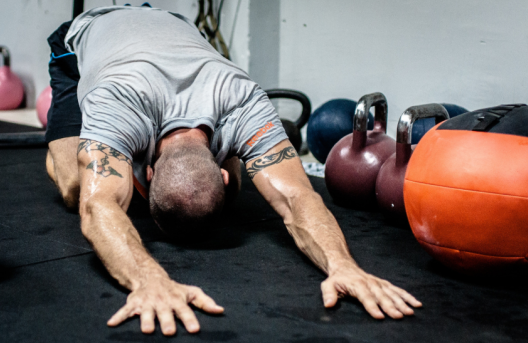
Move onto the floor in a quadruped position with your hands under your shoulders and knees under your hips. From here, perform small controlled scapular rotations as if drawing imaginary circles. The movement should originate from the shoulder blades rather than the arms. Alternate directions every 5–6 repetitions.
This exercise stimulates scapular rotation, a movement pattern that is often neglected, while improving joint control. Because it is performed with body weight and controlled loading, it also develops greater upper-body stability and coordination.
Dynamic wall stretch
Stand with your back and arms against a wall. Slowly slide your hands upward while maintaining constant contact between your elbows, forearms and the wall. Once you reach the highest comfortable point, slowly return to the starting position. Repeat for 8–10 repetitions.
This movement promotes thoracic opening and activation of the scapular muscles. It also helps correct rounded shoulder posture and improves awareness of upright alignment.
When and how often to practice: frequency and tips
Integrating the routine into your day
The strength of this routine lies in its simplicity: it can be integrated into almost any moment of the day. In the morning to start with more energy, during work breaks to release tension or in the evening to relax and recover. Even two 3-minute sessions can provide noticeable benefits when performed consistently and with attention.
It is recommended to begin with one daily session for at least a week while observing changes in posture, breathing and the general feeling of lightness in the upper body.
Adapting the exercises to your level
Not everyone begins with the same level of mobility, so it is important to respect your personal limits and adapt the range of movement accordingly. The quality of movement matters more than quantity. If an exercise feels too difficult, reduce the intensity or simplify the position while maintaining focus on scapular awareness.
Over time, you may gradually increase difficulty and duration, perhaps introducing light resistance or more advanced variations. The most important thing is progressing by listening to your body instead of forcing it.
More mobile shoulders = a more open posture
Visible benefits and feelings of lightness
One of the first sensations many people notice after performing the routine is a feeling of lightness in the upper body. The shoulders naturally lower, the chest opens and the neck regains freedom of movement. This is not only a physical benefit, but also a psychological one: a more open posture positively affects breathing, confidence and overall mood.
Many people also report greater body awareness after only a few days of consistent practice. It is almost as if the body “remembers” how it is supposed to move and begins correcting posture more naturally during everyday activities.
From local relief to global improvement
Working on scapular mobility is not an isolated intervention. Instead, it creates positive effects throughout the entire postural chain. It improves thoracic mobility, reduces lower back tension and supports both athletic and everyday movements. In simple terms, it improves the way we move and experience our bodies.
Integrating this routine does not simply mean loosening the shoulders. It means recovering a sense of control and well-being that often gets lost between chairs, screens and hectic daily schedules. Just 6 minutes are enough to begin — the rest comes through consistency and listening to your body.
Comments (0)