
Trolley
You have no items in your shopping cart

 Budgets
 Dumbers
 Discs
Discs
 Benches
 Racks and Rigs
 Weights Holders
 Isotonic machines
 Calisthenics
 Cardio
 Kettlebells
 Flooring
 Gym Set
 Accessories
 Combat
 ARTI MARZIALI
 CONTAINER GYM
 Tug-Of-War
 Used Gym Equipment
 PILATES MACCHINARI
 GINNASTICA ARTISTICA
 CAMPI DA PADEL
 Prodotti in Pronta Consegna
 Informazioni
 IRONMAN
 Gift Card
- Donatif
- Training and exercises
- 0 I like it
- 2048 Views
- 0 comments
- gym flooring, safety flooring, gym safety, shock-absorbing materials
READING TIME: 5 MINUTES ➤➤
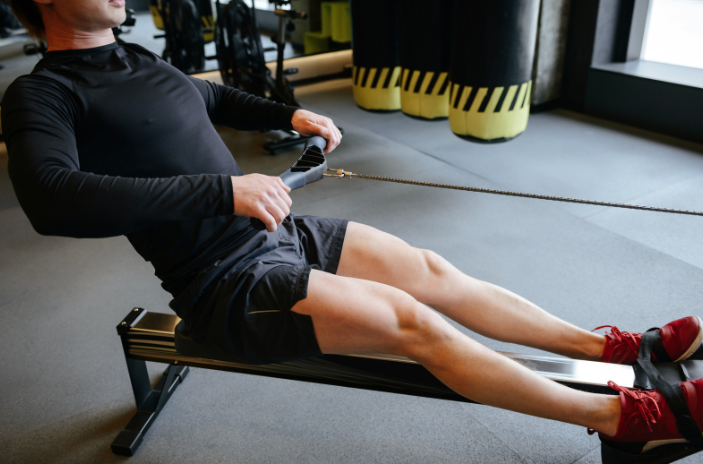
How Rowing Helps Runners: 6 Exercises to Improve Endurance and Power
The rowing machine for runners is often seen as just an alternative cardio tool to running, but its use can provide broader and more specific benefits. Many runners look for training methods that allow them to maintain high aerobic fitness while reducing the joint stress typical of high-impact sessions. In this context, the rowing machine becomes an interesting solution, especially during recovery periods, deload weeks, or as support within general conditioning programs.
One of the most interesting aspects involves the so-called transfer effect, meaning the ability of a complementary exercise to provide concrete benefits to the main discipline. In the case of running, the rowing machine allows athletes to work on cardiovascular endurance, coordination, posterior chain strength, and pacing control without constantly repeating the mechanical stress of road running. This makes rowing cross-training a practical option for both beginner and advanced runners.
Why the Rowing Machine Is Effective Cross-Training for Runners
The Transfer Effect Between Rowing and Running
The rowing movement involves the legs, core, and upper body in a coordinated way. Even though the technical gesture differs from running, there is a strong connection in terms of aerobic endurance management and continuous force production. For runners, this means training the cardiovascular system while maintaining a high energy demand but with significantly lower impact on knees, hips, and ankles.
From a functional perspective, the rowing machine for running also helps develop better rhythm and breathing awareness. The ability to adjust intensity, stroke rate, and session duration makes this tool suitable for both recovery workouts and more demanding sessions. In addition, the involvement of the posterior chain helps compensate for some imbalances commonly found in runners who focus almost exclusively on the running gesture.
Reducing Impact Without Losing Aerobic Fitness
One of the most common concerns among runners is the possibility of losing sport-specific conditioning when introducing alternative activities. In reality, the rowing machine allows athletes to maintain high cardiovascular volume without accumulating additional joint stress. This becomes especially useful during recovery from minor overload issues or during weeks when mileage needs to be temporarily reduced.
Training with a rowing machine can also help distribute weekly workload more effectively. Many runners use a low-impact indoor session after long runs or intense interval workouts. In this way, endurance continues to be stimulated without compromising muscular recovery. For those training in a home gym, the rowing machine also represents a practical solution during bad weather or winter months.
Which Athletic Qualities the Rowing Machine Improves in Runners
Cardiovascular Endurance and Pace Management
Rowing sessions help develop remarkable aerobic capacity thanks to the simultaneous involvement of large muscle groups. During continuous rowing, the heart works progressively and steadily, making this tool extremely useful for runners aiming to improve endurance and maintain consistent pacing over time.
Managing cadence on the rowing machine also improves mental control over effort. This transfer becomes useful in middle- and long-distance races, where pace distribution must remain precise. Controlled interval work also helps build fatigue tolerance without relying exclusively on road running.
Core Strength, Posterior Chain, and Stability
Many runners focus mainly on the lower limbs while neglecting the role of trunk stability and overall body control. The rowing machine significantly activates the core, glutes, lats, and hamstrings, all muscle groups that are fundamental for maintaining efficient running posture.
Improved trunk control can translate into a more economical and stable running form, especially over long distances. The ability to transfer force from the legs to the upper body also improves noticeably. For this reason, rowing cross-training is often included in conditioning programs for runners and triathletes.
6 Rowing Exercises Useful for Runners
Steady-State Controlled Rowing
This exercise involves a continuous session lasting between 20 and 40 minutes at moderate intensity. The main goal is to improve aerobic endurance without generating excessive muscular fatigue. For runners, it represents an effective solution on active recovery days or during high-mileage weeks.
During the session, it is important to maintain a regular cadence and focus on fluid movement execution. Breathing should remain controlled while avoiding sudden accelerations. This type of work helps maintain cardiovascular efficiency without adding further joint impact.
Moderate Interval Training
Rowing intervals can simulate the intermittent work commonly used in running. A typical structure may include 500-meter or 2-minute intervals alternated with short recovery periods. This method improves the ability to sustain higher intensities and recover quickly between efforts.
For runners, the interesting aspect involves aerobic threshold control. The rowing machine allows athletes to increase intensity while keeping joint overload risk low. It is particularly useful during periods when the number of road intervals must be reduced.
Short High-Intensity Sprints
Twenty- or thirty-second sprints allow athletes to work on explosiveness and power production. In this case, the priority is not session duration but execution quality. Recovery periods should remain complete to maintain high intensity during each interval.
This exercise may be especially useful for runners who want to improve acceleration, pace changes, and finishing speed during shorter races. Neuromuscular coordination also benefits from fast and powerful work performed with proper technique.
Pyramid Progression
The pyramid progression alternates increasing and decreasing intensity blocks. For example, athletes may start with one easy minute, gradually increase to four intense minutes, and then progressively return to more controlled rhythms.
This method improves effort management and teaches runners how to change pace while maintaining technical consistency. It also makes training mentally more engaging, reducing the monotony of longer indoor sessions.
Technical Rowing with Leg Focus
In this exercise, attention is focused mainly on lower-body drive. The initial phase of the rowing stroke should begin from the legs while maintaining a stable and controlled trunk. This work helps improve coordination and muscular activation.
For runners, the main benefit concerns strengthening the extensor chain, which is fundamental for supporting efficient running mechanics. Technical practice also helps avoid excessive compensations from the upper body.
Combined Rowing and Core Session
A widely used approach involves alternating rowing intervals with core stabilization exercises. After several minutes of rowing, athletes can include planks, resistance band exercises, or pelvic control movements.
This combination is useful for developing overall endurance and postural control. For runners, it means improving the ability to maintain technique and alignment even during the final stages of longer runs or demanding races.
How to Include the Rowing Machine in a Running Program
Weekly Frequency and Recovery
For most runners, one or two weekly rowing sessions may be enough to achieve concrete benefits. Duration and intensity should be adapted according to overall running volume and seasonal goals.
During higher-load periods, the rowing machine can replace an easy run, helping reduce overload risk. During recovery or transition phases, it can instead become a central tool for maintaining aerobic conditioning.
Common Mistakes to Avoid
One of the most common mistakes is turning every rowing session into a maximal workout. The rowing machine should be used as a strategic support tool rather than an additional source of uncontrolled fatigue. Technique also deserves attention because poor posture reduces training effectiveness.
Another mistake involves excessively replacing running with indoor training. The rowing machine for runners works best when integrated in a balanced and coherent program. The goal is not to eliminate running but to improve recovery quality and overall athletic preparation.
When the Rowing Machine Becomes a Strategic Tool for Runners
The rowing machine can become particularly useful during recovery from overload, general preparation phases, or periods with difficult weather conditions. Its ability to provide intense cardiovascular training with reduced impact represents a concrete advantage for both recreational and advanced runners.
When properly integrated into a program, rowing cross-training contributes to improving endurance, stability, and effort management. The combination of aerobic conditioning, posterior chain strengthening, and reduced joint stress makes this tool a functional option for runners who want to maintain training consistency without sacrificing athletic preparation quality.
Comments (0)