
Trolley
You have no items in your shopping cart

 Budgets
 Dumbers
 Discs
Discs
 Benches
 Racks and Rigs
 Weights Holders
 Isotonic machines
 Calisthenics
 Cardio
 Kettlebells
 Flooring
 Gym Set
 Accessories
 Combat
 ARTI MARZIALI
 CONTAINER GYM
 Tug-Of-War
 Used Gym Equipment
 PILATES MACCHINARI
 GINNASTICA ARTISTICA
 CAMPI DA PADEL
 Prodotti in Pronta Consegna
 Informazioni
 IRONMAN
 Gift Card
- Donatif
- Training and exercises
- 0 I like it
- 2362 Views
- 0 comments
READING TIME: 6 MINUTES ➤➤
In a world that moves faster and faster, finding a simple way to regain calm and inner balance has become a necessity. We often forget that one of the most powerful resources for regulating our emotions is literally right under our nose: our breath. This article will guide you through effective breathing techniques to manage anxiety and stress, helping you recover a sense of inner stability even during the most challenging moments.
- The power of breath during moments of tension
- Anti-stress breathing: the basics you should know
- Heart coherence and emotional self-regulation
- Daily strategies for anxiety management
The power of breath during moments of tension
Why breathing affects both mind and body
Every emotion we experience is reflected in our breathing. When we are anxious, our breathing becomes faster and more shallow. On the other hand, a deep and conscious breath is the first sign that the body is entering a state of calm. By influencing our breathing rhythm, we can send a direct signal to the parasympathetic nervous system, which is responsible for relaxation. This is why breathing is such a simple yet incredibly powerful tool for self-regulation.
The stress signals our body sends us
Stress manifests itself through a series of signals that we often ignore: muscle tension, accelerated heartbeat, sweating, and shortness of breath. These symptoms, seemingly harmless at first, can become chronic over time if left unmanaged. Learning to recognize them is the first step toward taking action. Through targeted breathing techniques, we can change these automatic bodily responses and bring the body back into a state of balance.
Anti-stress breathing: the basics you should know
The role of diaphragmatic breathing
Diaphragmatic breathing, also known as abdominal breathing, is one of the most effective techniques for calming the nervous system. Unlike chest breathing, which is common during moments of anxiety, diaphragmatic breathing activates the lower part of the lungs, stimulating the vagus nerve and promoting relaxation. Learning to breathe with the diaphragm means training yourself to release tension naturally and immediately.
From theory to practice: how to get started
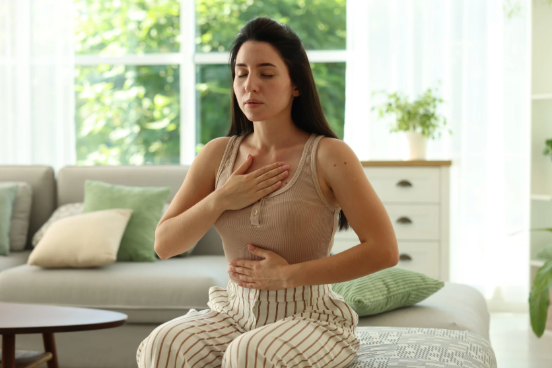
Getting started is simple: sit or lie down in a quiet environment, place one hand on your chest and the other on your abdomen. Slowly inhale through your nose, making sure only the hand on your abdomen rises. Gently exhale through your mouth, completely emptying your lungs. Repeat for at least five minutes, allowing each breath to become smoother and more natural. This simple exercise can turn into a powerful daily habit.
Heart coherence and emotional self-regulation
What heart coherence is and why it works
Heart coherence is a physiological state in which the heartbeat follows a regular and harmonious rhythm. This condition is achieved through specific breathing patterns and has a direct impact on emotional stability and mental clarity. Numerous studies have shown that heart coherence improves stress management, reduces anxiety, and supports overall well-being. It is a practice that connects body and mind, turning the breath into a tool for awareness and inner strength.
A simple exercise to achieve coherence
A classic method consists of breathing in a precise rhythm: inhale for 5 seconds, exhale for 5 seconds, maintaining this pace for at least five minutes. Focus on your heart while breathing and imagine each breath flowing through it. You can use a biofeedback app or a simple visual timer to help you maintain the rhythm. When practiced consistently, this exercise creates a positive habit that helps you face intense emotions with greater clarity and calmness.
Daily strategies for anxiety management
Integrating breathing into your routine
One of the most common mistakes is considering breathing techniques only as emergency tools. In reality, the true benefits come through consistency. Integrating short breathing sessions into your daily routine — in the morning, during lunch breaks, or before going to sleep — trains the body to remain calm even during neutral moments of the day. This daily practice reduces stress reactivity and increases the feeling of control over your emotions.
When and how long to practice for real benefits
You do not need hours of practice: just 10 minutes a day are enough to notice the first changes. What matters most is creating a routine, even a brief one, but practiced consistently. The breath then becomes an anchor during difficult moments and a silent ally in managing anxiety. Remember: every breath is an opportunity to return to the present moment and regain stability, even on the most chaotic days.
V
Comments (0)