
Trolley
You have no items in your shopping cart

 Budgets
 Dumbers
 Discs
Discs
 Benches
 Racks and Rigs
 Weights Holders
 Isotonic machines
 Calisthenics
 Cardio
 Kettlebells
 Flooring
 Gym Set
 Accessories
 Combat
 ARTI MARZIALI
 CONTAINER GYM
 Tug-Of-War
 Used Gym Equipment
 PILATES MACCHINARI
 GINNASTICA ARTISTICA
 CAMPI DA PADEL
 Prodotti in Pronta Consegna
 Informazioni
 IRONMAN
 Gift Card
- Donatif
- Training and exercises
- 0 I like it
- 3021 Views
- 0 comments
READING TIME: 7 MINUTES ➤➤
How to Improve Proprioception and Motor Control
Training is not just about building muscles or improving endurance. One often overlooked yet essential component for physical well-being and performance is proprioception, which is the body’s ability to perceive its position and movement in space. Developing good proprioception is important for everyone, but it becomes crucial for those who practice sports regularly and for people over a certain age who want to maintain balance, stability, and independence in everyday movements. This article will guide you through the benefits of motor control and the best routines to improve it effectively.
- Why proprioception is important
- The connection between proprioception, balance, and stability
- Routines and exercises to improve proprioception
- The benefits of better motor control
- Practical tips for athletes and people over 40
Why proprioception is important
Proprioception is the neuromuscular function that allows us to understand where our joints are positioned even with our eyes closed, automatically regulating movement and balance. It is the reason why we can walk on uneven ground without looking at our feet, or maintain balance even when something suddenly destabilizes us. This type of body awareness is essential for preventing falls, reducing injuries, and improving the effectiveness of athletic movements.
As we age or after an injury, this ability can decline, making movements less fluid and secure. For this reason, incorporating specific proprioception exercises into your routine is not just useful — it is necessary. The same applies to athletes, who through targeted training can refine their motor control and react more effectively to external stimuli during performance.
The connection between proprioception, balance, and stability
Talking about proprioception inevitably means talking about balance and stability as well. These three components work together to ensure that every movement is controlled, effective, and safe. Static balance (maintaining a position) and dynamic balance (remaining stable during movement) largely depend on good proprioception. When the body accurately perceives its position in space, it can correct even the smallest shifts or losses of balance in real time.
Joint stability, on the other hand, is what allows us to perform even complex movements without imbalance or overload. An unstable knee, for example, is often the result of poor proprioception combined with muscular weakness. In sports, this condition can reduce performance and increase the risk of injury. In people over 40, it may lead to difficulties in walking or managing everyday activities.
Routines and exercises to improve proprioception
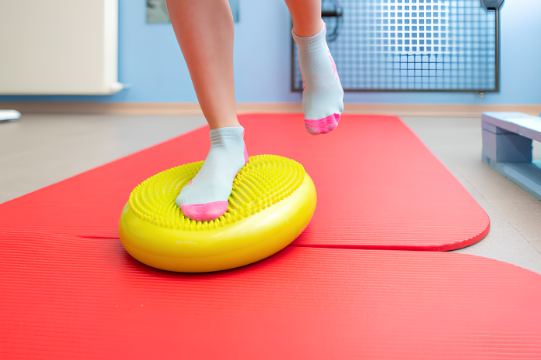
To improve proprioception, it is important to include exercises in your routine that stimulate balance and coordination. Exercises performed on unstable surfaces such as a BOSU ball, a balance cushion, or even simply on the floor with your eyes closed, force the body to “listen to itself” again and find new points of balance. In this way, the proprioceptive receptors located in muscles, tendons, and joints are stimulated, improving their efficiency.
An effective routine may include squats on an unstable cushion, lunges with torso rotation, line walking, or exercises performed with closed eyes. Consistency is essential: just 10–15 minutes per day can produce noticeable results within a few weeks. The recommendation is to perform these exercises at the end of your workout, when the muscles are activated but not yet fatigued, in order to maximize results and prevent injuries.
The benefits of better motor control
Having good motor control does not simply mean moving better — it also means living better. A body that responds in a coordinated way to external stimuli is more efficient in every type of activity, from sports to daily life. The likelihood of injuries decreases, posture improves, and movements become smoother, resulting in greater confidence and overall well-being.
In addition, improving motor control also means strengthening the brain. Proprioception is closely connected to the central nervous system, and every exercise that stimulates it helps reinforce the neural pathways linked to movement. This also has positive effects on attention, motor memory, and the ability to adapt to new or unexpected situations.
Practical tips for athletes and people over 40
For people over 40, working on proprioception becomes even more important. The natural physiological decline in motor abilities can be effectively countered through targeted exercises that keep the body-mind connection active. It is advisable to start with simple movements and gradually progress to more challenging ones, respecting your own limits and focusing on proper execution.
For athletes, integrating proprioceptive work into training programs is equally essential. Not only as a preventive measure, but also as a way to enhance performance. A controlled athletic movement is more precise, more powerful, and safer. Including balance and stability exercises in warm-ups or cool-down sessions is a winning strategy at any age.
Comments (0)