








Trolley
You have no items in your shopping cart
 Budgets
 Dumbers
 Discs
Discs
 Benches
 Racks and Rigs
 Weights Holders
 Isotonic machines
 Calisthenics
 Cardio
 Kettlebells
 Flooring
 Gym Set
 Accessories
 Used Gym Equipment
 Combat
 ARTI MARZIALI
 Tug-Of-War
 CAMPI DA PADEL
 PILATES MACCHINARI
 GINNASTICA ARTISTICA
 Gift Card
 Informazioni
- Donatif
- Training and exercises
- 0 I like it
- 11 Views
- 0 comments
- stress reduction, improved self-esteem, physical and mental well-being, gym training
READING TIME: 5 MINUTES ➤➤
How to Maintain a 10-Minute Postural Routine Without Skipping It
Maintaining a mini postural routine over time is one of the most common challenges for those who train at home. The real issue is not starting, but being able to stay consistent with a simple action that, precisely because it is short, is often underestimated or postponed. The result is a cycle of attempts and drop-offs that creates frustration and a sense of inefficacy.
The good news is that you don’t need more time, more motivation, or more discipline. You need a different approach. In this guide, we’ll explore how to turn a 10-minute routine into a stable, sustainable habit integrated into your daily life, without experiencing it as an extra obligation.
- Why short postural routines are easily abandoned
- The minimum threshold principle
- How to integrate the routine into your week
- The practical checklist
- Useful tools and supports
- From occasional attempt to a stable habit
Why short postural routines are easily abandoned
A 10-minute postural routine may seem easy on paper, but in reality it encounters invisible resistance. The first mistake is expecting to perform it the same way every time, with the same precision and at the same time of day. This rigid approach turns something useful into a commitment that is difficult to sustain in the long term.
The second issue is more subtle: perceiving the routine as an obligation. When it enters the mental list of things “to do,” it automatically becomes associated with effort and procrastination. Even if it requires little time, the brain tends to avoid it because it does not feel integrated into daily life.
The problem of perfection
Many people give up because they cannot stay consistent 100% of the time. Missing just one day can trigger the thought “I’ve lost the rhythm.” This mechanism leads to completely stopping the routine, even when simply resuming the next day would be enough.
The pursuit of perfection is therefore one of the main enemies of consistency. It is not the difficulty of the exercises that creates the block, but the unrealistic expectation of flawless execution.
The mistake of treating it as an obligation
When the routine is experienced as something to check off, it loses its practical value. It becomes a task, not a tool. This completely changes the perception of effort, making even 10 minutes feel heavier than they actually are.
To maintain a routine over time, it is essential to turn it into a natural action, not an imposed duty.
The minimum threshold principle: start small to last over time
The key concept for consistency is the minimum entry threshold. This means making the routine so simple that there are no excuses to skip it. It is not about doing less, but about always doing something, even on less favorable days.
An effective postural routine does not need to be perfect, but repeatable. This completely changes how it is perceived and maintained.
What “minimum effective routine” really means
A minimum effective routine consists of a few exercises, always the same, performed at a sustainable intensity. It does not require complex preparation or ideal conditions. It is designed to be performed even when motivation is low.
This approach drastically reduces mental friction and allows you to build a solid foundation over time.
Why 10 minutes are enough
Ten minutes, if well structured, are more than enough to work on mobility, alignment, and muscle activation. The point is not duration, but consistency. A short routine performed regularly has a greater impact than longer but sporadic sessions.
The real strength lies in repetition. This is what creates adaptation and long-term benefits.
How to integrate the postural routine into your week without stress
To avoid skipping the routine, it is essential to integrate it into your week without rigidity. It should not occupy a separate space but fit into moments that already exist in your day.
This approach reduces the perception of effort and increases the likelihood of consistency.
Bridge days and smart flexibility
So-called bridge days are moments when you cannot follow the full routine but can still perform a reduced version. Even a few minutes keep the behavior active and prevent abandonment.
This flexibility is essential for building real, not ideal, consistency.
Linking the routine to existing habits
Associating the routine with an already established habit, such as after a shower or before dinner, greatly facilitates its execution. This mechanism leverages existing automatisms, reducing decision-making effort.
In this way, the routine stops being something to remember and becomes something that happens naturally.
The practical checklist to avoid skipping the routine
A simple checklist helps maintain the routine without having to think about what to do each time. It reduces uncertainty and makes the process smoother.
There is no need for complexity: a few clear and repeatable elements are enough.
Environment preparation
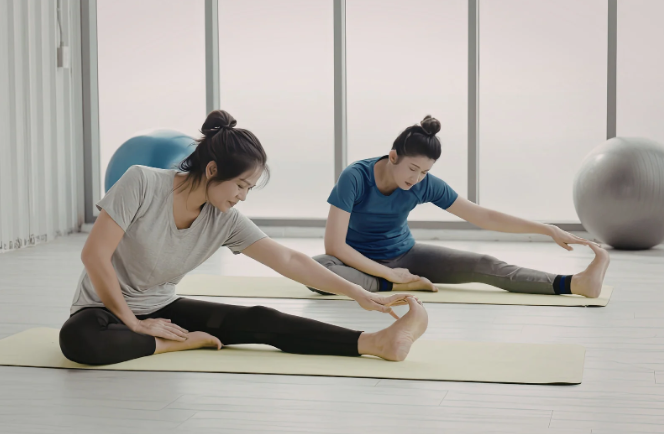
Having a ready-to-use space removes one of the main barriers. A mat already laid out or easily accessible reduces activation time and increases the likelihood of starting.
The environment should facilitate, not hinder. Every small reduction in friction matters.
Simple and repeatable sequence
Using the same sequence of exercises every time eliminates the need to decide what to do. This reduces mental fatigue and makes the routine automatic.
Repetition is not monotony, but efficiency. It is what allows the routine to become stable.
Tools and supports that improve consistency
Some tools can make the routine more accessible and immediate. They are not essential, but they help reduce friction and improve the overall experience.
The goal is not to add complexity, but to simplify execution.
The role of a mat and resistance bands
A mat defines a dedicated space and makes execution more comfortable. Resistance bands, on the other hand, allow you to work lightly but effectively on mobility and activation.
These tools help give structure to the routine without making it demanding.
Reducing mental and physical friction
Every element that simplifies starting the routine increases the likelihood that it will be performed. Reducing friction means removing unnecessary steps and making everything immediate.
Consistency comes from simplicity, not from willpower.
From occasional attempt to a stable habit
The most important shift is mental. Stop seeing the routine as something to do perfectly and start considering it a guaranteed daily minimum.
This change allows you to build a real habit, not an ideal one.
Changing mindset: from all-or-nothing to minimum guaranteed
Letting go of the idea “if I can’t do it perfectly, it’s useless” is essential. Even a reduced version of the routine has value. It keeps the behavior active and reinforces the identity of being consistent.
Imperfect consistency is always better than interruption.
The value of imperfect consistency
In the long run, what matters is not the quality of each individual session, but the overall frequency. A routine maintained over time generates progressive and sustainable benefits.
Making a mini postural routine stable means exactly this: turning a simple action into a constant presence in your week, without stress or unnecessary pressure.
Comments (0)