
Trolley
You have no items in your shopping cart

 Budgets
 Dumbers
 Discs
Discs
 Benches
 Racks and Rigs
 Weights Holders
 Isotonic machines
 Calisthenics
 Cardio
 Kettlebells
 Flooring
 Gym Set
 Accessories
 Combat
 ARTI MARZIALI
 CONTAINER GYM
 Tug-Of-War
 Used Gym Equipment
 PILATES MACCHINARI
 GINNASTICA ARTISTICA
 CAMPI DA PADEL
 Prodotti in Pronta Consegna
 Informazioni
 IRONMAN
 Gift Card
- Donatif
- Training and exercises
- 0 I like it
- 1737 Views
- 0 comments
- gym flooring, safety flooring, gym safety, shock-absorbing materials
READING TIME: 5 MINUTES ➤➤
Mini Bands for Glutes: 7 Effective Exercises Explained
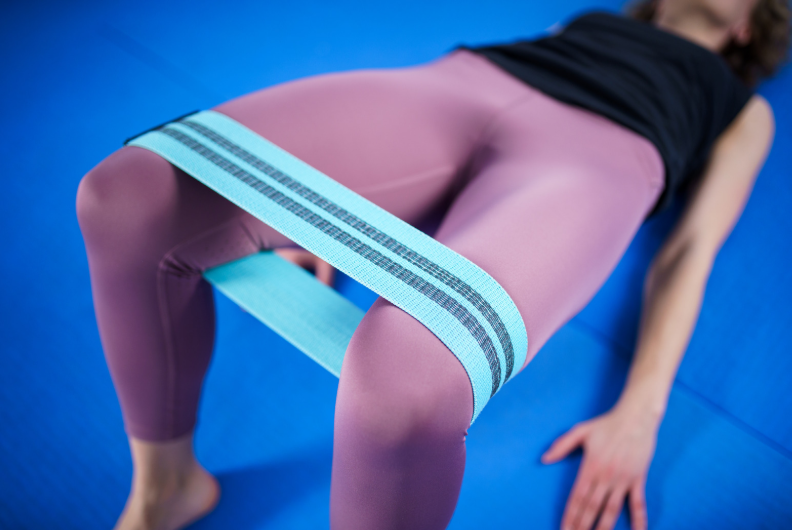
Mini bands for glutes are among the simplest accessories to include in a workout routine, but their effectiveness depends largely on how they are used. Simply placing the band above the knees and repeating random movements is not enough: to truly activate the glutes, you need control, stable posture, and resistance suited to your level. This applies whether you train at home, run and want to improve hip stability, or go to the gym and need more precise activation before loaded exercises.
The advantage of bands for glutes is that they allow you to work on hip abduction, extension, and lateral control without heavy equipment. They are lightweight, easy to carry, and can be used both as a warm-up tool and as part of the main workout. This guide explains 7 practical exercises with technical tips designed for beginners and intermediate users who want to train more effectively and consciously.
Why mini bands help train glutes more effectively
Muscle activation and movement control
Mini bands create lateral resistance that forces the glutes, especially the gluteus medius, to work more actively during movement. This is useful because many lower-body exercises are often performed by compensating with the quadriceps, lower back, or hip flexors. With a properly positioned mini band loop, the body receives immediate feedback: if the knees collapse inward or the pelvis loses stability, the band makes it noticeable. For this reason, mini bands are not only useful for creating a “burning” sensation but also for improving technical control.
When to use mini bands during training
Mini bands can be used at the beginning of a session to activate the glutes or as part of a light bodyweight circuit. Before squats, lunges, or hip thrusts, band exercises can help improve hip drive and controlled knee positioning. In home workouts, they become a practical tool for increasing intensity without immediately relying on dumbbells or barbells. Their use depends on the goal: activation, toning, motor control, or complementary work for running.
How to choose the right resistance
Light, medium, and heavy mini bands
A light mini band is suitable for people learning proper technique or for exercises with larger ranges of motion, such as lateral walks and monster walks. Medium resistance can work well for those who already have decent control and want to increase glute activation without sacrificing movement quality. Heavy resistance bands should be used carefully: if they force you to shorten the movement or compensate with your back, they are not improving the exercise. Proper execution is always more important than the resistance level itself.
How to know if the band fits your level
The right band allows you to complete repetitions while maintaining knee, pelvis, and torso control. If your knees collapse inward during squats or your lower back arches excessively during kickbacks, the resistance may be too strong. On the other hand, if the band provides no noticeable tension, the stimulus may be too weak. A set of light and medium resistance bands is useful because different exercises require different tension levels.
Seven mini band exercises for glutes
Glute bridge with mini band
The glute bridge is one of the easiest exercises to start with. Lie on your back with your feet flat on the floor, knees bent, and the mini band positioned above the knees. As you lift the hips, avoid arching the lower back while gently pushing the knees outward. Focus on squeezing the glutes at the top rather than pushing only through the heels or tightening the lower back excessively. This exercise is excellent for learning controlled hip extension.
Squat with mini band above the knees
In the squat with mini band, the elastic helps keep the knees aligned with the toes. Start with feet about shoulder-width apart, chest stable, and core engaged. During the descent, the knees should not collapse inward; the band provides slight resistance that encourages proper alignment and control. Although it does not replace loaded squats, it is highly effective for improving body awareness and movement stability.
Lateral band walk
The lateral walk directly targets hip stability and glute control. Place the mini band above the knees or around the ankles depending on your level, keeping a slight bend in the hips and knees. Take small, controlled steps without bouncing or dragging the trailing foot. The torso remains stable while the glutes maintain constant tension. This is one of the most effective mini band glute exercises for runners and athletes who want better pelvic control.
Monster walk
The monster walk is similar to the lateral walk but involves diagonal steps forward or backward. The mini band stays under tension throughout the movement while the body remains in a semi-squat position. One of the most common mistakes is taking steps that are too large, which reduces control and turns the exercise into a messy movement. Smaller and controlled steps are more effective for engaging the glutes dynamically and preparing the body for more complex athletic movements.
Seated abductions
Seated abductions are simple but highly effective for feeling the gluteus medius work. Sit on a stable bench or chair with the mini band above the knees and feet flat on the floor. From this position, open the knees outward while keeping the torso still and controlling the return phase. The movement should not be rushed or explosive: the closing phase is just as important as the opening phase. This exercise is beginner-friendly because it allows better isolation and control.
Quadruped kickback
The quadruped kickback targets hip extension and requires attention to spinal position. Start on all fours with hands under shoulders and knees under hips. The mini band can be placed above the knees or anchored under the foot depending on the type of band. Extend the leg backward without rotating the pelvis or arching the lower back. The movement should come from the glute rather than momentum, which is why slow and controlled repetitions work best.
Side-lying clamshell
The clamshell is performed lying on one side with knees bent and the mini band above the knees. Keep the feet together while opening the top knee upward without rolling the pelvis backward. Although it may look simple, it is highly effective when done correctly. Hip control is essential: if the body rotates backward to increase range of motion, the glutes lose part of the workload. This exercise is excellent for improving stability, muscle awareness, and hip control.
How to build a simple and effective routine
Suggested sequence for beginners
A simple routine can start with glute bridges, seated abductions, and lateral walks before adding squats, monster walks, kickbacks, and clamshells. Beginners can perform 2 or 3 sets per exercise with controlled repetitions and short but manageable rest periods. The goal is not to reach maximum fatigue immediately but to learn how to properly engage the glutes without losing posture. Training 2 or 3 times per week is generally enough to see progress while allowing proper recovery.
Mistakes to avoid during execution
The most common mistakes involve excessive speed, resistance that is too heavy, and poor pelvic control. When the band is too strong, the body compensates by stiffening the back or losing knee alignment, which reduces exercise quality. Holding your breath or always trying to maximize range of motion can also decrease effectiveness. With mini bands for glutes, the best progression comes from consistent tension, controlled breathing, and repeatable movement quality.
The advantage of consistent and controlled training
Progression, frequency, and movement quality
Results with mini bands depend on consistency and execution quality. To make training more challenging, you can gradually increase resistance, add extra sets, slow down the lowering phase, or include isometric pauses at peak contraction. These methods are more effective than simply increasing repetitions without control. Well-structured training improves muscle awareness, stability, and the ability to properly engage the glutes during more advanced exercises.
Mini bands and useful accessories for better workouts
To train consistently, it helps to have a small set of mini band loops with different resistance levels so you can choose the right band for each exercise. Lighter bands work well for activation and technique practice, while medium resistance bands are more suitable for dynamic movements. A stable exercise mat is also useful for floor exercises such as glute bridges, clamshells, and kickbacks. With just a few well-chosen tools, glute training becomes more organized, accessible, and easier to integrate into a weekly routine.
Comments (0)