
Trolley
You have no items in your shopping cart

 Budgets
 Dumbers
 Discs
Discs
 Benches
 Racks and Rigs
 Weights Holders
 Isotonic machines
 Calisthenics
 Cardio
 Kettlebells
 Flooring
 Gym Set
 Accessories
 Combat
 ARTI MARZIALI
 CONTAINER GYM
 Tug-Of-War
 Used Gym Equipment
 PILATES MACCHINARI
 GINNASTICA ARTISTICA
 CAMPI DA PADEL
 Prodotti in Pronta Consegna
 Informazioni
 IRONMAN
 Gift Card
- Donatif
- Training and exercises
- 0 I like it
- 2116 Views
- 0 comments
- stress reduction, improved self-esteem, physical and mental well-being, gym training
READING TIME: 5 MINUTES ➤➤
Karate, Judo, BJJ or MMA: which requirements really matter for equipment and surfaces
When it comes to combat sports, one of the most common misconceptions is that the basic setup is always the same. Tatami mats, some protective gear and open space may seem sufficient for any discipline. In reality, this simplification often leads to technical mistakes that impact safety, training quality and the professional perception of the space.
Karate, Judo, Brazilian Jiu-Jitsu and MMA share a common foundation, but differ significantly in terms of surface requirements, equipment and space organization. Understanding these differences is what allows a PT studio or a micro-gym to truly level up, avoiding generic and ineffective solutions.
- Why not all combat disciplines require the same setup
- Surfaces and flooring
- Equipment by discipline
- Space and configuration
- Practical selection criteria
Why not all combat disciplines require the same setup
Combat disciplines are mainly divided into striking, grappling and hybrid systems. This distinction is not theoretical but has direct implications on every element of the space: from flooring to equipment selection. Ignoring these differences means designing environments that are inefficient and potentially unsafe.
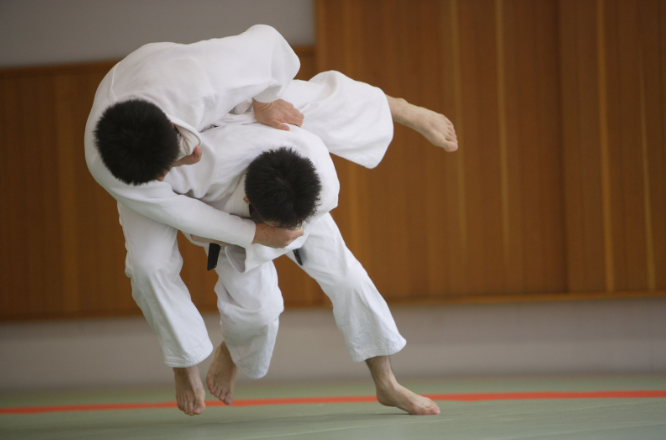
Karate, for example, focuses on standing work with fast and controlled movements, while Judo is based on high-impact throws. BJJ develops most of its training on the ground, while MMA combines all these dynamics. Treating them as equivalent leads to a technical setup mistake that immediately affects the user experience.
Differences between striking, grappling and hybrid disciplines
In striking disciplines like Karate, surface stability and responsiveness are the priority. In grappling disciplines like Judo and BJJ, the ability to absorb impact and protect against repeated falls becomes essential. MMA requires a complex balance between these needs, making the setup more challenging to design.
This distinction is not only functional but also strategic: making the right choice communicates expertise and reliability, which are key elements in attracting and retaining informed users.
The most common mistake in combat space design
The most common mistake is adopting an “average” solution that tries to suit everything but ends up excelling at nothing. A mat that is too rigid penalizes grappling, while one that is too soft compromises striking.
This approach creates inconsistent environments where users perceive a lack of specialization. In competitive contexts, this perception can make the difference between a chosen space and a rejected one.
Surfaces and flooring: the first real technical criterion
The surface is the most critical element in designing a combat sports space. It is not just about comfort, but about safety, performance and long-term durability. Each discipline imposes specific requirements that cannot be ignored without consequences.
A mistake in flooring selection compromises the entire setup, making even high-quality equipment ineffective. For this reason, it is the first element to evaluate in any project.
Impact absorption and safety in throws
In Judo and partly in MMA, the key factor is the mat’s ability to absorb repeated impacts. Throws generate significant forces that, if not properly managed, increase the risk of injury.
A proper mat must provide controlled density and elastic return, avoiding both excessive rigidity and the “sponge effect”. This balance is what distinguishes a professional solution from an improvised one.
Stability and grip for standing disciplines
In Karate, the surface must ensure stability and precision in movement. Too much softness compromises balance and speed, while a surface that is too slippery reduces control.
Grip therefore becomes a key factor, especially in high-intensity contexts. Proper flooring improves not only safety but also the technical quality of training.
Surface continuity for ground work
In BJJ, surface continuity is essential. Gaps, uneven areas or inconsistent materials immediately become a problem during rolling.
For this reason, it is crucial to choose solutions that ensure uniformity and wear resistance, maintaining consistent performance over time even under intensive use.
Equipment: what really changes between Karate, Judo, BJJ and MMA
Beyond the surface, equipment also varies significantly between disciplines. These are not just aesthetic differences, but tools designed to meet specific needs.
Choosing the right equipment means correctly translating technical requirements into practical solutions, avoiding waste and improving training effectiveness.
Striking disciplines: protection and striking tools
In Karate and the striking components of MMA, the focus is on gloves, pads and protective gear. These tools must ensure safety without compromising speed and precision.
Material quality and ergonomics become central elements, especially in professional or semi-professional contexts.
Grappling disciplines: mats and durability
In Judo and BJJ, equipment is more minimal but extremely specific. The mat becomes the central element, along with the durability of materials used for technical clothing.
The priority is durability and the ability to withstand continuous mechanical stress without loss of performance.
MMA: the technical compromise between multiple needs
MMA represents the most complex case, as it combines different requirements. A setup is needed that can handle both striking and grappling without penalizing either aspect.
This requires careful and informed selection, avoiding standardized solutions and favoring products designed for hybrid use.
Space and configuration: adapting the layout to the discipline
Space is not just about square meters, but about functional organization. A proper layout improves flow, safety and professional perception.
Each discipline requires a different configuration, which must also be adapted in smaller environments such as PT studios or micro-gyms.
Functional zones and operational safety
Separating training areas, providing safety margins and properly managing obstacles is essential. This is especially true in disciplines involving throws or rapid movement.
Careful design reduces risks and improves the overall quality of the experience.
Optimization for micro-gyms and PT studios
In smaller spaces, the challenge is to maximize functionality without compromising safety. This requires targeted and often modular choices.
An intelligent setup makes it possible to manage multiple disciplines while maintaining technical consistency, avoiding improvised solutions.
Practical criteria for making professional choices
At this point, it becomes clear that there is no universal solution. The choice must start from the specific requirements of each discipline and translate into coherent products.
This approach reduces uncertainty, improves service quality and strengthens the perception of professionalism.
Translating technical needs into products
Every choice must be justified by a specific requirement: absorption, stability, durability or versatility. This allows you to build a truly effective setup.
Products such as mats, punching bags and protective gear thus become strategic tools, not just accessories.
Avoiding setup mistakes and poor investments
The most costly mistake is investing in generic solutions that do not meet real needs. This leads to premature replacements and loss of credibility.
Adopting a criteria-based approach instead allows you to build a solid, safe and consistent space, capable of evolving over time without compromising quality.
Comments (0)