
Trolley
You have no items in your shopping cart

 Budgets
 Dumbers
 Discs
Discs
 Benches
 Racks and Rigs
 Weights Holders
 Isotonic machines
 Calisthenics
 Cardio
 Kettlebells
 Flooring
 Gym Set
 Accessories
 Combat
 ARTI MARZIALI
 CONTAINER GYM
 Tug-Of-War
 Used Gym Equipment
 PILATES MACCHINARI
 GINNASTICA ARTISTICA
 CAMPI DA PADEL
 Prodotti in Pronta Consegna
 Informazioni
 IRONMAN
 Gift Card
- Donatif
- Training and exercises
- 0 I like it
- 4929 Views
- 0 comments
READING TIME: 5 MINUTES ➤➤
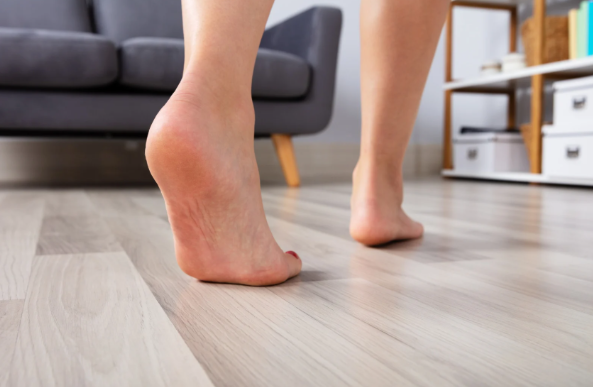
When it comes to walking and posture, people often focus on the legs, back, or pelvis. However, there is one part of the body that is too often overlooked despite playing a crucial role in every step we take: the foot. Restoring and maintaining good foot mobility is essential not only for walking better, but also for improving balance, preventing pain, and supporting overall daily well-being.
For people over 40 who lead a sedentary lifestyle, the benefits of a few simple daily exercises can be enormous. Just a few minutes a day are enough to reactivate foot joint function, create a more stable base of support, and restore fluid movement. In this article, we will explore how and why “movement starts from the feet.”
- Why foot mobility is essential for walking well
- Signs of a stiff foot and how to recognize them
- Toe mobility and everyday functionality
- Simple exercises to improve foot mobility
- How these movements improve walking
Why foot mobility is essential for walking well
The foot is a complex structure made up of 26 bones, 33 joints, and more than 100 muscles, tendons, and ligaments. Each component works together to support the body, absorb impact, and facilitate movement. When joint mobility decreases, every step can become less efficient, less stable, and more tiring.
Good mobility allows for proper weight distribution during walking, helps prevent postural compensations, and reduces stress on the knees, hips, and back. This is especially important for people over 40 who may begin to notice stiffness or reduced flexibility in their movements. Restoring mobility means addressing the root cause rather than simply managing the symptoms.
Signs of a stiff foot and how to recognize them
Many people do not immediately realize they have a stiff foot. The signs can be subtle: difficulty bending the toes, discomfort when lifting the heels, or a feeling of stiffness in the morning. Sometimes the first warning sign is an altered or less fluid walking pattern, which can lead to postural imbalances or minor widespread aches.
Other signs that should not be ignored include uneven wear on one part of your shoe sole, difficulty walking barefoot, or reduced balance on uneven surfaces. Recognizing these early indicators allows you to take action with targeted exercises and prevent musculoskeletal complications.
Toe mobility and everyday functionality
The toes play a crucial role in both support and propulsion during walking. When toe mobility is reduced, even simple daily activities—such as climbing stairs, bending down, or maintaining balance—become less natural. This is where small exercises can make a big difference, improving the foot’s ability to adapt to different surfaces.
Training toe flexibility and strength helps restore a function that is often overlooked but absolutely essential. This is particularly important for people who spend many hours sitting, as reduced neuromuscular stimulation of the feet can gradually lead to stiffness. Working on this mobility is not a luxury but a practical necessity for everyday life.
Simple exercises to improve foot mobility
You do not need a gym or specialized equipment to start working on foot mobility. Just 5–10 minutes a day with simple exercises that can be done at home are enough. One effective exercise is the “toe spread”: while seated, try to spread your toes as wide as possible and hold them open for a few seconds before repeating the movement several times.
Another useful exercise involves drawing the alphabet with your foot while keeping your leg still. This gently but progressively engages the joints. Rolling your foot over a tennis ball is also an excellent way to massage the plantar fascia and improve sensitivity. Consistency is the key to achieving lasting results.
How these movements improve walking
Walking is an automatic action, but that does not mean it is always performed correctly or efficiently. When the foot functions optimally, every phase of the gait cycle—contact, transition, and push-off—becomes smoother and less demanding. Improved mobility therefore translates into a more natural, stable, and confident walking pattern, especially on uneven terrain or in dynamic situations.
In addition, better foot function reduces the risk of falls and improves overall balance, both of which are fundamental for long-term well-being. It is not just a matter of movement—it is a matter of quality of life. Starting with your feet is the first step toward regaining independence, confidence, and ease in your everyday movements.
Comments (0)