
Trolley
You have no items in your shopping cart

 Budgets
 Dumbers
 Discs
Discs
 Benches
 Racks and Rigs
 Weights Holders
 Isotonic machines
 Calisthenics
 Cardio
 Kettlebells
 Flooring
 Gym Set
 Accessories
 Combat
 ARTI MARZIALI
 CONTAINER GYM
 Tug-Of-War
 Used Gym Equipment
 PILATES MACCHINARI
 GINNASTICA ARTISTICA
 CAMPI DA PADEL
 Prodotti in Pronta Consegna
 Informazioni
 IRONMAN
 Gift Card
- Donatif
- General information
- 0 I like it
- 1333 Views
- 0 comments
- stress reduction, improved self-esteem, physical and mental well-being, gym training
READING TIME: 5 MINUTES ➤➤
Garage Gym or Apartment Home Gym: Which Option Really Makes More Sense?
When it comes to a home gym, the comparison between a garage gym and training in an apartment is often approached superficially. There is a tendency to think that one solution is objectively better than the other, when in reality everything depends on context, constraints, and lifestyle. This leads many people to replicate setups seen online without asking whether they are truly sustainable in their real situation.
Understanding the difference between these two types of home gym means completely shifting perspective: it’s not about choosing equipment, but about building a space that aligns with your habits, limitations, and potential for growth. Only in this way can you avoid inefficient choices and create a truly functional home gym.
- The real difference between a garage gym and a home gym
- How equipment changes in the two scenarios
- Budget and investment logic
- Long-term evolution
- What to choose based on your lifestyle
The real difference between a garage gym and a home gym
The distinction between a garage gym and an home gym in an apartment is not just about space, but about operational freedom. A garage gym generally offers a more independent environment, less constrained by noise, vibrations, and structural limits. This allows for greater flexibility in both equipment selection and training style.
On the other hand, training in an apartment requires more careful context management. The issue is not only limited space, but also the need to coexist with neighbors, structures not designed for heavy loads, and practical constraints that influence every decision. This makes it essential to adopt a more strategic and less impulsive approach.
The physical context: space, structure, and setup freedom
In a garage gym, space is often larger and more flexible. This makes it possible to include full racks, Olympic barbells, and platforms without major compromises. The structure itself is usually more suitable for handling loads and impact, making the training experience closer to that of a commercial gym.
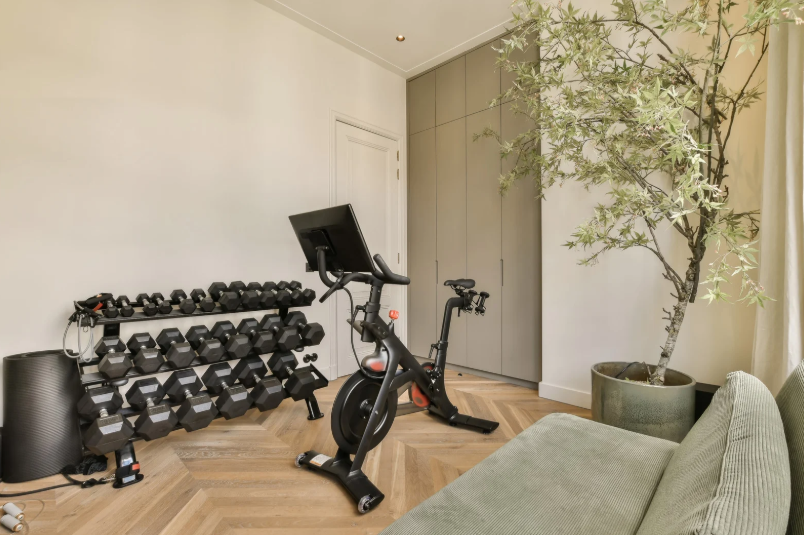
In an apartment, however, every square meter matters. Ceiling height, furniture layout, and the need to maintain a livable space require more compact choices. Here, the ability to design an essential yet effective setup becomes crucial, avoiding unnecessary bulk.
The issue of noise and vibrations
One of the most underestimated aspects is noise. In a garage gym, you can train with greater freedom, even using heavy loads and dynamic movements. The isolated environment reduces the risk of disturbing others.
In an apartment, however, noise becomes a central constraint. The use of rubber flooring, EVA mats, and shock-absorbing solutions is not optional, but essential. This fundamentally changes both the type of training and the equipment you can use.
How equipment changes in the two scenarios
Equipment selection cannot be separated from context. Copying a garage gym setup into an apartment is one of the most common mistakes and often leads to ineffective or frustrating results.
Each environment requires a different logic: expansive and modular in a garage, compact and optimized at home.
Garage gym: total freedom of configuration
A garage gym allows you to build a complete and progressive setup. You can start with a simple base and gradually add racks, benches, barbells, and accessories without constantly rethinking the space.
This freedom makes the garage gym ideal for those who want to develop a structured, performance-oriented training system with fewer technical compromises.
Apartment: compactness and multifunctionality
In an apartment, the key word is efficiency. Equipment must be multifunctional, foldable, and minimally invasive. Compact solutions allow you to maintain a livable space without giving up training.
This leads to prioritizing versatile machines and integrated systems capable of offering multiple exercises with minimal footprint. Design becomes more important than the sheer amount of equipment.
Budget and investment logic
Budget is not just about the initial cost, but about strategy. A garage gym typically requires a higher upfront investment, but offers greater continuity over time.
In contrast, an apartment home gym requires more careful resource management, avoiding impulsive purchases and focusing on truly sustainable solutions.
Initial cost and long-term development
A garage gym allows for progressive growth. Even starting with a basic setup, you can expand over time without having to replace everything you already own.
In an apartment, however, every purchase must be carefully considered. Limited space makes upgrades more difficult and increases the risk of having to resell or replace unsuitable equipment.
Common mistakes when copying online setups
Many users make the mistake of replicating setups seen online without considering their own context. This leads to poor investments and inefficient spaces.
The issue is not the quality of the equipment, but its compatibility with the environment. A perfect garage setup can become unusable in an apartment.
Long-term evolution: which one scales better
An often overlooked aspect is the ability of your home gym to evolve. Not all solutions offer the same growth potential.
Evaluating this from the start helps avoid future limitations and keeps motivation high over time.
Scalability of a garage gym
A garage gym is naturally scalable. The space and structure allow you to add new equipment without disrupting the existing setup.
This makes it ideal for those with long-term goals who want to build an increasingly complete training environment.
Structural limits of an apartment
In an apartment, scalability is more limited. Every addition must account for available space and its impact on livability.
This does not mean it is an inferior choice, but it does require greater awareness and smarter planning.
What to choose based on your lifestyle
The choice between a garage gym and an apartment home gym has no universal answer. It depends on how much space you have, how much you can invest, and how you approach training.
The real goal is not to have the perfect gym, but a solution you can use consistently, without friction or complications.
Ideal scenario for a garage gym
A garage gym is ideal for those who have dedicated space, want to train without limitations, and aim to build a complete setup over time. It is a performance-oriented and freedom-driven choice.
In this context, the initial investment pays off through the ability to evolve without constraints and train in a more structured way.
Ideal scenario for an apartment home gym
An apartment home gym is perfect for those seeking practicality, accessibility, and integration with daily life. It is a more minimalist solution, but often more sustainable in the long run.
When designed correctly, it allows consistent training without sacrificing space and comfort, becoming a natural part of your daily routine.
Comments (0)