
Trolley
You have no items in your shopping cart

 Budgets
 Dumbers
 Discs
Discs
 Benches
 Racks and Rigs
 Weights Holders
 Isotonic machines
 Calisthenics
 Cardio
 Kettlebells
 Flooring
 Gym Set
 Accessories
 Combat
 ARTI MARZIALI
 CONTAINER GYM
 Tug-Of-War
 Used Gym Equipment
 PILATES MACCHINARI
 GINNASTICA ARTISTICA
 CAMPI DA PADEL
 Prodotti in Pronta Consegna
 Informazioni
 Gift Card
- Donatif
- General information
- 0 I like it
- 1536 Views
- 0 comments
- stress reduction, improved self-esteem, physical and mental well-being, gym training
READING TIME: 5 MINUTES ➤➤
Home gym for weight loss: where to start if you don’t want to buy the wrong equipment
When people think about a home gym for weight loss, the most common mistake is starting from the equipment instead of the goal. You browse tools, compare prices, look at what others are using, and before long you end up with a long list of products that all seem useful. The problem is that losing weight at home doesn’t mean filling a room with machines, but creating a simple space that makes training easier to start and easier to repeat. The real difference is not the amount of equipment, but how well your setup supports consistency.
For those living in apartments or condos, this becomes even more practical. Space is limited, noise must be controlled, and every wrong purchase weighs twice: financially and mentally. Bulky, unused, or unfocused equipment is not just a waste of money, it becomes a frustrating reminder of a poor start. That’s why it makes sense to think practically about which equipment you really need to lose weight at home and what logic to follow to build a minimal but functional setup.
- Why losing weight at home is different from “going to the gym”
- The right approach: start with a minimal functional setup
- The essential equipment to truly get started
- Basic configuration: a practical home gym setup for weight loss
- Common mistakes that waste money and motivation
- How to turn your space into a system that actually gets you training
Why losing weight at home is different from “going to the gym”
Many people start with a vague idea: “I want to move more and lose weight.” It’s a valid goal, but it’s often translated poorly when it comes to buying equipment. You might think you need large cardio machines, benches, racks, accessories, and even a dedicated room right away. In reality, when the focus is weight loss at home, the goal is not to replicate a traditional gym, but to create the conditions to train consistently. This means prioritizing simple, versatile tools that are easy to use and always ready.
Home follows different rules than a gym. In a gym, the environment pushes you to train because everything is already set up. At home, every small obstacle can make you postpone. If you have to move furniture, assemble equipment, deal with noise, or find space every time, the chances of skipping a session increase. That’s why a home gym focused on weight loss must be designed with accessibility in mind: less friction, fewer excuses, more consistency.
The real goal: consistency and calorie burn
When it comes to losing weight, many people look for the most intense, technical, or impressive solution. But in everyday life, the decisive factor is the ability to train regularly. A well-designed setup doesn’t need to impress, it needs to work. It should allow you to combine general movement, basic strength work, and sustainable sessions without turning every workout into a major event. The key is building an environment that supports regular training at home, not a strong start that fades after a few weeks.
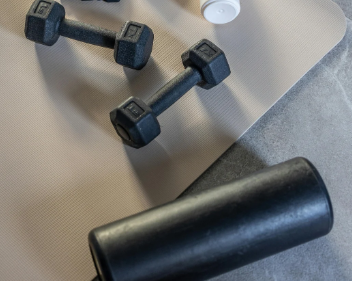
That’s why simplicity matters. A ready-to-use mat, a pair of light dumbbells, and a compact cardio solution can be enough to start effectively. The goal is not to do everything, but to do enough consistently. Those who start with a simple and coherent setup are far more likely to stay on track than those who buy too much, complicate things, and end up using their equipment inconsistently.
The myth of cardio machines
One of the most common beliefs is that you need a lot of cardio machines to lose weight. It sounds logical, but it often leads in the wrong direction. Not because bikes or treadmills are useless, but because they are seen as the only path. In reality, a home weight loss setup can be effective without filling your space with large, expensive machines that don’t match how you actually train.
The issue arises when cardio equipment becomes a mental shortcut. People assume that owning the machine will guarantee consistency, but that’s rarely the case. If the equipment is bulky, noisy, or poorly integrated into your routine, it quickly becomes unused. A smaller, more sustainable solution within a simple setup is far more effective than a large machine that never becomes part of your habits.
The right approach: start with a minimal functional setup
The smartest starting point is defining a minimal functional setup. This means choosing a few elements with a clear role. Each piece of equipment should help you do something useful: move better, train consistently, protect your space, and keep things simple. This approach reduces the common mistake of buying out of excitement or imitation without having a practical structure in place.
A minimal setup is not a limitation, it’s a form of control. It allows you to understand what you actually use, what you enjoy, and what fits your real life. Only after this phase does it make sense to add more. Starting small is often the most practical way to build a beginner home gym that doesn’t turn into unused clutter.
What “minimum effective” really means
The concept of minimum effective is about clearly separating essentials from extras. Essentials are what allow you to train immediately in an organized and repeatable way. Extras can be useful later, but they don’t change the fact that you can already start today. This distinction protects you from premature purchases and keeps the focus on behavior, which is the real driver of results.
In practice, a minimum effective setup lets you do bodyweight exercises, use light resistance, include some cardio, and protect your training surface. That’s enough to begin. Once these functions are covered, you already have a solid foundation. Everything else should be a conscious choice, not a reaction to the fear of “not having enough.”
Space, simplicity, and accessibility
In small spaces or shared living environments, planning matters more than enthusiasm. A tidy corner with easy access to equipment is often more effective than a full but chaotic room. Simplicity is not basic, it’s strategic. When you know exactly where to go, what to use, and how to start, you reduce mental effort.
Noise management is also part of this logic. A protected surface with EVA mats, compact equipment, and controlled movements helps create a setup that fits home life. If your setup feels intrusive or inconvenient, you’ll avoid it. If it’s discreet and ready, it naturally becomes part of your daily routine.
The essential equipment to truly get started
If you’re asking “what equipment do I need to lose weight at home?”, the first thing you need is clarity. At the beginning, the best choice is simple, versatile tools suited for home use. You don’t need dozens of categories, just a few coherent elements. The goal is to build a base that allows you to start immediately without feeling overwhelmed.
This base should cover three functions: creating a defined workout area, enabling basic strength work, and allowing some form of cardio. When these are in place, your setup is already effective for someone aiming to lose weight and build consistency.
Workout mat and surface
The workout mat is often underestimated, but it strongly impacts your experience. It defines your space, improves comfort, and signals the transition into training mode. Having a dedicated surface makes starting easier and your movements feel more structured.
Alongside it, EVA mats help protect the floor, improve comfort, and reduce noise. Especially in apartments, they are far from a minor detail. They make your setup more practical, quieter, and better suited for frequent use.
Light and versatile dumbbells
Light dumbbells are extremely valuable for beginners because they introduce resistance in a simple way. They are versatile, space-saving, and perfect for short, sustainable sessions. You don’t need heavy loads to start effectively—what matters is having a tool that enables variety and progression.
In an entry-level home gym, dumbbells work because they don’t require a complex system. You can use them standing, on the floor, or combined with bodyweight exercises. This flexibility is key for weight loss, as it keeps training engaging without adding unnecessary complexity.
A compact cardio solution
If you want to include cardio, a compact exercise bike is often more practical than larger alternatives. It takes up less space, integrates better into home environments, and is easier to manage. It shouldn’t be the centerpiece, but part of a balanced setup.
Its strength lies in accessibility. If your cardio option is easy to use, you’re more likely to stay consistent. This is very different from owning a large machine that requires effort just to use. When in doubt, choose something simpler that you’ll actually use regularly.
Basic configuration: a practical home gym setup for weight loss
A practical starting setup includes a workout mat, EVA mats, a pair of light dumbbells, and a compact exercise bike. It’s simple, clear, and aligned with a weight loss goal. It won’t promise miracles, but it creates structure and allows for mobility work, strength exercises, and cardio without overwhelming your space.
This setup is ideal for apartment living. It avoids noise issues, excessive bulk, and impulsive purchases. Each element has a clear role and doesn’t require a dedicated room. Even in small spaces, you can create an effective training area if your choices are guided by function rather than appearance.
Essential setup in small spaces
In limited space, organization is everything. A clean corner with ready-to-use equipment lowers the barrier to starting. You don’t need to prepare or rearrange your home each time. This small detail has a big impact on consistency.
When your setup integrates well into your space, it becomes easier to use regularly. There’s no constant conflict between living space and training space, which is crucial for maintaining motivation.
How to use it without overcomplicating
The best way to use this setup is to keep things simple. It’s a base, not a performance system. You can alternate between mat exercises, light dumbbell work, and short cardio sessions without overthinking it. The goal is repeatability.
If a workout is too complicated, you’ll skip it. If it’s easy to start, it becomes a habit. That’s why the real value of your setup lies in how often you use it, not how advanced it looks.
Common mistakes that waste money and motivation
The first mistake is buying too much too soon. It often comes from wanting quick results or feeling unprepared. In reality, it creates confusion. The more you have, the harder it becomes to decide what to use.
The second mistake is choosing equipment disconnected from your real behavior. A product may be good, but not suitable for your space or routine. The right question is not “is this good?”, but “will this help me train consistently?”
Buying too much too soon
Overbuying is often driven by enthusiasm. You want to make the perfect choice and feel ready. But for weight loss beginners, this usually leads to poor decisions. Each unnecessary item increases confusion and the risk of abandonment.
Starting small and observing your habits is far more effective. After a few weeks, you’ll understand what you actually need.
Choosing equipment disconnected from your goal
Another common mistake is buying based on categories rather than function. A setup should support your behavior over time. If a piece of equipment doesn’t make training easier or more consistent, it’s not a priority.
Especially in small spaces, every item must justify its presence. Otherwise, your home gym becomes clutter instead of a useful system.
How to turn your space into a system that actually gets you training
The key step is shifting from thinking about equipment to thinking about systems. A home gym for weight loss works when it supports action. That means making it easy to start, keeping tools ready, and removing friction.
The goal is not perfection, but usability. The best setup is the one that helps you train even on low-energy days.
Reducing mental friction
Mental friction includes anything that makes starting harder: searching for equipment, clearing space, or deciding what to do. Reducing it means having a simple, ready-to-use setup.
The clearer your environment, the easier it is to act.
Building a sustainable routine
A sustainable routine comes from a setup that fits your real life. Not an ideal gym, but your current context. Your space should be functional, simple, and organized.
Starting with a mat, light dumbbells, a compact bike, and a protected surface is already a strong choice. You don’t need everything—you need the right things.
Comments (0)