
Trolley
You have no items in your shopping cart

 Budgets
 Dumbers
 Discs
Discs
 Benches
 Racks and Rigs
 Weights Holders
 Isotonic machines
 Calisthenics
 Cardio
 Kettlebells
 Flooring
 Gym Set
 Accessories
 Combat
 ARTI MARZIALI
 CONTAINER GYM
 Tug-Of-War
 Used Gym Equipment
 PILATES MACCHINARI
 GINNASTICA ARTISTICA
 CAMPI DA PADEL
 Prodotti in Pronta Consegna
 Informazioni
 IRONMAN
 Gift Card
- Donatif
- General information
- 0 I like it
- 1796 Views
- 0 comments
- stress reduction, improved self-esteem, physical and mental well-being, gym training
READING TIME: 5 MINUTES ➤➤
How to Set Up a Home Gym in a Small Room Without Creating Chaos
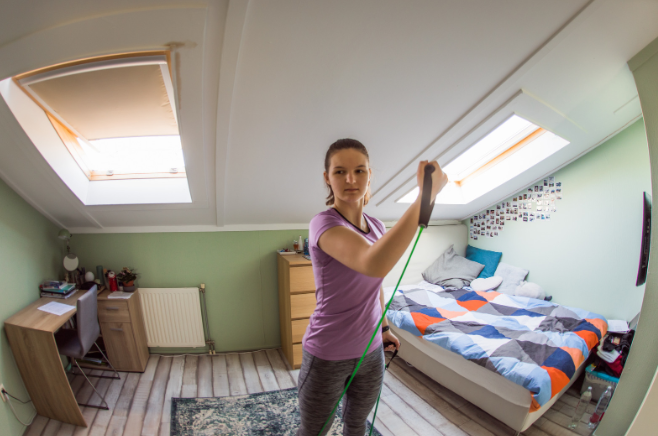
Setting up a home gym in a small space is one of the most common challenges for those who train at home, especially in apartment settings where every square meter counts. The biggest risk is not so much the lack of space, but the absence of a strategy: without a clear plan, even a few pieces of equipment can quickly turn into clutter and disorder.
The good news is that with a well-organized and thoughtful installation, it is possible to create a functional, clean, and enjoyable training environment. It’s not about having fewer tools, but about assembling them the right way, following a precise logic that starts from the space and extends to every detail.
- Why space is the real starting point
- How to design an effective mini-layout
- Correct installation sequence
- The right equipment to avoid clutter
- Common mistakes to avoid
- From chaos to control
Why space is the real starting point
The first mistake many people make is starting to assemble equipment without defining a layout. In a small room, every decision directly impacts usability, and fixing mistakes later becomes complicated. Thinking about the layout first drastically reduces errors, waste, and frustration.
Turning an empty space into a functional home gym requires vision. It’s not enough to place a bench or a rack: you need to understand how these elements interact, how the body moves during training, and which areas must remain free. This is where the difference between chaos and control begins.
Thinking about the layout first prevents hard-to-fix mistakes
An improvised setup often leads to having to dismantle everything after a few weeks. This not only increases effort but also affects motivation. A well-planned mini-layout allows you to start with a stable and lasting configuration right away.
Deciding in advance where each element will go helps maintain order from the beginning, avoiding that “randomly filled” feeling that makes the room hard to use.
From empty space to functional environment
The transformation should be gradual and logical. First define the areas, then place the main elements, and finally complete the details. This approach creates an organized transition that reduces the risk of mistakes.
A well-designed environment is immediately recognizable: every element has a clear function, and there are no unnecessary obstacles in movement.
How to design an effective mini-layout
A good layout does not mean filling every available space, but leaving room to move. Managing minimum distances is essential to ensure safety and comfort during training.
Dividing the room into micro-zones helps maintain both visual and practical order. Even a few square meters can become highly functional if organized properly.
Minimum distances between elements
Each piece of equipment requires an operational space that must be respected. A bench, for example, should not be pushed against a wall if it limits movement. The same applies to a rack, which needs lateral and frontal space.
Respecting these distances prevents friction, collisions, and restricted movements, turning the home gym into a truly usable space.
Functional zones: training, loading, and movement
Separating functions is a simple but effective strategy. A dedicated training area, one for weight loading, and one for free movement help maintain order and clarity.
This division also works on a mental level: each area has a clear purpose, making the experience smoother and less chaotic.
Correct installation sequence
The order in which you set up a home gym is often underestimated, yet it is one of the most important factors in avoiding chaos. A correct installation sequence ensures stability and consistency in the space.
Following a precise logic allows you to build your gym step by step, without having to go back or adapt to previous mistakes.
From flooring to structure: what to install first
The flooring is always the starting point. It protects the space and defines the training area. Immediately after, you move on to the main structures such as racks or supports, which represent the backbone of the home gym.
This progression creates a solid base on which to place everything else, avoiding instability or misalignment.
Adding accessories without creating clutter
Once the main elements are in place, accessories and complements are added. Here it is essential to maintain a logical order, avoiding overcrowding the space.
Each element should have a defined position, preferably non-intrusive, to preserve overall functionality.
The right equipment to avoid clutter
The choice of equipment directly affects how organized your space will be. In small environments, opting for compact solutions is often the smartest decision.
It’s not about sacrificing quality, but about choosing tools that integrate with the space instead of overwhelming it.
Compact and foldable solutions
A foldable bench or a compact rack can drastically reduce space usage when not in use. This approach increases flexibility.
The ability to adapt your setup over time makes your home gym more dynamic and less rigid.
Vertical organization and weight management
Using walls is a key strategy. Weight holders and vertical supports free up floor space, improving visual order.
Smart weight management prevents messy accumulation and makes every item easily accessible.
Common mistakes that turn the room into clutter
Many problems arise from decisions made without an overall vision. Random placement is one of the most frequent mistakes and quickly leads to chaos.
Recognizing these mistakes allows you to avoid them from the start, saving time and effort.
Random placement and lack of planning
Adding equipment without a plan leads to unusable spaces and limited movement. The lack of strategy makes it difficult even to start training.
An effective home gym always starts with at least a minimal but conscious design.
Overloading the space and poor accessibility
Adding too many elements is a common mistake. More equipment does not mean better training, especially if the space becomes impractical.
Leaving free space is a strategic choice that improves the experience and enhances overall functionality.
From chaos to control
Even a good setup can be improved over time. Small adjustments allow the space to better match your real needs.
The goal is to maintain an organized environment over time, preventing disorder from gradually returning.
Small adjustments that make a difference
Slightly repositioning equipment or improving weight arrangement can have a significant impact. These interventions keep the space efficient.
Attention to detail is what separates a functional home gym from an improvised one.
Maintaining order and functionality over time
Order is not just an initial phase, but an ongoing practice. Maintaining a logical arrangement helps preserve the quality of the space.
A well-organized home gym is not only more visually appealing but also makes every workout smoother, simpler, and more motivating.
Comments (0)