
Trolley
You have no items in your shopping cart

 Budgets
 Dumbers
 Discs
Discs
 Benches
 Racks and Rigs
 Weights Holders
 Isotonic machines
 Calisthenics
 Cardio
 Kettlebells
 Flooring
 Gym Set
 Accessories
 Combat
 ARTI MARZIALI
 CONTAINER GYM
 Tug-Of-War
 Used Gym Equipment
 PILATES MACCHINARI
 GINNASTICA ARTISTICA
 CAMPI DA PADEL
 Prodotti in Pronta Consegna
 Informazioni
 IRONMAN
 Gift Card
- Donatif
- General information
- 0 I like it
- 1353 Views
- 0 comments
- stress reduction, improved self-esteem, physical and mental well-being, gym training
READING TIME: 5 MINUTES ➤➤
Isotonic Training vs Free Weights in Hip Rehabilitation
In post-traumatic recovery work, the choice between isotonic machines and free weights is never just a technical preference, but a decision that directly affects the quality of the rehabilitation process, execution safety, and the speed at which the individual can regain confident movement. When it comes to hip rehabilitation in the gym, each phase requires different tools, varying levels of control, and a load progression aligned with the actual capabilities of the patient or recovering athlete. For personal trainers, coaches, and micro gym owners, understanding this difference means creating a more effective and credible training environment.
The contrast between guided load and free load is often presented too rigidly, as if one approach were inherently superior to the other. In reality, in solid professional practice, the key is not choosing a single path, but understanding when to use an isotonic hip machine and when to introduce barbells and free weights in rehabilitation. This interpretive ability reveals the dual nature of a well-designed facility: on one hand, the precision of machines; on the other, the functional depth of free weight training.
- Structural differences between isotonic machines and free weights
- Motor control and safety: when to choose isotonic training
- Functional recovery: advantages of free weights
- Load progression in hip rehabilitation
- Isotonic machines and strength training: strategic integration
Structural Differences Between Isotonic Machines and Free Weights
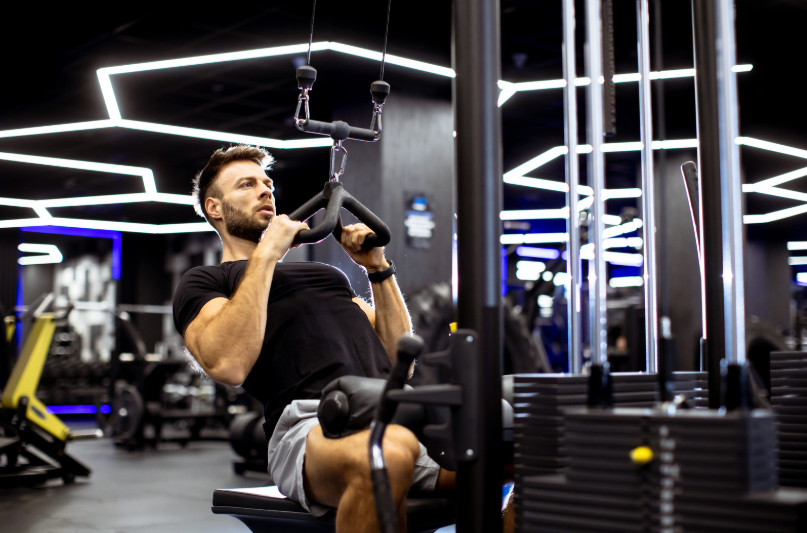
Isotonic machines are designed to provide a constrained, predictable, and repeatable movement. This means that the trajectory is predefined by the equipment structure, allowing the individual to focus less on overall stabilization. In a post-injury hip rehabilitation context, this is especially useful when the primary goal is to safely regain strength, limit compensations, and target specific muscle groups without overloading still vulnerable structures. The machine reduces movement unpredictability and allows for a clearer assessment of load tolerance.
Free weights, on the other hand, expose the individual to broader neuromuscular demands. Barbells, dumbbells, and kettlebells do not guide the movement but require the body to organize stability, posture, and control in space. This makes the work more complex and, in many cases, closer to real-life or sport-specific demands. In hip rehabilitation, however, this complexity should only be introduced once the individual has regained sufficient control, joint awareness, and load management capacity.
How Guided Machines Work in Rehabilitation
A guided-load machine allows for more precise movement isolation and reduces variables that may interfere with recovery. In early or intermediate phases, for example, professionals can work on hip extension, flexion, or abduction with mechanical assistance that helps maintain a cleaner execution. This is crucial when patients tend to protect the injured side, shift weight asymmetrically, or compensate with the lumbar spine or knee.
From an operational standpoint, isotonic machines offer a major advantage: they allow progressive load adjustments, often in small increments, enabling fine-tuned progression. For personal trainers or micro gyms aiming to deliver a serious service, this means working with technical precision, better controlling volume, intensity, and movement quality. The machine does not replace professional assessment but becomes a reliable tool for guiding recovery when load tolerance is still fragile.
The Role of Barbells in Functional Hip Recovery
As individuals begin to regain mobility, strength, and confidence, barbells in rehabilitation become increasingly valuable. Their contribution goes beyond strength gains, focusing on rebuilding complex movement patterns. The hip never works in isolation in real life: it plays a role in walking, climbing, accelerating, decelerating, and lifting objects. Free weights enable training that better reflects these real-world demands.
When used correctly, barbells allow reintroduction of patterns such as hip hinge, partial squat, elevated deadlift, or controlled lunges, restoring the ability to express strength in an integrated way. At this stage, the goal is not simply “lifting more,” but restoring coordination between hip, trunk, foot, and pelvic control. This is where strength training reveals its functional value, acting as a bridge between rehabilitation and return to authentic movement.
Motor Control and Safety: When to Choose Isotonic Training
Choosing isotonic training is often the most appropriate option when individuals need to rebuild confidence in movement. After trauma, surgery, or prolonged pain, the hip is often “protected” by the motor system, leading to stiffness, reduced range of motion, and compensations that affect the entire kinetic chain. In these conditions, guided machines offer a more predictable and controllable environment, ideal for rebuilding a stable foundation before increasing complexity.
However, safety does not depend solely on the presence of a machine. It depends on selecting the correct angle, appropriate range, sustainable load, and volume compatible with the individual’s condition. Isotonic training becomes truly effective when integrated into a progression strategy rather than used as an automatic solution. In expert hands, it refines recovery; in inexperienced hands, it risks becoming a meaningless exercise with little transfer.
Joint Stability and Reduction of Compensations
In the early stages of recovery, reducing compensations is often the main goal. Individuals who cannot yet manage load effectively at the hip tend to redistribute effort to other areas, overusing the lumbar spine, dominant quadriceps, or the contralateral limb. Isotonic machines help isolate the movement, improving control and making it easier for professionals to identify where movement quality deteriorates.
This is also crucial from a perceptual standpoint. Many recovering individuals experience not only strength loss but also reduced awareness of the affected segment. Guided work helps “re-educate” perception of contraction, force production, and return, improving execution quality and reducing the risk of load being absorbed by unintended areas.
Managing Range of Motion in Early Stages
One of the most delicate aspects of hip rehabilitation in the gym is managing the range of motion. Introducing excessive range too early can irritate tissues, create apprehension, or worsen compensations. Machines often allow work within clearly defined movement arcs, making training more focused and aligned with the individual’s clinical or functional stage.
ROM management is not a limitation but a strategy. Temporarily reducing movement amplitude to improve execution quality helps build stronger foundations. Only later can range, speed, and stabilization demands be increased. In this sense, isotonic training is an intelligent choice when recovery requires gradual progression, precision, and reduced psychological stress.
Functional Recovery: Advantages of Free Weights
Once the protected phase is over, free weights often become essential for transforming machine-based strength into functional strength applicable to daily life or sport. The body does not move along fixed paths, and the hip must manage force production, control, and transfer in open environments. At a certain stage, free load training is no longer advanced—it becomes necessary.
Functional recovery requires managing movement in space, with demands for balance, coordination, and adaptability. Free weights introduce variability and motor responsibility, forcing the system to integrate what machines simplified. This transition reveals whether recovery is truly complete—not just the ability to push against resistance, but to organize effective, clean, and transferable movement.
Muscle Activation and Intermuscular Coordination
One of the main benefits of free weights is the demand for intermuscular coordination. During exercises with barbells or dumbbells, individuals must not only produce force but also stabilize the pelvis, control the trunk, and distribute load correctly across the foot, knee, and hip. This makes training richer and more aligned with real-life movement needs.
From a professional perspective, this allows clearer observation of overall movement quality. Free weights do not hide weaknesses—they expose them. This makes them invaluable when the goal shifts from local strength recovery to rebuilding an efficient motor system. The hip reconnects with the rest of the body, giving recovery a more complete meaning.
Transition to Complex, Real Movements
In advanced rehabilitation, the real question is not whether the individual can use a machine, but whether they are ready to perform complex movements again. Standing up, changing direction, picking objects off the ground, climbing stairs, or returning to sport all require freedom of movement that machines cannot fully replicate. Free weights allow gradual exposure to these demands.
Introducing controlled variations of squats, hinges, carries, or split stances helps rebuild confidence realistically. Training is no longer perceived as separate from daily life but as a bridge back to function. This continuity is what gives strength training its value in rehabilitation: not as a display of strength, but as an evolved form of recovery.
Load Progression in Hip Rehabilitation
One of the most common mistakes is treating load as a simple quantity to increase. In a serious program, progression also involves density, range, speed, stability requirements, and coordination complexity. In hip rehabilitation, this is crucial because the same weight can be easy in a guided context and much more demanding in a free one. Professionals must think not only in kilograms but in overall stimulus quality.
Effective progression maintains continuity between phases. If the transition from isotonic to free weights is too abrupt, confidence is lost and compensations return. If delayed too long, strength may not transfer effectively. The quality of the process depends on timing, technical consistency, and constant monitoring of individual response.
From Guided to Free Load: Methodological Continuity
The transition should not feel like a change in philosophy but an evolution of the same path. Machines build control; free weights expand function. Between them lies a valuable overlap phase, with assisted exercises, simplified patterns, controlled ROM, and moderate loads. This is where individuals learn to transfer what they developed on machines into free movement.
Well-structured continuity reassures clients, improves clarity, and enhances professional credibility. For micro gyms, it is also a distinguishing factor: demonstrating that every tool has a purpose and that recovery is structured, not improvised. Technical competence often shows most clearly in transitions rather than extreme choices.
Common Mistakes in Tool Selection
The first mistake is assuming machines are always safer and free weights always riskier. Reality is more nuanced. Poorly used machines—with incorrect setup, excessive ROM, or poorly calibrated load—can be ineffective or even harmful. Conversely, intelligently programmed free weights can be perfectly safe and appropriate in recovery.
The second mistake is choosing tools based on gym identity rather than individual needs. Some facilities rely too heavily on machines to avoid complexity, while others promote barbells ideologically. In both cases, the central point is lost: in rehabilitation, the right tool is the one that best fits the recovery phase, movement quality, and next objective.
Isotonic Machines and Strength Training: Strategic Integration
The most effective approach is not choosing between two worlds but integrating them. A facility equipped with both precision isotonic machines and well-designed free weight equipment has a clear advantage: it can guide individuals through all recovery phases without forcing transitions or methodological gaps. This dual availability is not redundancy, but a strategic asset for delivering more credible and personalized work.
For personal trainers and micro gyms, integrating guided and free training is also a positioning choice. It demonstrates a focus on function rather than trends, and the ability to guide clients from delicate recovery phases toward real strength, movement, and autonomy. This combination reflects a mature, results-oriented technical vision.
The Value of a Hybrid Approach
A hybrid approach combines the strengths of both tools. Machines protect, guide, and quantify early reconstruction phases; free weights restore complexity, function, and transferability. Together, they create a complete pathway that adapts to recovery timelines without compromising movement quality. This reduces professional uncertainty and increases client confidence.
From a communication standpoint, this approach also clarifies the value of investing in both equipment and expertise. It is not about having many tools, but having the right ones and knowing when to use them. The real difference lies not in individual equipment, but in the system that makes it effective within a coherent progression.
How to Structure a Micro Gym for Rehabilitation
A micro gym aiming to be credible in hip rehabilitation should design its equipment with functionality in mind. It needs machines that allow precise adjustments, stable trajectories, and progressive load increments, alongside a free weight area with barbells, platforms, supports, and accessories for clean technical progression. Quality is measured by the ability to cover all phases, not by the sheer number of tools.
Ultimately, the comparison between isotonic training and free weights in hip rehabilitation should not be seen as a clash of opposites, but as a methodological choice. Effective professionals understand that recovery requires control first, then function—and that each phase has its ideal tool. This practical, informed perspective is what transforms a gym into a place truly capable of guiding individuals back to movement.
Comments (0)