
Trolley
You have no items in your shopping cart

 Budgets
 Dumbers
 Discs
Discs
 Benches
 Racks and Rigs
 Weights Holders
 Isotonic machines
 Calisthenics
 Cardio
 Kettlebells
 Flooring
 Gym Set
 Accessories
 Combat
 ARTI MARZIALI
 CONTAINER GYM
 Tug-Of-War
 Used Gym Equipment
 PILATES MACCHINARI
 GINNASTICA ARTISTICA
 CAMPI DA PADEL
 Prodotti in Pronta Consegna
 Informazioni
 IRONMAN
 Gift Card
- Donatif
- General information
- 0 I like it
- 3449 Views
- 0 comments
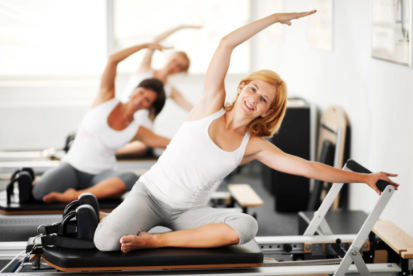
READING TIME: 6 MINUTES ➤➤
In an increasingly fast-paced and stimulus-heavy world, finding simple and effective tools to manage anxiety and reduce stress has become essential. Pilates, often known for its postural and muscular benefits, is also proving to be a powerful ally on an emotional and neurological level. When combined with mindful breathing and a practice attentive to internal sensations, it can become a true ritual of daily self-care, capable of calming the nervous system in just a few minutes.
This article explores how to structure 15-minute micro-practices that combine the best of Pilates, relaxing breathing techniques, and mindfulness in motion. Ideal for people living under pressure, these sequences are designed to be sustainable, transformative, and easy to maintain even on the busiest days.
- The connection between anxiety, stress and the nervous system
- Relaxing breathing and nervous system regulation
- Slow movement, isometrics and gentle mobility
- Mindfulness in motion: presence and awareness
- How to start: short routines with high adherence
The connection between anxiety, stress and the nervous system
What hyperarousal is and how it affects the body
Hyperarousal is a state of constant alert in which our sympathetic nervous system remains active even in the absence of real threats. This evolutionary mechanism, useful in dangerous situations, becomes counterproductive when it becomes chronic, leading to symptoms such as insomnia, muscle tension, restlessness, and difficulty concentrating. Work pressure, digital overload, and everyday worries can fuel this cycle, keeping the body in a permanent state of defense.
The good news is that the body also has an opposite system: the parasympathetic nervous system, responsible for relaxation and recovery. Intentionally activating it through movement and breathing is one of the keys to breaking the stress cycle. This is where Pilates, practiced with awareness, becomes a powerful tool for nervous system regulation.
Why Pilates is effective against anxiety
Pilates is based on controlled movements, deep breathing, and internal focus: three elements that make it ideal for reducing nervous system activation. Unlike high-intensity practices, which may increase adrenaline, Pilates works in synergy with the nervous system to guide the body toward a state of balance.
When performed with focus and slow pacing, Pilates becomes a practice of mind-body integration, helping not only to strengthen and mobilize the body but also to anchor awareness in the present moment. This centering effect is particularly useful for those who experience generalized anxiety or live in a constant state of psychophysical tension.
Relaxing breathing and nervous system regulation
The power of slow nasal breathing
Breathing is the direct bridge between mind and body. Breathing slowly through the nose activates receptors in the parasympathetic nervous system, particularly the vagus nerve, helping to create a state of deep calm. This type of relaxing breathing is central in anti-stress Pilates protocols, where each movement is synchronized with conscious inhalation and exhalation.
Neuroscientific studies confirm that slow and rhythmic breathing can modify brain patterns, reduce heart rate, and even lower blood pressure. Integrating this technique into a daily 15-minute practice produces cumulative effects, improving stress resilience over time.
Mindful breathing techniques in Pilates
In Pilates, breathing is never left to chance. The lateral thoracic breathing typical of the discipline allows the rib cage to expand while maintaining core activation. When performed slowly, this technique becomes a tool to anchor awareness in the present and reduce mental agitation.
During a sequence of anti-stress Pilates, each movement is accompanied by a precise breathing pattern: inhale during expansion, exhale during contraction. This rhythm functions like a form of dynamic meditation, promoting calmness and centering even for those who find it difficult to sit still.
Slow movement, isometrics and gentle mobility
Micro body practices for relaxation
You don’t have to sweat to release stress. On the contrary, slow and isometric movements combined with mindful breathing can be even more effective. In a 15-minute Pilates protocol designed for anxiety relief, the focus is on low-impact exercises with emphasis on gentle mobility of the hips, pelvis, and spine.
This approach allows deep muscles to activate without excessively stimulating the sympathetic nervous system. Sustained isometric holds, such as maintaining a bridge position or a soft plank, provide a sense of stability and control, often compromised during moments of intense anxiety.
15-minute sequences: practical guidelines
An effective routine includes: 2–3 minutes of centering and breathing, 10 minutes of slow mobility and isometric work, and a final 2–3 minutes of relaxation and integration. Movements should be fluid, slow, guided by breathing and deep attention to the body. The goal is not performance but internal regulation.
The recommendation is to choose 4–5 exercises and repeat them in a loop to maintain simplicity and encourage consistency. Some examples include “roll down,” “bridge,” “cat stretch,” and “leg slides.” The secret lies in quality, not quantity. Each movement is an invitation to return to yourself.
Mindfulness in motion: presence and awareness
Integrating attention and movement to calm the mind
Mindfulness applied to movement means being fully present in the body, moment by moment. There is no need to sit still to meditate: practicing Pilates with awareness is an advanced form of active meditation. Every gesture becomes an opportunity to observe, accept, and let go.
This presence deeply calms the mind by shifting attention from automatic thoughts to bodily sensations. The result is a greater sense of inner mastery and a reduction in states of agitation—an essential benefit for those living on the edge of daily anxiety.
Focus and sensory anchoring in Pilates protocols
Integrating visual focus, the tactile perception of the mat, the rhythm of breathing, and muscular sensations helps create a true sensory anchor. This embodied awareness is what distinguishes simple physical exercise from a transformative practice.
Over time, practitioners learn to recognize early activation signals, intervene with practical tools, and cultivate a sense of agency. Pilates thus becomes not only a discipline but a language through which we can communicate with our nervous system.
How to start: short routines with high adherence
When to practice and how to stay consistent
The best time for an anti-stress micro-practice is whenever you feel the need: in the morning to start the day centered, during a lunch break to release tension, or in the evening to promote better sleep. The key is consistency, not perfection.
Creating a dedicated space, even a small one, helps make the practice part of your daily routine. All you need is a mat, 15 minutes of time, and the willingness to listen to yourself. Every day becomes an opportunity to reconnect with yourself—even in the middle of chaos.
Strategies to make the practice a daily habit
To encourage adherence, it is helpful to associate the practice with an existing ritual (such as your morning coffee or closing your computer at the end of the day). Using short guided videos, keeping a body journal, or simply leaving the mat visible can make a big difference. Simplicity is the best ally of consistency.
Over time, the practice becomes a welcomed appointment, an anchor of calm during difficult moments. And when you begin to feel its benefits—greater presence, less reactivity, and a more vibrant body—it becomes natural to continue. Because well-being is not a luxury: it is a right that can be cultivated, 15 minutes at a time.
Comments (0)