
Trolley
You have no items in your shopping cart

 Budgets
 Dumbers
 Discs
Discs
 Benches
 Racks and Rigs
 Weights Holders
 Isotonic machines
 Calisthenics
 Cardio
 Kettlebells
 Flooring
 Gym Set
 Accessories
 Combat
 ARTI MARZIALI
 CONTAINER GYM
 Tug-Of-War
 Used Gym Equipment
 PILATES MACCHINARI
 GINNASTICA ARTISTICA
 CAMPI DA PADEL
 Prodotti in Pronta Consegna
 Informazioni
 IRONMAN
 Gift Card
- Donatif
- General information
- 0 I like it
- 1650 Views
- 0 comments
- stress reduction, improved self-esteem, physical and mental well-being, gym training
READING TIME: 5 MINUTES ➤➤
PT Studio or Micro Gym: How Flooring Choice Changes
When it comes to sports flooring, one of the most common mistakes is treating a PT studio and a micro gym as if they were nearly identical versions of the same space. At first glance, they may both appear to be lightweight professional environments, with limited square footage and a more controlled setup compared to a traditional gym. In reality, however, the way the space is used, the type of service offered, the volume of simultaneous users, and the daily stress placed on surfaces differ significantly. This is where flooring choice stops being a purely aesthetic or technical matter and becomes a true design decision.
A well-chosen floor does more than simply “cover” the base; it contributes to operational continuity, perceived reliability, safety, and alignment with the business model. In a PT studio, flooring supports a more guided, precise, and often more personalized experience. In a micro gym, on the other hand, the same surface must handle a more distributed dynamic, with more users, greater variability, and a different level of wear. Understanding this difference helps avoid poorly calibrated investments and allows you to create a space that is truly aligned with the service you want to offer.
- Why PT studios and micro gyms should not be treated the same
- How flooring changes based on flow and usage volume
- Equipment, loads, and functional zones: what really changes
- Maintenance, image, and service perception
- How to make a proportional choice without over- or under-designing
Why PT studios and micro gyms should not be treated the same
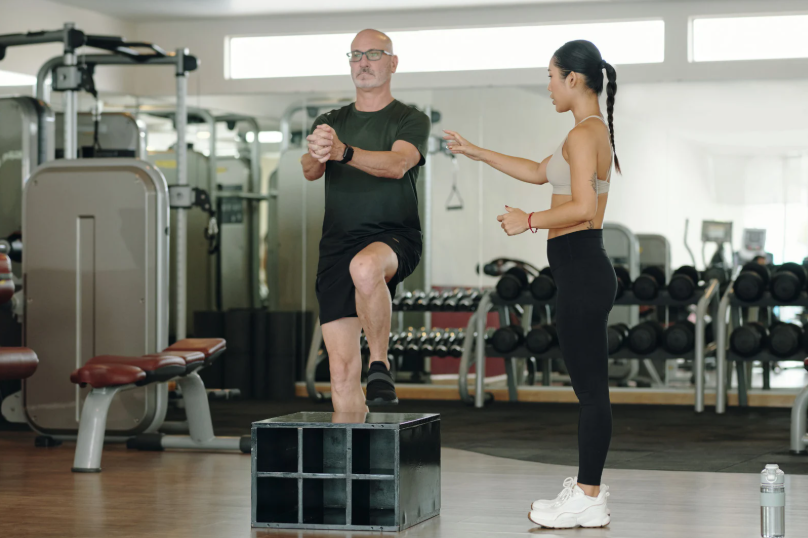
A PT studio is typically built around a highly guided professional relationship. The client enters, is coached, and uses a space designed to support a structured journey, moving within an environment where every element communicates order, control, and method. In this context, flooring must support not only training but also the perceived quality of the service. The floor becomes part of the space’s language: it absorbs noise, conveys cleanliness, defines training zones, and reinforces the idea of a deliberately designed environment.
A micro gym, while still compact, tends to operate on a broader logic. There may be small groups, time slots with multiple users, more variation in exercises, and a more diverse use of equipment. This means the flooring must not only “perform well” but do so under more constant and less predictable pressure. Treating the two spaces as equivalent often leads to opposite mistakes: in the first case, overengineering the system; in the second, choosing a solution that is too light to handle real daily use.
How flooring changes based on flow and usage volume
A low-simultaneity space does not have the same priorities as a multi-user environment
One of the most underestimated aspects when choosing gym flooring is simultaneous usage. In a PT studio, the number of people present at the same time is often limited. This makes it easier to control movement, distribute loads, and manage localized wear. In many cases, it is possible to choose flooring that prioritizes precision, comfort, ease of cleaning, and visual consistency, without needing to design every area as if it were under constant heavy traffic.
In a micro gym, the situation changes. Even with limited space, the alternation between users, exercises, and equipment generates higher stress on the flooring. Movement increases, load points shift, more areas are activated, and the likelihood of widespread wear rises quickly. This requires a more rigorous evaluation of thickness, density, impact behavior, and the surface’s ability to maintain consistent performance over time. A solution that works well in a highly controlled PT studio may prove fragile or inefficient in a busier micro gym.
Operational continuity impacts the choice more than it seems
When a professional activity is interrupted due to flooring issues, the damage is not just material. Sessions must be rescheduled, clients managed, brand perception protected, and operations reorganized. In a PT studio, this directly affects the client relationship, as the service relies heavily on continuity and trust. For this reason, flooring should also be selected based on ease of maintenance and the ability to intervene without significantly disrupting the environment.
In a micro gym, operational continuity becomes even more systemic. A blocked area can interfere with user rotation, session planning, and overall efficiency perception. This is why a professional choice should go beyond initial cost and consider lifecycle performance. A surface that better withstands real use, is easy to clean, and maintains a tidy appearance over time delivers a tangible operational advantage, far outweighing any apparent initial savings.
Equipment, loads, and functional zones: what really changes
When rubber flooring is the most coherent base
Rubber flooring often represents the most balanced solution when building a flexible and credible professional space. In a PT studio, it can provide continuity across main training areas, offering a solid compromise between comfort, grip, shock absorption, and technical appearance. Its effectiveness increases when the project is well proportioned and zones are designed according to actual exercises performed. In this scenario, the material is not chosen to imitate a larger gym, but to support a high-quality, perception-driven service.
In a micro gym, the role of rubber flooring becomes even more central, as it must support more variable and frequent use. Here, density, correct thickness, load stability, and the ability to maintain performance under repeated use with equipment and free weights become crucial. An undersized solution can lead to deformation, reduced comfort, increased noise, and a less solid overall feel. At this stage, design logic makes the difference between a simply installed solution and a truly professional one.
Where tatami and platforms make sense in a professional project
Tatami mats and lifting platforms should never be included by imitation or trend, but only when they serve a real function. In a PT studio, tatami may make sense in areas dedicated to mobility, floor work, or specific activities requiring a different surface. Similarly, a platform is appropriate when there is a clear focus on lifting, barbell work, or exercises generating concentrated loads. The goal is not to add “gym-like” elements, but to build functional zones with a clear operational purpose.
In a micro gym, the evaluation must be even stricter, as every square meter must generate real value. A well-designed platform can protect the surface, improve safety, and organize a high-intensity area. Tatami, on the other hand, should only be included if the training model truly requires it. Adding specialized surfaces without a clear logic risks fragmenting the space and reducing overall readability. When the project is well designed, every material aligns with flows, equipment, and service; otherwise, the flooring becomes a patchwork of disconnected solutions.
Maintenance, image, and service perception
In PT, experience control is key
In a PT studio, client perception is an integral part of the value offered. Flooring contributes quietly but decisively to this experience, communicating order, care, and attention to detail. An uneven, noisy, or visually inconsistent surface can weaken the professional message, even when the technical service is strong. On the other hand, well-chosen flooring reinforces the sense of being in a space designed to work effectively, with method and continuity. This directly impacts trust, especially in contexts where clients purchase personalized services and expect an environment that reflects that level of quality.
Maintenance, in this model, is not just a practical issue. Cleanability, aesthetic durability, and ease of management affect the consistency of the experience. A PT studio must always appear ready, stable, and aligned with its positioning. For this reason, flooring selection must consider daily routines, cleaning time, sensitivity to wear marks, and the material’s ability to maintain a professional appearance without disproportionate effort. Perceived quality does not come from a single detail, but from the overall coherence of the surfaces the client interacts with.
In a micro gym, system durability matters most
In a micro gym, perception remains important but is more closely tied to overall robustness. Users evaluate space quality through its ability to withstand daily operations without losing order, comfort, or reliability. Flooring that marks easily, shows dirt quickly, or rapidly reveals performance limits conveys a sense of improvisation. This can become a commercial issue, as the space appears less structured than intended.
Maintenance should therefore be treated as a management factor, not a secondary concern. In a micro gym, it is essential to prioritize surfaces that handle repeated use well, allow for quick cleaning, and maintain a tidy appearance despite higher usage frequency. The right choice protects not only the base but also the rhythm of the activity. In a compact yet operational professional environment, true efficiency comes from materials that support real work without requiring constant adjustments.
How to make a proportional choice without over- or under-designing
The risk of overspending in a PT studio
One of the most common mistakes in a PT studio is adopting solutions designed for more intensive environments simply because they appear more technical or authoritative. In reality, an overly heavy or specialized choice can lock up budget without delivering proportional value. If the working model is controlled, simultaneous users are few, and high-impact areas are limited, it is often smarter to invest in coherent, well-finished, easy-to-maintain flooring integrated into an orderly overall design. Professionalism is not about excess material, but about precision in choice.
A good PT studio project should start with a simple question: what actually happens in the space every day? From there, surfaces, thicknesses, dedicated zones, and operational priorities are defined. This approach reduces the risk of overbuying and allows resources to be allocated to other elements that shape the client experience. In this context, flooring is not a symbol of power, but a tool for professional coherence.
The risk of underspending in a micro gym
In a micro gym, the opposite risk is more common: underestimating the difference between a compact space and a low-demand space. Smaller square footage may suggest that a simple solution is enough, but as user numbers, rotation, and equipment diversity increase, the flooring quickly comes under stress. Saving too much upfront can lead to premature wear, reduced comfort, higher corrective costs, and a less professional overall perception. It is a classic case where cost-cutting results in a less efficient investment.
Making a proportional choice means understanding the micro gym for what it truly is: not a smaller version of a large gym, but not just a slightly equipped PT studio either. It is a model with specific needs, requiring flooring that supports operational continuity, usage variability, and perceived quality. When flooring is selected based on the business model, flows, and active areas, the space becomes more credible, stable, and easier to manage. This design coherence ultimately distinguishes a facility that truly works from one that only appears correct on paper.
Comments (0)