
Trolley
You have no items in your shopping cart

 Budgets
 Dumbers
 Discs
Discs
 Benches
 Racks and Rigs
 Weights Holders
 Isotonic machines
 Calisthenics
 Cardio
 Kettlebells
 Flooring
 Gym Set
 Accessories
 Combat
 ARTI MARZIALI
 CONTAINER GYM
 Tug-Of-War
 Used Gym Equipment
 PILATES MACCHINARI
 GINNASTICA ARTISTICA
 CAMPI DA PADEL
 Prodotti in Pronta Consegna
 Informazioni
 IRONMAN
 Gift Card
- Donatif
- General information
- 0 I like it
- 1425 Views
- 0 comments
- stress reduction, improved self-esteem, physical and mental well-being, gym training
READING TIME: 5 MINUTES ➤➤
How to Clean and Maintain Rubber Flooring and Tatami Without Damaging Them
Anyone who manages a gym, a personal training studio, or a micro gym knows that the training surface is far from a secondary detail. A well-maintained sports floor affects the perception of order, daily usability, and the longevity of the investment. For this reason, talking about proper maintenance of rubber flooring and tatami means addressing a practical and relevant topic, closely linked to the operational continuity of the space.
The most common mistake is assuming that all surfaces can be cleaned in the same way. In reality, rubber and tatami react differently to water, cleaning agents, friction, and maintenance frequency. Establishing a simple yet consistent routine helps preserve the material’s appearance, reduce premature wear, and make daily management much more efficient.
- Why maintenance varies from one material to another
- How to properly clean rubber flooring
- How to keep tatami in good condition over time
- How often you should actually intervene
- Common mistakes that damage materials
- A simple routine that improves durability and management
Why maintenance varies from one material to another
Rubber flooring is designed to absorb impact, withstand loads, and provide stability during training. However, this durability does not mean it can be treated with any product or overly aggressive methods. Rubber can be affected by unsuitable detergents, chemical residues, and excessive washing, especially when these practices compromise the surface finish or alter the material’s appearance over time.
Tatami, on the other hand, requires even more specific care. Although designed for intensive use, its surface can suffer from retained moisture, excess water, and inadequate cleaning in joint areas. For this reason, maintenance should never follow a one-size-fits-all rule, but rather be based on clear distinctions between materials, usage intensity, and application context. This difference is what truly defines a high-quality maintenance routine.
How to properly clean rubber flooring
Which products and tools to use
For routine cleaning of rubber flooring, it is best to start with simple and consistent actions. Removing dust, debris, and surface dirt with non-abrasive tools prevents particles from accumulating and turning into a cause of mechanical wear over time. Cleaning with a properly dosed, neutral product compatible with the surface is generally the most balanced choice to maintain cleanliness and visual appeal without stressing the material.
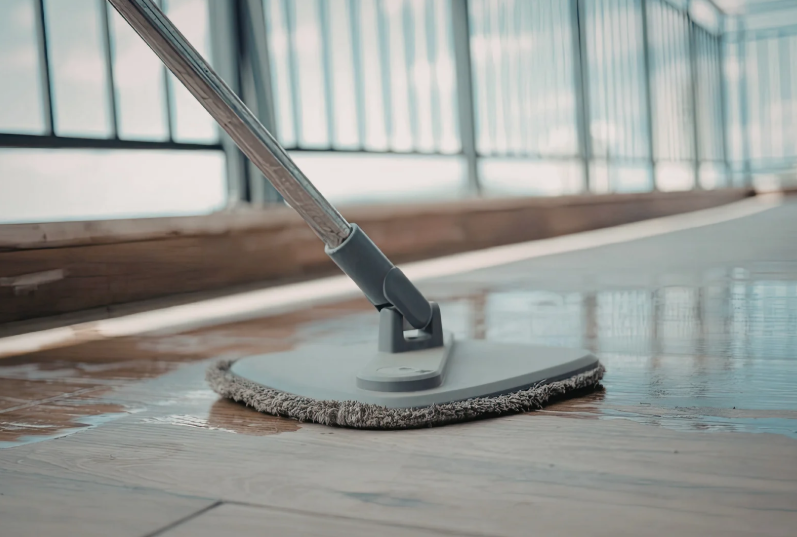
The tools used also make a difference. Soft cloths, well-wrung mops, and non-scratching equipment allow effective cleaning without leaving marks or unwanted residues. At this stage, it is important to remember that the best maintenance is not the most aggressive, but the most consistent. Regular rubber floor cleaning, carried out correctly, reduces the need for intensive interventions and helps preserve elasticity, uniformity, and comfort.
What to avoid to prevent accelerated wear
One of the most common mistakes is using overly strong detergents in the belief that they will deliver better results. In reality, aggressive degreasers, solvents, or unsuitable formulations can damage the surface appearance and, over time, make the material more prone to dullness, dryness, or localized alterations. The same applies to hard brushes, abrasive tools, and repeated washing with excessive amounts of liquid.
Another practice to avoid is the occasional but heavy cleaning approach, where the surface is neglected for days or weeks and then subjected to an intense cleaning session. This method does not simplify management—it complicates it. For gym operators and personal trainers, it is far more effective to build a light but consistent maintenance routine that aligns with actual usage without putting the material at risk.
How to keep tatami in good condition over time
Daily cleaning and drying
Tatami requires careful maintenance, especially because it often comes into direct contact with the body, sweat, and dynamic movements such as rolling and close-contact exercises. For this reason, it is important to act consistently by removing surface dirt and performing controlled cleaning without saturating the surface with water. A well-maintained tatami is not one that is obsessively treated, but one that is managed regularly and thoughtfully.
Drying is a crucial step. After cleaning, the surface should return quickly to optimal conditions, avoiding stagnation or retained moisture. This aspect is often underestimated but has a significant impact on long-term preservation. When cleaning is well-calibrated and drying is properly managed, tatami maintenance becomes easier, more predictable, and less prone to surface wear issues.
Key attention points: joints, edges, and surface
With tatami, it is not only the central surface that matters, but also the joints, edges, and interlocking areas. These zones tend to collect dust and debris more easily and therefore require more careful attention. Neglecting them allows small daily accumulations to become a source of visual and functional deterioration, with effects that develop gradually but consistently.
It is therefore advisable to include periodic visual checks to detect lifting, micro-separations, or areas where routine cleaning may not be sufficiently effective. This attention does not complicate management—it makes it smarter. In a sports environment, true efficiency comes from simple, repeatable practices rather than complex procedures that are difficult to sustain over time.
How often you should actually intervene
The ideal frequency depends on usage volume, type of activity, and how much dirt the surface accumulates throughout the day. In high-traffic areas, routine cleaning should be part of daily operations, while more thorough checks can be scheduled regularly during the week. The key point is not to follow a theoretical one-size-fits-all frequency, but to build a realistic and sustainable rhythm aligned with actual usage.
A good approach follows a practical sequence: use, care, durability. When maintenance naturally integrates into space management, everything becomes more efficient. Emergency interventions decrease, the likelihood of mistakes is reduced, and the value of the investment is better preserved. In this sense, proper long-term maintenance is not an extra task, but a fundamental part of good organization.
Common mistakes that damage materials
The first mistake is treating different surfaces as if they were the same. It is an understandable shortcut, but not a useful one. Another frequent error is using products out of habit rather than compatibility, perhaps because they are already available or considered generally effective. Added to this are excessive water use, poor drying practices, and the use of overly rigid tools, all of which can compromise both the appearance and functionality of the surface.
There is also a more subtle but equally important mistake: waiting for visible signs of wear before changing approach. By that point, management has already become reactive. A well-designed maintenance routine, instead, works preventively. It does not create alarmism or complexity, but helps avoid premature deterioration and ensures safer daily operation of the sports space.
A simple routine that improves durability and management
The most effective solution, in most cases, is a simple but consistent routine. This means clearly distinguishing between rubber flooring and tatami, using compatible products, avoiding excess water, checking sensitive areas, and maintaining a realistic intervention frequency. This approach works because it relies on small, repeatable actions rather than occasional intensive efforts.
For gym owners, personal trainers, or micro gym operators, the benefit is twofold. On one hand, it protects an existing investment; on the other, it simplifies daily operations without adding unnecessary complexity. In this sense, knowing how to clean and maintain rubber flooring and tatami without damaging them not only helps preserve the surface but also supports smoother operations, greater confidence, and better overall control of the environment’s quality.
Comments (0)