
Trolley
You have no items in your shopping cart
 Budgets
 Dumbers
 Discs
Discs
 Benches
 Racks and Rigs
 Weights Holders
 Isotonic machines
 Calisthenics
 Cardio
 Kettlebells
 Flooring
 Gym Set
 Accessories
 Used Gym Equipment
 Combat
 ARTI MARZIALI
 Tug-Of-War
 CAMPI DA PADEL
 PILATES MACCHINARI
 GINNASTICA ARTISTICA
 CONTAINER GYM
 Gift Card
 Informazioni
 Prodotti in Pronta Consegna
- Donatif
- General information
- 0 I like it
- 2 Views
- 0 comments
- gym flooring, safety flooring, gym safety, shock-absorbing materials
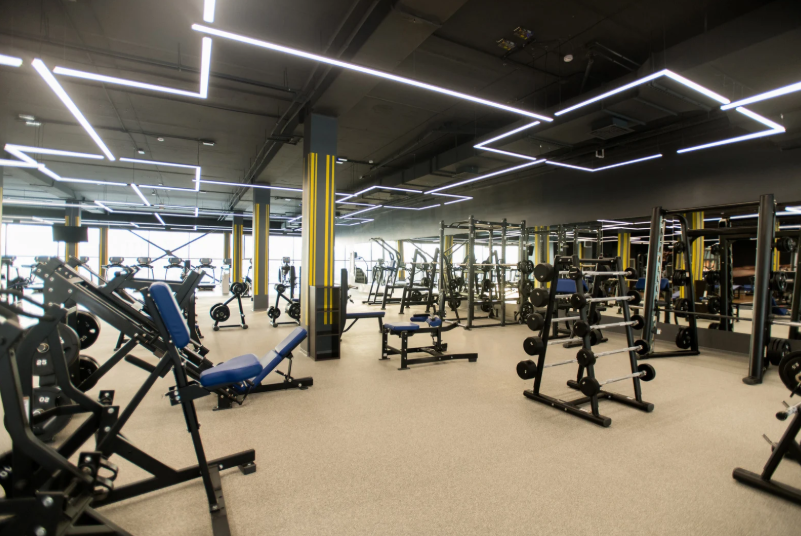
Standard and custom in the same project: how to avoid incompatibilities in layout, measurements and workflows
Integrating standard elements and custom components within the same gym project may seem like a straightforward choice: you start from ready-made modules, add tailored solutions, and create an environment that better fits the actual space. In reality, however, the quality of the result does not depend solely on the individual products. A standard rack, a custom storage solution, technical flooring, and a bespoke structure can all be correct on their own, yet create issues if they are not considered as parts of a unified system.
The critical point is the technical compatibility between standard and custom elements. In a fitness center, a corporate gym, or a professional B2B project, incompatibilities often emerge in the details: insufficient spacing between areas, unverified heights, missing anchoring points, unrealistic installation sequences, or pathways that seem clear on paper but become obstacles in daily use. A well-informed decision, therefore, is not just about what to purchase, but how each element will coexist within the final layout.
Why a mixed project is not just a sum of components
In a mixed project, standard solutions provide speed, predictability, and a technically defined baseline. Custom elements, on the other hand, allow adaptation to specific constraints such as irregular walls, unique ceiling heights, branding requirements, tight spaces, fixed pathways, or operational needs not covered by standard modules. The risk arises when these two approaches are managed separately, without a comprehensive verification of measurements, functions, and real-world usage.
For installers, designers, and B2B partners, the real leap in quality lies in moving from selecting individual components to embracing a systemic integration approach. It is not enough to know that a structure is solid or that a module is compatible within a product line. It is essential to assess how each element interacts with flooring, pathways, nearby equipment, available heights, anchoring points, and user flows. Only then can the project remain efficient after installation.
The most common incompatibilities between standard and custom elements
The most frequent incompatibilities are not always visible at the early stages. They often emerge when the layout moves from design to installation, or when the gym is in full operation. A standard component may perfectly meet its own specifications but become inefficient when placed next to a custom element with different depth, height, or accessibility characteristics.
For this reason, compatibility should not be treated as a final check, but as a core design criterion. Every decision regarding racks, storage, flooring, integrated structures, and functional areas must be evaluated in relation to the others. The right question is not only “does this component fit the space?”, but “does this component work within the space, alongside others, during daily use?”.
Layout, pathways and work areas
Layout is the first area where standard and custom elements may conflict. A standard module may have well-defined dimensions, but when placed next to custom storage or a bespoke structure, operational pathways can become restricted. This affects user circulation, equipment handling, and the overall perception of order within the space.
A proper assessment must consider not only the static footprint of each element, but also the space required to use it. A rack, for example, occupies more than its base area: it requires clearance for barbells, plates, athlete movement, and lateral access. In a mixed project, this perspective prevents a formally correct layout from becoming inefficient in practice.
Heights, clearances and structural interactions
Heights are often underestimated, especially when combining standard structures with custom components. An element may fit the room in absolute terms, but conflict with beams, systems, mirrors, lighting, ceilings, or other existing features. Even a few centimeters can affect installation sequences or limit functionality.
Vertical and lateral clearances must be evaluated together. A tall structure may not pose issues on its own but can become critical when placed near protruding accessories, barbell supports, or custom storage solutions. True compatibility comes from analyzing interactions between areas, not just reading technical datasheets.
Anchoring, flooring and installation constraints
Anchoring is another sensitive aspect. Walls, floors, and supports do not always share the same characteristics, especially in existing gyms or repurposed spaces. A custom component may require specific anchoring points, while a standard module follows predefined installation logic. If these requirements are not aligned, installation can become more complex than expected.
Flooring also plays a key role in compatibility. Thickness, density, joints, cuts, and finishes can interfere with bases, plates, anchoring systems, and final heights. For this reason, when integrating custom racks, tailored storage, flooring, and standard structures, it is essential to verify installation order and actual levels before confirming the project.
The technical checklist before approving a mixed project
A technical checklist is not about adding bureaucracy, but about reducing risk. In B2B projects, especially when installers, designers, and gym owners are involved, every early verification helps avoid corrections, on-site adjustments, and operational delays. Compatibility must be validated before ordering, not discovered during installation.
The checklist should include real measurements, minimum clearances, available heights, tolerances, installation sequences, accessibility, area interactions, and structural constraints. This approach transforms a set of components into a coherent project, where standard solutions ensure efficiency and custom elements add precision without introducing critical issues.
Real measurements and operational tolerances
Nominal dimensions are not enough. In a mixed project, it is necessary to work with real-world measurements, taking into account uneven walls, non-uniform floors, baseboards, systems, doors, columns, and existing constraints. The gap between design and reality may seem minimal, but becomes crucial when installing custom elements.
Operational tolerances must also include usability space. An area may be sufficient to place equipment, but not to use it effectively. Verifying openings, movement paths, clearances, and loading zones helps prevent interference between equipment and users, making the project safer, clearer, and more functional.
Installation sequences and accessibility
Installation sequence is an integral part of compatibility. Some components must be installed before others, certain structures require maneuvering space, and some elements can only be fixed after flooring installation. Ignoring this sequence can lead to unnecessary disassembly, adjustments, or time loss.
Accessibility must be considered both during installation and future maintenance. A custom element may be perfect in terms of design and function, but problematic if it blocks access to anchors, walls, sockets, or technical areas. A well-designed project always ensures operational continuity even after delivery.
User flows between racks, storage and functional areas
User flow is where the project is truly tested in daily operation. Users move between racks, benches, barbells, plates, storage areas, functional zones, and free training spaces following practical—not theoretical—paths. If these paths are not anticipated, the result may be congestion, overlap, or underutilized areas.
In a professional gym, well-designed flow improves usability and reduces operational friction. Storage should be close to where it is needed, without obstructing movement. Standard structures must integrate seamlessly with custom solutions, preserving the logic of the environment. This is where technical compatibility translates into real efficiency.
Turning technical compatibility into a design decision
Compatibility should not be treated as a secondary check, but as a decision-making criterion. When comparing standard and custom solutions, the focus should not be limited to price, availability, or finish. The key is to identify which combination minimizes incompatibility risks, simplifies installation, and ensures smoother long-term management of the space.
This is why a mixed project requires clear technical alignment between designers, installers, and gym operators. The best choice balances customization and reliability, avoiding solutions that are too disconnected from the overall layout. Custom solutions truly work when they enhance the entire project, not when they introduce uncontrolled complexity.
An integrated project is more reliable when built on a systemic vision
A gym project that combines standard and custom elements can deliver a much more precise result than a fully modular solution. However, this level of precision requires method. Every measurement, pathway, height, anchoring point, and usage sequence must be verified in relation to the rest of the environment. Only then does the project remain consistent from selection to daily use.
The real difference lies in moving from a collection of components to an integrated system. When racks, storage, flooring, and structures are designed together, the gym becomes more organized, manageable, and operationally solid. In this sense, compatibility between standard and custom elements is not just a technical concern: it is a fundamental condition for building professional, reliable, and truly functional spaces.
Comments (0)