
Trolley
You have no items in your shopping cart

 Budgets
 Dumbers
 Discs
Discs
 Benches
 Racks and Rigs
 Weights Holders
 Isotonic machines
 Calisthenics
 Cardio
 Kettlebells
 Flooring
 Gym Set
 Accessories
 Combat
 ARTI MARZIALI
 CONTAINER GYM
 Tug-Of-War
 Used Gym Equipment
 PILATES MACCHINARI
 GINNASTICA ARTISTICA
 CAMPI DA PADEL
 Prodotti in Pronta Consegna
 Informazioni
 IRONMAN
 Gift Card
- Donatif
- General information
- 0 I like it
- 1349 Views
- 0 comments
- stress reduction, improved self-esteem, physical and mental well-being, gym training
Punching bag, tatami or full structure: where to start in a combat-oriented PT space
Integrating a combat component into a personal training studio is an increasingly common strategic choice, but one that is often underestimated in its complexity. The real issue is not what to buy, but where to start in order to build a space that is coherent, functional, and sustainable over time. When space and budget are limited, every decision becomes critical and can determine the success or failure of the entire project.
The most common temptation is to start with the most iconic element, the one that immediately communicates “combat” to the client. However, this logic often leads to inefficient investments and spaces that are difficult to use effectively. To avoid costly mistakes, it is essential to reason in terms of function, versatility, and progression, not visual impact.
- Why the initial choice determines the credibility of your combat space
- Punching bag: when it makes sense to start here
- Tatami: the invisible but strategic foundation
- Full combat structure: an advanced investment
- Strategic comparison: function, space, and return
- Where to really start in a combat-oriented PT studio
Why the initial choice determines the credibility of your combat space
The first piece of equipment you introduce into a combat-oriented PT space is not just a purchase, but a statement of intent. It defines the type of training you can offer, the target audience you will attract, and how clients perceive your expertise. A wrong investment at this stage can lead to an incoherent space that is difficult to use and lacks credibility.
Many professionals fall into the trap of choosing based on visual impact, assuming that a recognizable element is enough to communicate value. In reality, clients quickly perceive whether a space is built with logic or improvisation. The difference lies in prioritizing what is functional to real training over what is merely aesthetic.
Common mistake: starting from the most visible element
The punching bag is often the first choice because it is immediately associated with the combat world. However, without a structured methodology and adequate space, it risks becoming an underused element. This leads to a paradox: a visible investment that produces little value.
This type of decision is driven by cognitive biases such as visual confirmation and the fear of “not looking combat enough.” But in a PT studio, the priority is not appearance, but operational efficiency based on the actual client base.
From symbolic to functional: changing the investment logic
Shifting from a symbolic to a functional approach means asking: which equipment allows me to work more, with more clients, and in more contexts? This question completely changes investment priorities.
A strategic approach reduces risk and increases control over the evolution of the space. It’s not about giving up visual impact, but about building it progressively on a solid and coherent foundation.
Punching bag: when it makes sense to start here
The punching bag is a highly specific tool, mainly designed for striking training. It offers an immediate and intuitive experience, making it effective for dynamic and engaging sessions. However, this very specificity is also its main limitation.
In a PT studio, where variety and adaptability are essential, the punching bag risks being used only in a limited portion of sessions. This reduces the return on investment, especially if the space does not allow smooth and continuous use.
Main function and operational limits
The function of the punching bag is clear: developing strikes, coordination, and endurance. But outside of this context, its use becomes marginal. It does not support ground work or more complex technical training, limiting programming possibilities.
This makes it a sensible choice only when there is already a structured base or a specific target focused on striking. Otherwise, it risks being a premature investment.
Space requirements and client profile
The punching bag requires dedicated space, both for installation and safe use. In small environments, it can become a bulky and inflexible element, reducing the overall quality of the space.
It is also particularly effective with clients already motivated toward combat training. For a general audience, it may not be sufficient to build a complete and progressive offering.
Tatami: the invisible but strategic foundation
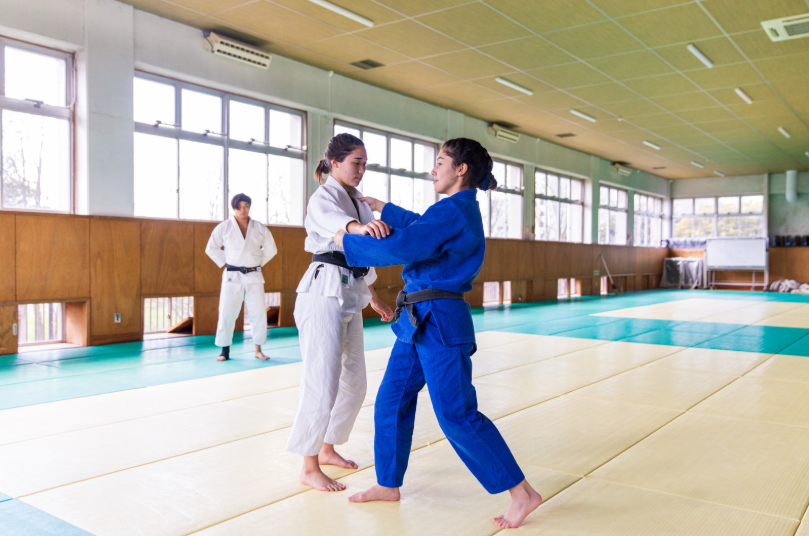
The tatami is often the least visually striking choice, but also the most strategic. It does not immediately communicate “combat,” but it creates the conditions to develop a wide range of activities, from bodyweight training to grappling techniques.
Its strength lies in its versatility: it allows training to be adapted to different levels, goals, and client types, making it a high-return investment over time.
Versatility and service development
With a tatami, it is possible to build a progressive offering, ranging from conditioning to technical work. This allows combat training to be integrated gradually, without forcing a radical change in the business model.
Moreover, the tatami supports activities beyond combat, further increasing its value within a PT studio.
Impact on safety and professional perception
A frequently overlooked aspect is safety. The tatami reduces the risk of injury and allows for more controlled training, especially with inexperienced clients. This increases trust and enhances the perception of professionalism.
A well-designed tatami area communicates order, method, and attention to detail—key elements for building long-term credibility.
Full combat structure: an advanced investment
Full structures, such as cages or multifunctional rigs, represent the highest level of investment. They offer an immersive and highly specialized experience but require space, budget, and a clearly defined business model.
Introducing a full structure too early can result in partial usage and insufficient economic return. It is a decision that must be justified by real demand and a clear strategy.
When it is truly justified
This type of investment makes sense when there is already an established client base and a structured offering. In such cases, the structure becomes a growth and differentiation accelerator.
Without these conditions, it risks becoming an oversized element compared to the actual needs of the studio.
Risks of overinvestment
The main risk is locking space and capital into a rigid, inflexible element. This limits adaptability and makes it harder to correct strategic mistakes.
In a PT context, where flexibility is crucial, this rigidity can become a significant limitation.
Strategic comparison: function, space, and return
When analyzing punching bags, tatami, and full structures in terms of function, versatility, and real usage, a clear hierarchy emerges. The tatami offers the best balance between cost, space, and operational possibilities, while the punching bag and full structures are more specific and restrictive.
The choice should therefore be based not on what “looks more combat,” but on what allows you to work better and grow over time. This approach reduces risk and increases the sustainability of the investment.
Which equipment generates the most real usage
The most effective equipment is the one used most frequently, in more contexts, and with more clients. In this sense, the tatami represents the most efficient starting point.
Punching bags and full structures become relevant only at a later stage, when the offering is already established.
Priorities based on operational scenario
In a small space with a limited budget, priority should be given to versatile and adaptable elements. This maximizes both space and investment efficiency.
In more structured environments, more specific elements can be introduced, but always following a progressive logic.
Where to really start in a combat-oriented PT studio
The most strategic answer is not choosing between a punching bag, tatami, or full structure, but defining an investment sequence. Starting with a tatami allows you to build a solid foundation, onto which more specific elements can be added later.
This approach reduces uncertainty and allows the space to evolve alongside the business, avoiding premature or incoherent investments.
Progressive investment sequence
The ideal path starts with a versatile base, continues with the introduction of specific elements like the punching bag, and culminates—only if necessary—with more complex structures. This progression ensures optimal resource utilization.
Each phase should be justified by real demand and a clear strategic direction.
Building a coherent and scalable space
An effective combat space is not created through a single purchase, but through a coherent and scalable vision. Each element must integrate with the others, creating a functional and credible environment.
Starting the right way means laying the foundations for sustainable growth, avoiding mistakes that could compromise the entire project.
Comments (0)