
Trolley
You have no items in your shopping cart

 Budgets
 Dumbers
 Discs
Discs
 Benches
 Racks and Rigs
 Weights Holders
 Isotonic machines
 Calisthenics
 Cardio
 Kettlebells
 Flooring
 Gym Set
 Accessories
 Combat
 ARTI MARZIALI
 CONTAINER GYM
 Tug-Of-War
 Used Gym Equipment
 PILATES MACCHINARI
 GINNASTICA ARTISTICA
 CAMPI DA PADEL
 Prodotti in Pronta Consegna
 Informazioni
 IRONMAN
 Gift Card
- Donatif
- General information
- 0 I like it
- 1171 Views
- 0 comments
- gym flooring, safety flooring, gym safety, shock-absorbing materials
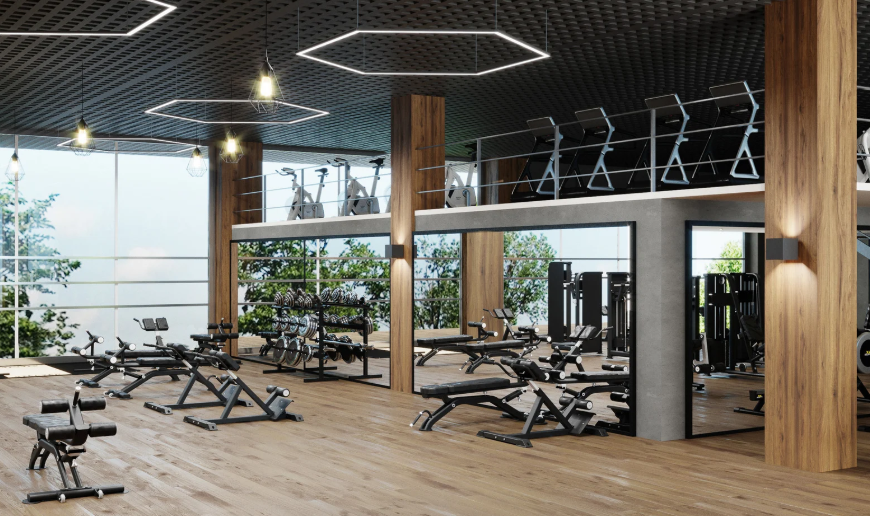
Refurbished Equipment in Gyms: Does Placement Really Matter?
In the debate between new and refurbished gym equipment, one of the most common assumptions is that technical quality is the only real differentiator. In reality, within a gym, customer perception is not uniform: it changes significantly depending on where a machine is placed and how visible that area is. This means that the exact same refurbished machine can be perfectly acceptable in one area and perceived as a limitation in another.
Understanding this dynamic is essential for those who manage or design a fitness center, as it helps avoid a very common mistake: distributing refurbished equipment evenly without considering its impact on the overall perception of the facility. This is not just about aesthetics, but about trust, positioning, and consistency of the user experience.
- Why perception changes between visible and functional areas
- Front-stage areas: where refurbished equipment has the greatest impact
- Back-stage areas: where refurbished equipment is more defensible
- Direct comparison: visibility vs function
- Design strategy: distributing refurbished equipment intelligently
Why perception changes between visible and functional areas
The perception of quality in a gym is never neutral. Users tend to form an overall judgment based on immediate visual elements, often without a deep technical evaluation. This phenomenon is linked to cognitive mechanisms such as the contrast effect and the trust heuristic, which lead people to assess an environment based on what appears most evident and representative.
In this context, the positioning of equipment plays a decisive role. The most visible areas automatically become a benchmark for the perceived quality of the entire fitness center, while more technical or less exposed zones are evaluated using different criteria, more focused on functionality than on image.
The role of visibility in building trust
Highly visible areas, such as the entrance or the cardio zone, directly influence customer trust. Here, a quick and often unconscious evaluation takes place, associating the appearance of equipment with the professionalism of the facility. A refurbished machine, even if perfectly functional, can be perceived negatively if placed in a highly visible context.
This does not mean that refurbished equipment is unsuitable, but rather that it must be managed more carefully. In these areas, every detail contributes to building a coherent and reassuring image, and any element perceived as “less new” can disrupt that balance.
Function vs image: two different logics within the same space
Within a gym, two logics coexist: visual experience and functionality. In visible areas, the former prevails, while in operational zones, the latter dominates. Ignoring this distinction leads to ineffective decisions, especially when introducing refurbished equipment.
A conscious approach requires clearly distinguishing between spaces where visual impact matters and those where performance is the priority. Only in this way can refurbished equipment be leveraged without compromising overall perception.
Front-stage areas: where refurbished equipment has the greatest impact
Front-stage areas are those most exposed to the customer’s view and represent the “business card” of the gym. Here, attention to perceived quality is at its highest, and every element contributes to defining the identity of the facility.
In these spaces, the use of refurbished equipment must be evaluated with extreme caution, because the risk is not technical but reputational. Even minimal differences can be amplified by visibility and influence the overall judgment.
Cardio area and entrance: the first visual impact
The cardio area is often the most visible and frequently used, as well as the one many users immediately associate with the idea of a modern gym. Expectations here are high and oriented toward an image of innovation and care.
Introducing refurbished equipment in this area can only work if its aesthetic level is indistinguishable from new. Otherwise, the risk is creating a dissonance that negatively affects the perception of the entire facility.
Comparison effect and implicit expectations
In visible areas, users automatically compare different pieces of equipment. If some appear visually less “recent,” customers tend to extend that perception to the entire equipment fleet, even irrationally.
This effect makes the front-stage particularly sensitive to the use of refurbished equipment, as it amplifies differences and reduces tolerance margins. Therefore, choices must always align with the gym’s positioning.
Back-stage areas: where refurbished equipment is more defensible
Back-stage areas are less exposed and often dedicated to more technical or specific uses. In these spaces, the customer’s attention shifts from form to substance, prioritizing functionality over aesthetics.
This makes refurbished equipment a much more defensible choice, both economically and perceptually. Here, the value of equipment is mainly linked to its operational effectiveness.
Technical and strength zones: function comes first
In areas dedicated to strength training or more technical exercises, users are generally more experienced and less influenced by visual appearance. What matters is stability, precision, and safety.
In this context, refurbished equipment can be an optimal solution, as it allows high functional standards while reducing initial investment.
Acceptance margin and real user behavior
The acceptance margin for refurbished equipment increases significantly in less visible areas. Users tend to be more tolerant and focus on practical use, reducing the importance of aesthetics.
This behavior makes the back-stage a strategic area for introducing refurbished equipment, enabling resource optimization without compromising the overall experience.
Direct comparison: visibility vs function
The comparison between front-stage and back-stage areas highlights a clear difference in how refurbished equipment is perceived. It is not a matter of intrinsic quality, but of context and expectations.
Understanding this distinction is crucial to avoid distribution errors that can compromise both reputation and investment effectiveness.
Perceptual differences and tolerance thresholds
In visible areas, tolerance thresholds are very low: even small signs of “not new” can negatively influence perception. Conversely, in functional zones, tolerance increases, allowing greater flexibility.
This difference should guide design choices, avoiding uniform approaches that ignore perceptual variability.
Impact on reputation and economic decisions
An incorrect distribution of refurbished equipment may generate short-term savings but lead to long-term reputational costs. Conversely, a targeted strategy allows balancing economic efficiency and perceived quality.
The point is not choosing between new and refurbished, but deciding where each option is most effective.
Design strategy: distributing refurbished equipment intelligently
Moving from a uniform approach to a selective distribution represents a paradigm shift in gym design. Not all areas carry the same weight, and this must be reflected in investment decisions.
An effective strategy starts with analyzing visibility and function, then defining where refurbished equipment can be safely introduced and where new equipment is preferable.
From uniform equipment layout to selective logic
The idea of uniformity, often associated with consistency, can be limiting if it does not consider the differences between various gym areas. An intelligent distribution allows each space to be optimized according to its role.
This approach makes it possible to fully leverage refurbished equipment, enhancing it in suitable contexts while minimizing its impact in critical zones.
How to protect image and margins
The challenge is to find a balance between cost control and reputation protection. Using refurbished equipment in the right areas allows maintaining sustainable margins without compromising the gym’s image.
Ultimately, the placement of refurbished equipment is not a secondary detail, but a strategic lever that directly affects customer perception and the success of the project.
Comments (0)