
Trolley
You have no items in your shopping cart

 Budgets
 Dumbers
 Discs
Discs
 Benches
 Racks and Rigs
 Weights Holders
 Isotonic machines
 Calisthenics
 Cardio
 Kettlebells
 Flooring
 Gym Set
 Accessories
 Combat
 ARTI MARZIALI
 CONTAINER GYM
 Tug-Of-War
 Used Gym Equipment
 PILATES MACCHINARI
 GINNASTICA ARTISTICA
 CAMPI DA PADEL
 Prodotti in Pronta Consegna
 Informazioni
 IRONMAN
 Gift Card
- Donatif
- General information
- 0 I like it
- 1066 Views
- 0 comments
- gym flooring, safety flooring, gym safety, shock-absorbing materials
Modular or Multifunctional: When a Small Project Should Already Plan for Growth
In a compact fitness project, the choice between expandable modules and a multifunction machine should not depend only on the available square footage. A small space may truly be final, or it may represent the first phase of an area designed to grow over time. For an installer, designer, or B2B partner, understanding this distinction correctly means avoiding a technically tidy solution today that may become limiting tomorrow.
The point is not to determine whether modular systems are always better than a single machine. In many cases, a compact multifunction station is the most coherent solution because it concentrates functions, simplifies management, and reduces initial complexity. In other scenarios, however, starting with racks, rigs, benches, storage systems, and expandable stations helps protect the investment and create a more flexible growth roadmap.
A Small Project Is Not Always a Closed Project
A common mistake in planning a small fitness area is treating limited space as an absolute constraint. In reality, the initial size tells only part of the story. The type of users, expected usage frequency, possibility of expanding the room, availability of mountable walls, and the commercial evolution of the facility also matter.
For this reason, designers must distinguish between a small space and a closed project. A small space may be stable, with clearly defined functions and no plans for future expansion. Or it may be an initial installation intended to accommodate new stations, accessories, and operational needs over time. In the latter case, an overly compact solution can become a limitation.
Why Initial Space Alone Does Not Define the Architecture
Available floor space helps determine dimensions, clearances, and user flow, but it is not enough to define the overall architecture. A single multifunction machine may solve the startup phase effectively, but if the facility later introduces new services, small group classes, or an expanded strength area, the closed structure may require early replacement.
On the other hand, a modular configuration may appear more complex in the beginning, but it allows new elements to be added without redesigning the entire layout. The value is not only technical but operational as well. It means maintaining continuity between the first installation, future growth, and day-to-day space management.
When Scalability Becomes a Prudent Choice
Scalability becomes a prudent strategy when the client does not yet have stable demand but knows the area may grow in the future. This is common in newly opened gyms, personal training studios, hotel gyms, corporate fitness spaces, or small professional facilities that want to test an initial setup without locking the project into a fixed structure.
In these cases, planning expansion points, accessory compatibility, and a progressive development logic reduces the risk of costly redesigns. This does not mean purchasing everything immediately or forcing an oversized structure from day one. It means designing the first phase as part of a possible long-term sequence.
When It Makes Sense to Start with Expandable Modules
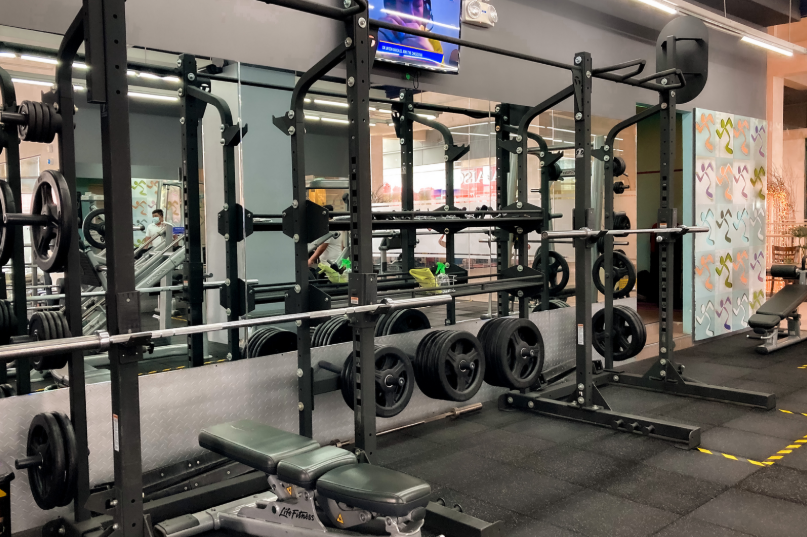
Expandable modules are ideal when the project has a credible growth trajectory. If the fitness area starts with a limited number of users but aims to increase services, training stations, or workout types, a modular structure provides greater flexibility. Racks, rigs, supports, benches, and storage systems can be added gradually while maintaining aesthetic and functional consistency.
This approach is especially useful when the layout must remain organized even after expansion. A well-planned modular installation avoids occupying strategic areas with equipment that later becomes difficult to integrate. The result is a space that grows without losing order, safety, or usability.
Growth Roadmaps and Layout Continuity
An effective roadmap starts with three questions: what is needed immediately, what may be required in a second phase, and which constraints should be avoided today. If the project includes future additions such as new stations, wall-mounted structures, or a larger strength zone, a modular system allows the foundation to remain coherent from the start.
Layout continuity is a practical advantage. Equipment additions are not perceived as random upgrades but as parts of a unified system. This helps the facility maintain a professional appearance and also simplifies the installer’s work because every future phase integrates into a pre-existing logic.
Racks, Rigs, Benches, and Storage as Progressive Elements
A project may evolve more effectively by starting with a rack or a structure prepared for accessories instead of a fully closed multifunction machine. During the first phase, the facility can cover essential exercises with a basic setup. Later, it can add benches, pull-up systems, supports, complementary stations, and storage solutions.
Storage should never be considered secondary. In compact spaces, organization and accessibility determine the real quality of the area. Planning from the beginning where plates, barbells, dumbbells, and accessories will be stored prevents improvised clutter and makes future expansion much easier.
When a Single Machine Remains the Most Coherent Choice
A multifunction machine remains a very solid choice when the project is stable, the number of users is controlled, and no major expansions are expected. In these situations, concentrating multiple functions into a single structure can make the area easier to manage and more intuitive to use.
It is also a coherent solution when the client wants a straightforward configuration with fewer variables and predictable maintenance. For hotels, small corporate gyms, residential fitness areas, or secondary workout spaces, a multifunction station can provide an effective balance between footprint, functionality, and operational control.
Simplified Management and Area Control
A single machine reduces spatial fragmentation. Users find a central station with concentrated functions and more intuitive workout flows. This can be particularly important when no technical staff is constantly present or when the area must remain organized with limited supervision.
From a design perspective, simplicity has value. Fewer separate elements mean fewer decisions regarding positioning, compatibility, and future integration. If the project does not require phased growth, choosing a complete machine can prevent unnecessary complexity.
Intended Use, User Profile, and Training Frequency
The decision must reflect the actual users. If the area serves a general audience with guided workouts and basic exercise needs, a multifunction machine may be more suitable than an open modular system. It provides a recognizable structure and reduces the risk of improper use.
If the user base is more technical, diverse, or expected to grow, modular solutions become more attractive. A facility planning for personal training, barbell work, strength progression, and specialized accessories will rarely remain satisfied with a single closed machine in the long term.
How to Avoid Design Mistakes in the Early Stages
The main risk is confusing prudence with rigidity. Starting small does not necessarily mean choosing the most closed solution available. At the same time, scalability should not become an excuse to overcomplicate a simple project. The correct decision comes from understanding the context, not from an abstract preference for modular or multifunction equipment.
Good planning evaluates the initial phase, growth margin, and recommended architecture together. If the project is expected to remain compact, a single machine may be the most rational foundation. If there is a credible growth trajectory, expandable modules help protect the investment and avoid future redesigns.
Growth Margins, Technical Constraints, and Future Costs
Growth margins must be evaluated before the purchase, not after. Available walls, floor load capacity, ceiling height, pathways, machine power requirements, and safety clearances all influence the decision. An expandable system requires more careful planning, but it can reduce future costs if expansion is likely.
A single machine may instead be more efficient when future modification costs are irrelevant because no evolution is expected. The goal is to avoid a choice that appears economical during the first phase but later creates replacements, relocations, or compatibility problems.
A Decision Based on the Project, Not the Size
The correct question is not: “the space is small, so which equipment takes up less room?” The more useful question is: “should this space remain the same, or should it be able to grow?” This is where a more mature evaluation between closed architecture and expandable architecture begins.
For installers and designers, this distinction protects the final outcome. It allows them to propose a proportional solution without pushing unnecessary scalability or defaulting to a single machine out of habit. A small area can remain simple without necessarily becoming restrictive.
Comments (0)