
Trolley
You have no items in your shopping cart

 Budgets
 Dumbers
 Discs
Discs
 Benches
 Racks and Rigs
 Weights Holders
 Isotonic machines
 Calisthenics
 Cardio
 Kettlebells
 Flooring
 Gym Set
 Accessories
 Combat
 ARTI MARZIALI
 CONTAINER GYM
 Tug-Of-War
 Used Gym Equipment
 PILATES MACCHINARI
 GINNASTICA ARTISTICA
 CAMPI DA PADEL
 Prodotti in Pronta Consegna
 Informazioni
 IRONMAN
 Gift Card
- Donatif
- General information
- 0 I like it
- 3295 Views
- 0 comments
READING TIME: 10 MINUTES ➤➤
In an era in which the pursuit of well-being has become a collective priority, rediscovering the roots of what we now consider “mindful fitness” can offer a surprising perspective. Joseph Pilates, the creator of the method that bears his name, is a figure who continues to inspire thousands of enthusiasts around the world thanks to an approach that combines physical discipline, mental balance, and body awareness. But who was this man really? And why, a century later, has his method not lost its power—in fact, why does it seem more relevant today than ever?
In this article we will tell the story of a visionary of movement, exploring not only his origins but also the legacy he left behind and the evolution of a system that, while remaining faithful to its principles, has crossed different eras and cultures. Because knowing the past gives depth to the present — and, in the case of Pilates, it allows us to rediscover authenticity in a world that is often far too noisy.
- The roots of a legendary method
- The foundational principles of Pilates
- A legacy that traveled around the world
- Why Pilates is still relevant
The roots of a legendary method
Joseph Pilates: the man behind the method
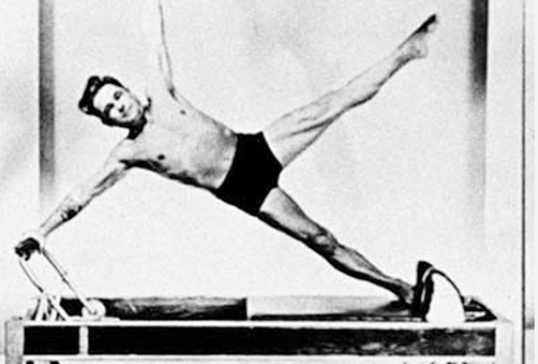
Joseph Hubertus Pilates was born in 1883 in Germany, in a context marked by childhood health problems that pushed him, from an early age, to take a deep interest in how the human body works. Suffering from asthma, rickets, and rheumatic fever, he began a self-taught journey that led him to study anatomy, yoga, martial arts, and gymnastics. This intense and personal research became the seed of a revolutionary method designed not only to strengthen the body but also to harmonize it with the mind.
Despite his modest origins, Pilates quickly developed a clear vision of psychophysical balance, which would later become the cornerstone of his method. His determination to transform weakness into strength, and suffering into awareness, has made his story a source of inspiration for entire generations.
From Germany to imprisonment: the birth of an intuition
During the First World War, Joseph Pilates was interned in a prison camp in the United Kingdom. It was precisely in that hostile and restrictive environment that he began developing the fundamental principles of his method, using bed springs and other improvised tools to help fellow prisoners maintain physical fitness. This phase was crucial: the method was born from a real need, in extreme conditions, immediately proving its adaptive and functional power.
At the end of the war, after returning to Germany, Pilates further refined his technique, even presenting it to the Hamburg police. But the turning point came with his emigration to the United States, where he would find the fertile ground needed to transform his method into a global movement.
The first studio in New York and success among dancers
In 1926, together with his wife Clara, Joseph opened the first Pilates studio in New York, in the same building that housed several dance schools. The method quickly spread among renowned dancers and choreographers, thanks to its ability to strengthen the body without making it rigid, preventing injuries and improving posture. Personalities such as George Balanchine and Martha Graham recognized the value of Pilates’ work, helping legitimize it within the artistic world.
This connection with dance deeply influenced the perception of the method, making it synonymous with grace, precision, and awareness. From a rehabilitation tool during wartime to a refined discipline at the heart of New York’s artistic scene, Pilates established itself as a truly unique practice.
The foundational principles of Pilates
Control, concentration, centering
At the core of the Pilates method are six key concepts that Joseph referred to as the “principles of control.” Among these, control represents the absolute foundation: every movement must be executed with precision, avoiding automatism and compensation. It is a philosophy of “less is more,” where quality prevails over quantity.
Concentration is what distinguishes Pilates from other forms of physical exercise: the practitioner is called to bring attention to every gesture, every breath, and every internal sensation. This constant focus allows a genuine connection with the body to develop. Finally, centering (or powerhouse) refers to the central area of the body, including the abdomen, glutes, lower back, and inner thighs: every movement begins from this point according to a functional and biomechanically correct logic.
Breathing, fluidity, and precision
Breathing in the Pilates method is not merely mechanical support but an active tool for enhancing body awareness. Breathing in coordination with movement helps maintain rhythm, support the center, and reduce tension. Joseph insisted on the importance of “fully expelling the air” to cleanse the lungs and give the body renewed energy.
Fluidity and precision complete the framework of the fundamental principles: every exercise should have a clear beginning, development, and conclusion, without abrupt or interrupted movements. This elegant and measured approach makes Pilates resemble a slow dance, yet one that is profoundly transformative. It is not just any form of exercise: it is an art of movement that teaches the body to move better, both inside and outside the practice room.
The original method: what still distinguishes it today
Despite the explosion of modern variations, classical Pilates — the version faithfully inspired by Joseph’s teachings — still retains an unmatched strength and coherence. The sequence of exercises, the quality of teaching, and the meticulous attention to technique are all designed to build a harmonious, strong, and flexible body.
This attention to detail, this fidelity to a time-tested system, is what still makes it revolutionary today. In an era of intense workouts and fleeting fitness trends, classical Pilates offers a return to the essence: mindful and transformative movement. And the fact that it was born more than one hundred years ago yet continues to attract new practitioners every day confirms its timeless value.
A legacy that traveled around the world
The direct students and the transmission of the method
After Joseph Pilates’ death in 1967, his method was carried forward by a group of his most loyal students, often referred to as “The Elders”. Among them were teachers such as Romana Kryzanowska, Carola Trier, and Kathy Grant, each of whom helped pass on the method while preserving its original spirit. These direct students were crucial in preserving the integrity of classical Pilates, and many current schools can trace their teaching lineage back to them.
The legacy of the Pilates method is therefore not only technical but also ethical and philosophical. Teaching Pilates does not simply mean transmitting exercises, but conveying an approach to health and well-being that involves the entire person. This has helped create a strong and passionate community, often very attentive to faithfulness to the original method.
From the original studio to global diffusion
From the small New York studio, the Pilates method has experienced steady growth around the world. In the 1980s and 1990s, the fitness boom also brought greater commercialization of the method, with group classes and adaptations often far removed from the original approach. At the same time, however, certified schools emerged that committed themselves to keeping the authentic heart of Pilates alive, offering rigorous and in-depth training programs.
Today Pilates is practiced on every continent, both in specialized studios and in fitness centers, hospitals, and dance schools. Its versatility makes it accessible to all ages and physical conditions, but its history continues to hold a particular fascination for those seeking a deep connection between body and mind.
Pilates today: schools, certifications, and fidelity to the method
In a global landscape rich with different approaches and influences, many schools have chosen to anchor themselves firmly to the roots, offering certification programs that strictly follow the original teachings. Training with a certified method means learning a complete, coherent, and transformative discipline, far removed from the simplifications often proposed in general fitness courses.
Faithfulness to the method is not a form of nostalgia but a conscious choice: the decision to embrace a tradition that has proven its effectiveness through decades of real practice. It is precisely this combination of rigor and relevance that makes classical Pilates a valuable resource for those seeking quality, authenticity, and lasting results.
Why Pilates is still relevant
A method that speaks to both body and mind
In the daily chaos of modern life, the Pilates method presents itself as a form of mindful resistance. It is not just about training muscles, but about reconnecting with oneself through movement. In a world that often separates body and mind, Pilates offers a space of integration: every exercise becomes a moment of presence, listening, and rediscovery of one’s center.
This holistic dimension makes it extremely contemporary: today more than ever there is a need for practices that are not only functional but also meaningful. Pilates, with its precise language and harmonious structure, teaches us how to live better within our bodies, making them stronger, more flexible, and more aware.
Authenticity and a return to origins in contemporary fitness
In recent years, the fitness landscape has seen a real “hunger for authenticity”. More and more people are moving away from standardized programs and seeking paths that have history, coherence, and vision. In this sense, the Pilates method represents a conscious and countercultural choice: it is not only effective, but also rich in meaning.
Returning to the origins does not mean rejecting progress, but selecting what truly has value. And the success of Pilates today is clear evidence: its effectiveness is not the result of marketing, but of time, practice, and the depth of its philosophical foundation. It is a discipline that has managed to cross eras while remaining faithful to itself.
Pilates as a modern response to stress and sedentary lifestyles
The digital age has brought enormous advantages, but also new challenges for the human body: sedentary lifestyles, chronic tension, and mental stress. Pilates stands as an intelligent response to all of this: by working on posture, breathing, and motor control, it directly counteracts the negative effects of modern life.
Moreover, regular practice of the method promotes stress reduction, improved sleep quality, and increased awareness. There is no need to “destroy yourself” at the gym to achieve benefits: sometimes it is enough to breathe, move with intention, and restore balance. In this sense, Pilates is not only relevant — it is necessary.
Comments (0)