







Trolley
You have no items in your shopping cart
 Budgets
 Dumbers
 Discs
Discs
 Benches
 Racks and Rigs
 Weights Holders
 Isotonic machines
 Calisthenics
 Cardio
 Kettlebells
 Flooring
 Gym Set
 Accessories
 Used Gym Equipment
 Combat
 ARTI MARZIALI
 Tug-Of-War
 CAMPI DA PADEL
 PILATES MACCHINARI
 GINNASTICA ARTISTICA
 Gift Card
 Informazioni
- Donatif
- Sports products
- 0 I like it
- 5 Views
- 0 comments
READING TIME: 5 MINUTES ➤➤
Budget Home Gym: Set Up the Perfect Workout Space at Home
Creating a functional and efficient home gym for under €200 is not only possible but can become a long-term investment in your health, motivation, and lifestyle. In this complete guide, you'll discover how to best organize your space, which equipment to choose, and how to set up effective routines to achieve professional results—without giving up the comfort of your home.
- Why choose a home gym: long-term benefits
- Small spaces, big results: how to organize your home gym
- Essential equipment to start for under €200
- At-home workouts: effective routines even without equipment
- Home fitness ROI: savings and measurable results
Why choose a home gym: long-term benefits
Investing in yourself: commitment that pays off
Setting up a home gym is much more than a financial choice. It's a commitment to yourself—a clear step toward prioritizing your health. Even a small investment creates a strong psychological connection: what you pay for, you value more. Having your own equipment at home encourages consistent use, making workouts more accessible and customizable, without excuses about time or travel.
Control, convenience, and status: the gym becomes part of your home
A home gym gives you full control over your workout environment: flexible hours, no waiting for machines, no loud music or prying eyes. It's also a way to elevate your status—owning a personalized fitness space reflects independence, organization, and self-care. Transforming part of your home into a gym sends a message of value, efficiency, and an active lifestyle.
Small spaces, big results: how to organize your home gym
Where to set up your home gym
You don’t need a large room to create an effective home gym. A corner of the living room, a garage nook, or even a hallway can become a functional workout area. Choose a space with good ventilation, safe flooring, and—if possible—mirrors to check your form. Motivation often starts with a pleasant environment, so pick a spot that inspires and makes you feel comfortable.
Maximizing every inch: space-saving solutions
On a limited budget and with tight space, every inch counts. Foldable equipment, adjustable benches, and wall-mounted supports allow for complete workouts without clutter. Roll-up mats, resistance bands, and adjustable dumbbells are great space-saving options. The goal is to maximize functionality while minimizing bulk, creating a gym that’s always ready without being invasive.
Essential equipment to start for under €200
Bodyweight and multifunctional tools: start with the basics
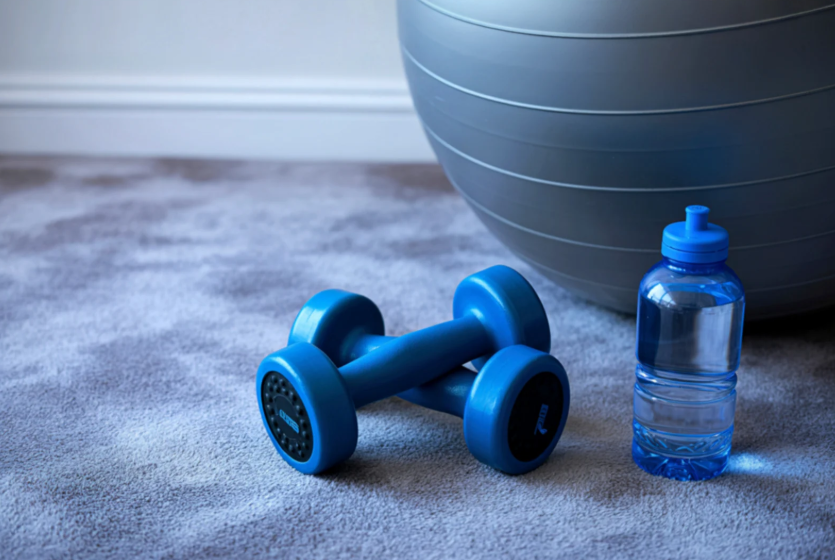
You only need a few tools to get started—if chosen wisely. Bodyweight training is one of the most effective foundations and can be enhanced with multifunctional equipment. A set of resistance bands (€15–30), a pair of adjustable dumbbells (€40–60), a jump rope (€5–10), and a non-slip mat (€20) are all you need to build complete routines—from cardio to muscle toning.
What to buy first: priorities and smart budgeting
With a budget under €200, it’s crucial to set priorities. Start with tools offering the widest range of exercises. A TRX or suspension system (€30–40) is a valuable investment to work the whole body using your own weight. Add a step platform (€20–25) and a kettlebell (€20–30), and you’ll cover a wide range of movements. The aim isn’t to have everything at once but to build a solid, versatile foundation.
At-home workouts: effective routines even without equipment
Scheduling sessions to stay consistent
One key to successful at-home training is having a plan. Create a weekly schedule with fixed days and times to maintain consistency. Set micro-goals (e.g., 3 workouts per week) and alternate between training types: strength, cardio, mobility. A defined routine brings structure and reduces the chance of skipping sessions.
Essential bodyweight exercises
If you're just starting out or working with limited space, bodyweight exercises are a great way to build strength and endurance. Moves like squats, lunges, push-ups, planks, and jumping jacks require no equipment but offer full-body benefits when done correctly. Using timed intervals (like HIIT) can boost calorie burn, tone muscles, and improve overall fitness—without ever leaving your home.
Home fitness ROI: savings and measurable results
Comparing gym memberships vs. home gyms
Spending less than €200 on a home gym equals about 2–3 months of a standard gym membership. But while memberships expire, equipment lasts—and becomes more cost-effective over time. The ability to train daily, anytime, significantly increases the use of your investment. In a year, you could save over €500—not to mention the time saved on commuting and prep.
Your gym, your rules: customization and motivation
With your own personal gym, you set the rules: music, temperature, workout style. This control boosts motivation, as the experience becomes entirely yours. Personalization also deepens your connection to the activity—when a space reflects your identity, it’s easier to use it regularly. The real ROI isn’t just financial—it’s also about well-being, energy, and self-confidence.
Comments (0)