
Trolley
You have no items in your shopping cart

 Budgets
 Dumbers
 Discs
Discs
 Benches
 Racks and Rigs
 Weights Holders
 Isotonic machines
 Calisthenics
 Cardio
 Kettlebells
 Flooring
 Gym Set
 Accessories
 Combat
 ARTI MARZIALI
 CONTAINER GYM
 Tug-Of-War
 Used Gym Equipment
 PILATES MACCHINARI
 GINNASTICA ARTISTICA
 CAMPI DA PADEL
 Prodotti in Pronta Consegna
 Informazioni
 IRONMAN
 Gift Card
- Donatif
- Sports products
- 0 I like it
- 1594 Views
- 0 comments
- gym flooring, safety flooring, gym safety, shock-absorbing materials
READING TIME: 5 MINUTES ➤➤
Elliptical vs Treadmill: Which One Should You Choose for Home?
Choosing between an elliptical trainer and a treadmill is one of the most common dilemmas for anyone looking to create a home fitness space. Both machines provide effective cardiovascular workouts, but they differ significantly in terms of movement, footprint, comfort, and training outcomes. Understanding these differences can help you avoid purchasing equipment that doesn't suit your needs and make a more informed long-term investment.
The ideal choice does not depend on one machine being universally better than the other, but rather on the relationship between your goals, available space, and workout habits. By analyzing the main practical aspects, it becomes easier to identify the best compromise between performance, convenience, and daily usability.
- The Main Differences Between an Elliptical and a Treadmill
- Joint Impact and Workout Comfort
- Which Machine Best Supports Your Fitness Goals
- Space Requirements, Footprint, and Home Convenience
- Which One Should You Choose Based on Your Profile?
- How to Make the Right Decision
The Main Differences Between an Elliptical and a Treadmill
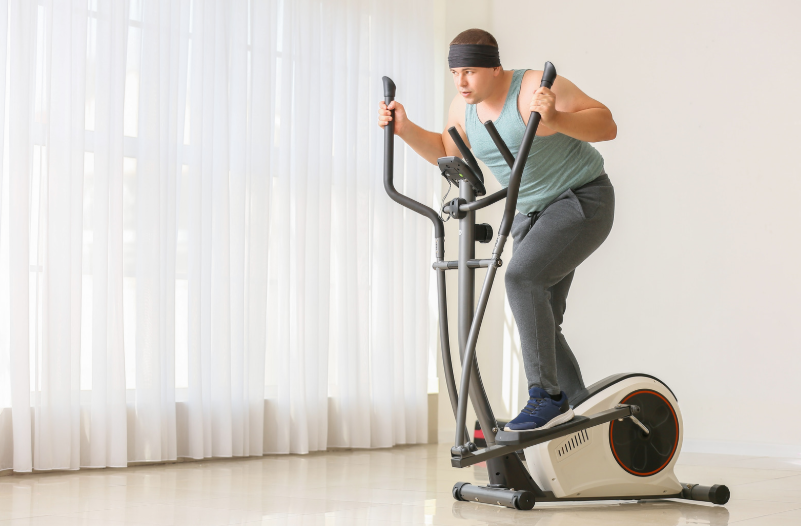
The most obvious difference concerns the type of movement. A treadmill replicates walking or running, offering a natural motion that is immediately familiar to most people. An elliptical trainer, on the other hand, uses a guided path that combines leg movement with upper-body engagement through moving handlebars. This creates a smooth, continuous motion that reduces sudden impact forces.
From a workout experience perspective, treadmills are generally perceived as more dynamic and closer to outdoor activities. Ellipticals provide a greater sense of stability and control, making them especially appealing to users who want regular cardio sessions without placing excessive stress on the body. Both machines can improve overall fitness, but they do so in different ways.
Joint Impact and Workout Comfort
One of the most frequently researched aspects of the elliptical vs treadmill comparison is joint impact. While running on a treadmill, every foot strike generates force that is absorbed by the ankles, knees, and hips. Modern treadmills feature effective cushioning systems, but the movement remains more demanding than that of an elliptical trainer.
The elliptical is often considered a low-impact solution because the feet remain in constant contact with the pedals. This feature can be particularly beneficial for beginners, individuals carrying extra weight, or those returning to exercise after a period of inactivity. The continuous motion reduces stress on the joints and allows for longer workouts with a greater sense of comfort.
Which Machine Best Supports Your Fitness Goals
Weight Loss and Calorie Burn
If your primary goal is weight loss, both machines can be highly effective when used consistently. Calorie expenditure depends mainly on workout intensity, duration, and frequency. A treadmill used for high-intensity running can produce a significant calorie burn, especially during interval training sessions.
Thanks to the simultaneous involvement of the upper and lower body, the elliptical can also deliver excellent muscular engagement. For many users, its greater comfort encourages longer and more frequent workouts, which can positively influence body composition goals over time.
Cardiovascular Endurance and Workout Consistency
Both machines are excellent tools for improving cardiovascular fitness. A treadmill allows users to easily adjust speed and incline, simulating different terrains and training conditions. This makes it particularly attractive to those who enjoy walking or running and want a more specific training experience.
The elliptical stands out for its ability to maintain a steady and controlled effort level. Many users find it easier to incorporate into their daily routine because of the reduced perceived joint stress. Consistency is often the key factor in achieving long-term fitness results.
Space Requirements, Footprint, and Home Convenience
Available space is one of the factors that most strongly influences the final decision. A folding treadmill can be an excellent option for smaller apartments because it can be stored more easily after use. However, it still requires adequate floor space and a safety area around the machine while in operation.
Modern compact ellipticals are designed to fit more comfortably into home environments, although they generally do not offer the same folding capability as many treadmills. Before purchasing, it is advisable to carefully check dimensions, ceiling height requirements, and the space needed for full movement. Evaluating these factors in advance helps avoid usability issues and improves the overall experience.
Which One Should You Choose Based on Your Profile?
Busy Professional
People with limited time often look for workouts that are easy to start and simple to integrate into a busy schedule. In this case, the choice depends largely on personal preference. Those who enjoy walking or running may find a treadmill more motivating, while users seeking a lower-impact option may prefer an elliptical trainer.
Consistency matters more than the type of machine itself. Regularly using equipment you genuinely enjoy will generally produce better results than investing in a theoretically perfect machine that rarely gets used.
Beginner
Beginners often appreciate the elliptical because of its ease of use and smooth movement pattern. The feeling of stability and reduced joint impact can encourage a gradual and sustainable introduction to exercise.
A treadmill remains an excellent option for those who want to replicate a natural movement pattern and progressively improve their walking or running ability. The important thing is to start with programs that match your current fitness level.
Family with Multiple Users
When fitness equipment is shared among several people, versatility becomes a key consideration. Treadmills offer an intuitive workout experience suitable for users of different ages and fitness levels. Walking is, after all, an activity accessible to nearly everyone.
An elliptical can be equally suitable when users are looking for low-impact workouts and a machine that supports regular use. Considering the needs of the person who will use the equipment most frequently can help guide the decision.
How to Make the Right Decision
Choosing between an elliptical trainer and a treadmill should begin with three fundamental questions: What is your primary fitness goal? How much space do you have available? Which movement feels more enjoyable to you? If you want to simulate walking and running, a treadmill is the most natural option. If you prioritize joint comfort and smooth movement, an elliptical may offer significant advantages.
For most home users, there is no universally correct answer. The best machine is the one that will be used consistently for months and years. By carefully evaluating your goals, available space, and personal preferences, you can reduce uncertainty and choose the solution that best fits your home fitness needs.
Comments (0)