








Trolley
You have no items in your shopping cart
 Budgets
 Dumbers
 Discs
Discs
 Benches
 Racks and Rigs
 Weights Holders
 Isotonic machines
 Calisthenics
 Cardio
 Kettlebells
 Flooring
 Gym Set
 Accessories
 Used Gym Equipment
 Combat
 ARTI MARZIALI
 Tug-Of-War
 CAMPI DA PADEL
 PILATES MACCHINARI
 GINNASTICA ARTISTICA
 Gift Card
 Informazioni
- Donatif
- Sports products
- 0 I like it
- 20 Views
- 0 comments
- stress reduction, improved self-esteem, physical and mental well-being, gym training
READING TIME: 5 MINUTES ➤➤
Parallel Bars vs Walkers: when to choose a fixed structure in rehabilitation
In the process of recovering assisted walking, choosing between fixed parallel bars and walkers represents a strategic decision that directly impacts the effectiveness of treatment. It is not simply about preferring one tool over another, but about understanding which solution ensures the best balance between safety, motor control, and functional progression.
parallel bars for rehabilitation and walkers meet different, often complementary needs, but are deeply distinct from both a biomechanical and therapeutic perspective. Analyzing these differences allows healthcare professionals to design more precise rehabilitation pathways, reducing risks and improving clinical outcomes in the medium to long term.
- Structural differences between fixed parallel bars and walkers
- The role of stability in gait retraining
- Clinical applications of fixed parallel bars
- Limitations and advantages of walkers
- How to choose the most effective solution
Structural differences between fixed parallel bars and walkers
The differences between parallel bars and walkers start from a key element: the mechanical structure. Fixed parallel bars are designed to provide continuous and stable support, anchored to the ground, eliminating any variable related to the movement of the aid itself. This allows the patient to focus exclusively on the motor gesture, without having to manage instability or sudden adjustments.
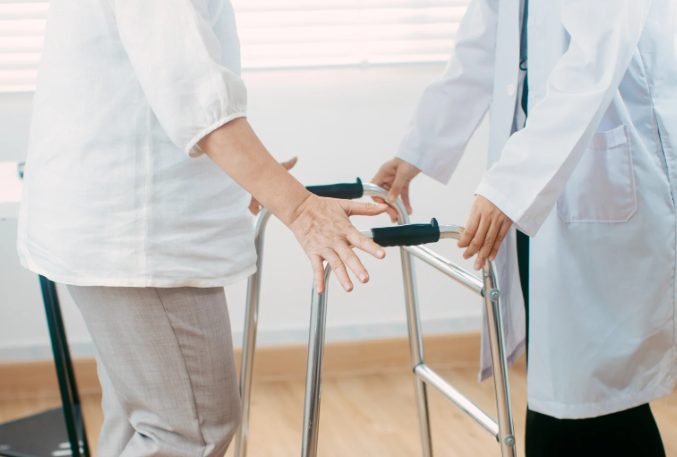
On the other hand, walkers introduce a dynamic component that requires a higher level of coordination. The device moves together with the patient, making it necessary to control both the body and the tool simultaneously. This feature can be useful in advanced stages, but in the early phases of rehabilitation it often represents an additional layer of complexity.
Mechanical stability and movement constraints
The structural stability of parallel bars makes it possible to create a controlled environment where patients can experiment with movement without the risk of losing balance. This positive constraint supports motor learning, especially in individuals with neurological or post-traumatic deficits.
The presence of a symmetrical double support also allows for even load distribution, facilitating the recovery of correct motor patterns. In this context, stability is not a limitation but an accelerator of the rehabilitation process.
Freedom of movement in mobile supports
Walkers offer greater freedom, but they also require a higher level of control. The patient must be able to manage the device while walking, coordinating movements and continuous adjustments. This makes them more suitable for a transitional phase toward autonomy.
However, in the absence of adequate motor control, this freedom can lead to instability and compensatory movement patterns, slowing down the recovery process rather than supporting it.
The role of stability in gait retraining
Mechanical stability is one of the most critical factors in gait retraining. In the initial phase, the patient needs a predictable environment where each movement can be performed without external interference. Fixed parallel bars perfectly meet this need, offering a safe and controlled setting.
This level of stability allows the nervous system to focus on movement quality, facilitating neuromotor reorganization. In the context of neurological physiotherapy, this aspect is essential for restoring compromised functions.
Motor control and patient safety
Motor control is closely linked to the perception of safety. When patients feel stable, they are more likely to perform complete and correct movements. Parallel bars reduce the risk of falls and allow therapists to intervene precisely during gait execution.
This condition promotes faster learning and reduces fear of movement, a factor often underestimated but crucial to rehabilitation success.
Reduction of incorrect compensatory patterns
In the presence of instability, the body tends to activate compensatory strategies that, over time, can become dysfunctional. Fixed parallel bars limit these compensations, guiding the patient toward a more correct execution of the motor gesture.
This approach helps build solid foundations for subsequent rehabilitation phases, preventing errors that could compromise functional recovery.
Clinical applications of fixed parallel bars
Parallel bars are used in numerous clinical contexts, particularly in neurological and post-operative rehabilitation. In these scenarios, the need to ensure stability and control takes priority over mobility.
The ability to modulate load and work in a protected environment makes this tool essential in the early stages of recovery, when the patient is not yet able to manage a dynamic support.
Neurological and post-operative physiotherapy
In neurological patients, such as those affected by stroke or spinal injuries, the stability provided by parallel bars allows work on basic motor patterns in complete safety. This facilitates the recovery of motor functions and reduces the risk of regression.
In orthopedic settings, after surgical procedures, parallel bars allow a gradual return to weight-bearing, avoiding excessive stress on the involved structures.
Early stages of assisted walking
During the early stages of assisted walking, the patient needs a stable support that enables confidence and control. Parallel bars represent the ideal starting point for this process.
Only after consolidating basic skills should more dynamic tools such as walkers be introduced, within a framework of functional progression.
Limitations and advantages of walkers
Walkers represent a versatile solution, but they are not always appropriate in the early stages of rehabilitation. Their main advantage is mobility, allowing patients to move independently in broader environments.
However, this same feature requires greater control and coordination, making them less suitable for patients with significant motor impairments.
When mobile support becomes useful
Walkers become particularly useful when the patient has already achieved good stability and needs to transfer learned skills into a more dynamic context. At this stage, the device supports the transition toward greater autonomy.
Their use must always be guided by careful clinical evaluation to avoid premature introduction that could compromise outcomes.
Transition toward functional autonomy
The main function of the walker is to support the patient in achieving autonomy. However, this transition must occur gradually and in a controlled manner, starting from a solid foundation built with stable tools.
Proper integration of parallel bars and walkers means optimizing the rehabilitation pathway while respecting the patient’s timing and capabilities.
How to choose the most effective solution based on the patient
The choice between parallel bars and walkers must be based on a thorough clinical evaluation, considering the patient’s condition, rehabilitation goals, and stage of the therapeutic pathway. There is no universal solution, only a tailored approach.
Parallel bars represent the ideal starting point when the priority is recovering motor control and safety. Walkers, on the other hand, come into play in later stages when mobility and autonomy become the focus.
Clinical evaluation and rehabilitation goals
Every decision must be guided by objective parameters such as balance level, muscle strength, and coordination ability. Only through detailed analysis is it possible to identify the most suitable tool.
An approach based on technical expertise and clinical observation allows maximizing treatment effectiveness and reducing recovery time.
Progressive integration of tools
The integration of parallel bars and walkers represents the most effective strategy to guide the patient throughout the rehabilitation journey. Progression must be gradual, respecting individual capabilities and therapeutic goals.
In this sense, mechanical stability is not only a starting point but the foundation on which to build a solid and lasting recovery, oriented toward full patient autonomy.
Comments (0)