
Trolley
You have no items in your shopping cart

 Budgets
 Dumbers
 Discs
Discs
 Benches
 Racks and Rigs
 Weights Holders
 Isotonic machines
 Calisthenics
 Cardio
 Kettlebells
 Flooring
 Gym Set
 Accessories
 Combat
 ARTI MARZIALI
 CONTAINER GYM
 Tug-Of-War
 Used Gym Equipment
 PILATES MACCHINARI
 GINNASTICA ARTISTICA
 CAMPI DA PADEL
 Prodotti in Pronta Consegna
 Informazioni
 Gift Card
- Donatif
- Sports products
- 0 I like it
- 1 Views
- 0 comments
- gym flooring, safety flooring, gym safety, shock-absorbing materials
READING TIME: 5 MINUTES ➤➤
Loop Bands vs Flat Resistance Bands: When to Use One or the Other
Choosing between loop bands and flat resistance bands may seem like a minor detail, but in practice it can significantly affect how an exercise is performed. Both rely on elastic resistance, both are useful for home workouts, athletic preparation, and mobility training, yet they are not interchangeable in every situation. The difference is not just about shape, but also about grip, stability, movement control, and the freedom to adjust tension.
For beginners, runners, or home fitness enthusiasts with basic experience, the main question is often straightforward: which type of band is best for the exercise I want to perform? The answer is not to choose the “most complete” product, but to understand when a loop band makes an exercise simpler and more controlled, and when a flat resistance band provides greater versatility. In this comparison, we’ll examine the functional differences in practical terms to help reduce the risk of choosing the wrong training tool.
Functional Differences Between Loop Bands and Flat Resistance Bands
Shape, Grip, and Movement Management
Loop bands are closed bands designed to be placed around the legs, ankles, knees, or arms. Their shape makes them particularly practical for exercises that require stable and continuous resistance without the need to hold the band or tie knots. They are especially effective for muscle activation, knee control, pelvic stability, and strengthening the glutes and hips.
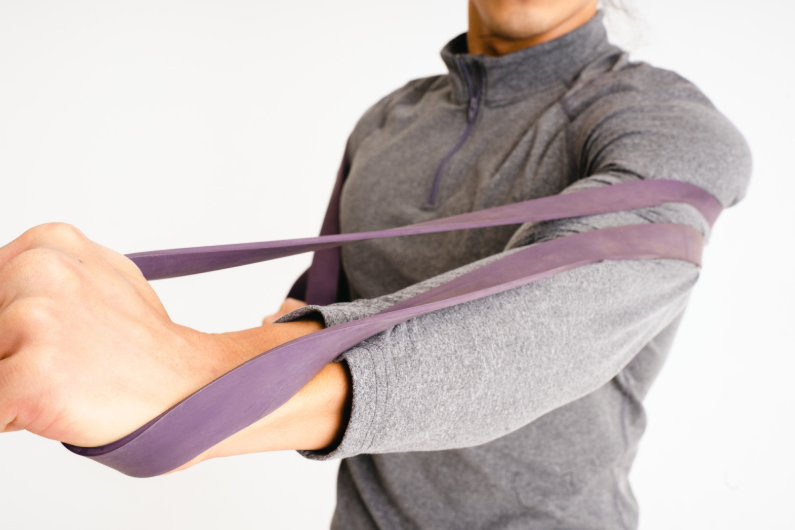
Flat resistance bands, on the other hand, are open-ended and generally longer. They can be held, wrapped, anchored under the feet, or used with handles depending on the model. This flexibility makes them suitable for pulling exercises, mobility work, stretching, and upper-body strengthening. However, they require more attention to grip and positioning because tension depends heavily on how much the band is shortened or stretched during movement.
Resistance Type and Exercise Control
With a loop band, resistance is immediate and easy to feel. Once positioned, the band stays in place and provides a predictable level of tension throughout the movement. This helps users focus on exercise quality without constantly adjusting their grip. For exercises such as lateral walks, squats with abduction, or glute activation drills, loop bands provide a valuable sense of control.
Flat resistance bands offer greater freedom in adjusting exercise difficulty. Simply changing the working length of the band, increasing initial tension, or modifying the anchor point can make an exercise easier or more challenging. This is a significant advantage for progressive training, although it can create uncertainty for beginners. For this reason, it is important to evaluate not only resistance levels but also the specific exercise the band will be used for.
When to Choose Loop Bands
Glute, Leg, and Stabilizer Activation
Loop bands are often the best option when the goal is to strengthen the glutes, legs, and stabilizing muscles. Their main advantage is the ability to maintain constant lateral tension, which is particularly useful in exercises that require proper knee, hip, and pelvic alignment. For example, during lateral band walks, the band forces the user to resist knee collapse, improving movement awareness and muscle engagement.
This makes them highly effective for runners and athletes who rely on lower-body stability. A runner can use a loop band to activate the gluteus medius, hip abductors, and stabilizing muscles before training or as part of a short strengthening routine at home. In these situations, a simple tool that provides clear and consistent resistance is often more valuable than a complex piece of equipment.
Practical Use for Home Training and Runners
In a home workout environment, loop bands offer a major advantage: they take up very little space while enabling effective training routines. They are ideal for bodyweight exercises enhanced by elastic resistance, including squats, glute bridges, kickbacks, knee-abduction drills, and activation exercises performed before a more demanding session. For beginners, this simplicity is often a deciding factor.
The limitation of loop bands becomes apparent when greater upper-body versatility or a wider range of motion is required. Because they are closed and relatively short, they are not always the most convenient option for pulling, pushing, shoulder mobility exercises, or assisted stretching. While they can still be used, they are not the most natural choice for these applications. Their greatest strength remains compact, controlled, and repeatable lower-body movements.
When to Choose Flat Resistance Bands
Mobility, Stretching, and Upper-Body Training
Flat resistance bands are the better choice when a flexible, longer tool is needed to accommodate a variety of movement patterns. For mobility exercises, assisted stretching, shoulder-opening drills, or upper-body strengthening, flat bands allow users to adjust distance and tension more precisely. A wider grip reduces resistance, while a shorter grip increases it.
This feature is particularly valuable for those who want to strengthen the back, arms, shoulders, and posture without relying on weights. Rows, lat pulldown-style movements, triceps extensions, biceps curls, and controlled shoulder openings often feel more natural with a flat band than with a loop band. The adjustable grip allows the exercise to be tailored to the user’s body structure and strength level.
Adaptability for Progressive Training
One of the main strengths of flat resistance bands is their adaptability. Exercise intensity can be adjusted without changing equipment. By shortening the band, increasing initial stretch, or modifying the anchor position, users can progressively increase resistance. This flexibility supports gradual progression while maintaining a comfortable level of control.
For individuals who are unsure about their specific training goals, this adaptability is a major advantage. A flat band can be used for mobility today and general strength training tomorrow. However, it also requires more technical awareness because unstable grip positions or excessive tension can make movements less fluid. Its versatility is exceptional, but it should be used thoughtfully.
How to Choose Based on the Exercise
Exercises Best Suited for Loop Bands
Loop bands work best in exercises where the band remains fixed around the body and creates circular or lateral resistance. Lateral walks, monster walks, squats with the band above the knees, glute bridges with abduction, and floor-based activation exercises are all excellent examples. In these movements, the band stays in place, requires no grip, and allows the user to focus entirely on movement quality.
A practical example highlights this advantage: if the goal is to improve glute activation before running, a mini loop band is often the most direct and effective solution. It can be put on in seconds, maintains consistent tension, and makes it easier to feel the work of the stabilizing muscles. This simplicity explains why loop bands are so popular among runners and beginners alike.
Exercises Best Suited for Flat Resistance Bands
Flat bands are more suitable for exercises that involve pulling, pushing, wrapping, or adjusting resistance length. Rows performed with the band under the feet, back-strengthening pulls, shoulder mobility exercises, and assisted stretching for the posterior chain all benefit from the flexibility of an open-ended band. The ability to change hand position makes these movements highly customizable.
Another practical example involves individuals seeking a single piece of equipment for warm-ups, mobility work, and light strength training at home. In this case, a flat resistance band with handles, or a sufficiently long open band, often provides a more comprehensive solution than a loop band. While it does not necessarily replace loop bands for glute and leg exercises, it offers greater versatility for broader movement patterns.
How to Avoid Buying the Wrong Band
Common Mistake: Choosing Based Only on Resistance Level
One of the most common mistakes is selecting a band solely according to its resistance level. Higher resistance does not automatically mean a better workout. For beginners, a band that is too strong can compromise exercise quality, reduce control, and make movements less effective. The correct approach is always to identify the intended exercise first and then select the most suitable band type.
For activation and stability work, a light or medium-resistance loop band is often more useful than an excessively strong band. For pulling exercises, mobility training, or progressive strength development, a manageable flat band generally offers greater adaptability. The goal should not be to find the strongest tool but the one that provides the greatest clarity, control, and consistency during training.
The Most Practical Solution for Smarter Training
If simplicity is the goal, the practical rule is straightforward: use loop bands when the exercise requires stable resistance around the legs, knees, ankles, or arms, and choose flat resistance bands when you need to grip, pull, wrap, or freely adjust tension. This distinction immediately reduces confusion and helps match each tool to its most natural application.
For many users, the ideal solution is not choosing one over the other but using both for different purposes. A mini loop band can be perfect for activation, glute training, and stability work, while a flat band can complement mobility exercises, back training, arm strengthening, and stretching. This approach leads to a more informed purchase decision, a more organized training routine, and more effective exercise execution overall.
Comments (0)