
Trolley
You have no items in your shopping cart

 Budgets
 Dumbers
 Discs
Discs
 Benches
 Racks and Rigs
 Weights Holders
 Isotonic machines
 Calisthenics
 Cardio
 Kettlebells
 Flooring
 Gym Set
 Accessories
 Combat
 ARTI MARZIALI
 CONTAINER GYM
 Tug-Of-War
 Used Gym Equipment
 PILATES MACCHINARI
 GINNASTICA ARTISTICA
 CAMPI DA PADEL
 Prodotti in Pronta Consegna
 Informazioni
 IRONMAN
 Gift Card
- Donatif
- Sports products
- 0 I like it
- 2471 Views
- 0 comments
- gym flooring, safety flooring, gym safety, shock-absorbing materials
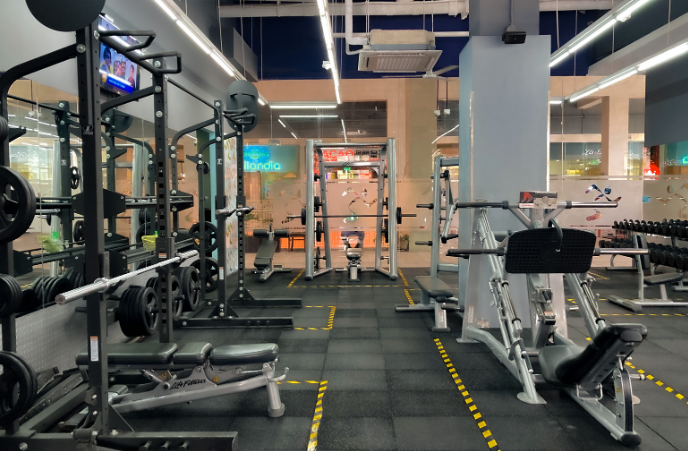
READING TIME: 5 MINUTES ➤➤
Modular or Multi-Gym: What Really Helps If You're Not Technical
When setting up a home gym or a small shared workout space in a condo, the first question is not only about space or budget. The more practical concern is understanding which equipment makes training clearer, less overwhelming, and easier to maintain over time. A multi-gym station promises organization, guided movements, and fewer decisions to make. A simple modular setup, on the other hand, offers more freedom but may seem harder to understand if you lack experience.
The choice should not begin with the assumption that one solution is always better than the other. For a non-technical user, the real difference lies between a structure that genuinely reduces confusion and one that merely hides it at the beginning. A guided machine can be extremely helpful if the main issue is navigating exercises and adjustments. A setup with a bench, adjustable dumbbells, and a few accessories may instead be more useful when the goal is to learn gradually without being locked into a system that feels too restrictive.
Why simplicity does not always mean fewer machines
For someone with little experience, perceived simplicity mainly comes from the number of decisions required before starting a workout. It is not just about how many pieces of equipment are in the room, but how many questions the user must solve every time: which exercise to do, how to adjust the machine, what weight to use, how much space is needed, and how much room there is for mistakes. A setup that appears complete can feel easy if it guides these decisions well, but it can become frustrating if every function requires complicated adjustments.
In the same way, a setup with only a few components is not automatically simple. A bench, a pair of adjustable dumbbells, and a compact rack can be very intuitive, but only if the user knows how to build an essential training routine. Real simplicity depends on the balance between accessibility and understanding. If the equipment helps users understand what they are doing, progress gradually, and make adjustments without starting over from scratch, then it truly lowers the technical barrier.
When a multi-gym really helps a beginner
A multi-gym machine is useful when the user needs a stable framework. Guided movements, predefined stations, and weight stacks reduce operational uncertainty. This is a concrete advantage for people training at home, those with limited time, or users sharing equipment in a condominium setting. A multi-gym removes many preliminary decisions and makes transitioning between exercises easier, especially when the goal is consistency rather than studying every technical detail.
The limitation appears when guidance turns into dependency. If the machine offers many functions but does not help the user understand movement mechanics, the person may only feel confident within that specific structure. In this situation, simplicity becomes partial: it reduces initial doubt but does not always improve awareness. For this reason, a multi-gym is more suitable when the primary need is to reduce decision fatigue, maintain order, and have a ready-to-use solution, rather than seeking maximum flexibility for long-term evolution.
When a simple modular setup is easier to manage
A modular setup works best when it is truly essential. For an entry-level user, this does not mean starting with many accessories, but rather creating a clear foundation: an adjustable bench, dumbbells, possibly a compact rack, and a few coherent additions. This structure requires a small learning curve but offers meaningful flexibility in return. Users can understand which exercises they use most, which weights they actually need, and which future additions make sense only after building consistent habits.
The greatest advantage is adaptability. If the available space changes, the training level improves, or multiple people begin using the equipment, a modular system can grow without forcing a complete replacement. For users afraid of choosing a setup that feels too restrictive, this provides an important sense of control. However, modularity must remain proportional: too many modules, compatibility options, and variations can transform a flexible choice into a new source of confusion.
Practical criteria for choosing without overload
The first criterion is the level of autonomy required. If the user wants more guidance and fewer adjustments, a multi-gym is often easier to tolerate. If instead the goal is gradual learning with acceptance of a small initial learning curve, a simple modular setup can be more educational. The second criterion is progression: a guided machine creates a clearer path, while a modular composition allows exercises, loads, and configurations to evolve more freely.
The third criterion is the margin for error. In an entry-level home gym, a setup that is too open may create indecision, while one that is too closed may limit future growth. The most balanced solution is the one requiring few decisions at the beginning without restricting the user after only a few months. For this reason, the real question is not which equipment appears easier, but which structure makes training simpler today and improvement clearer tomorrow.
A good choice should reduce uncertainty, not only save space
For a beginner, a multi-gym is not automatically the most suitable solution. It is a strong option when the primary value is guidance: more controlled movements, organized stations, and fewer combinations to manage. A simple modular setup is more appropriate when the goal is maintaining a minimum level of freedom, learning personal training preferences, and building a home gym without becoming locked into a single approach too early.
The most effective decision starts with recognizing your actual starting point. Someone overwhelmed by complexity may prefer a clearly organized multi-gym station. Someone looking for an essential, progressive, and adaptable base may lean toward a bench, adjustable dumbbells, and a compact rack. In both cases, the goal is not to buy the equipment that promises less effort, but to choose a structure that truly reduces uncertainty and makes training more consistent, understandable, and sustainable over time.
Comments (0)