
Trolley
You have no items in your shopping cart

 Budgets
 Dumbers
 Discs
Discs
 Benches
 Racks and Rigs
 Weights Holders
 Isotonic machines
 Calisthenics
 Cardio
 Kettlebells
 Flooring
 Gym Set
 Accessories
 Combat
 ARTI MARZIALI
 CONTAINER GYM
 Tug-Of-War
 Used Gym Equipment
 PILATES MACCHINARI
 GINNASTICA ARTISTICA
 CAMPI DA PADEL
 Prodotti in Pronta Consegna
 Informazioni
 IRONMAN
 Gift Card
- Donatif
- Sports products
- 0 I like it
- 3815 Views
- 0 comments
READING TIME: 7 MINUTES ➤➤
Pilates Chair and Barrel: when to use them and who they are really for
In the world of Pilates, every piece of equipment has a specific function and responds to different needs in terms of training, postural correction and functional development. Among the lesser-known yet extremely effective tools are the Wunda Chair and the Ladder Barrel. These are not alternatives to the Reformer, but true complementary devices designed to work on specific joint ranges, stability and neuromuscular control. Understanding when to introduce them, who they are intended for and what real benefits they provide is essential for any instructor or advanced practitioner who wants to structure a technical, targeted and conscious training approach.
This article provides a comprehensive and authoritative overview of Chair and Barrel equipment, analyzing their structure, uses, differences compared to other tools in the Pilates repertoire, and practical guidance for integrating them in a professional environment. The goal is to provide decision-making criteria based on functionality and quality, helping instructors and studio owners make informed and effective choices.
- What the Pilates Chair is and its main variations
- Ladder Barrel: structure, use and objectives
- Chair vs Barrel vs Reformer: differences in use
- Integrating Chair and Barrel in a professional studio
- How to evaluate the quality of this equipment
What the Pilates Chair is and its main variations
Origins and development of the Wunda Chair
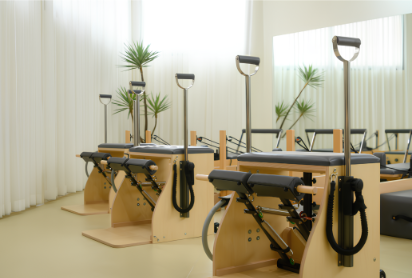
The Wunda Chair is one of the original pieces of equipment in the Pilates method, designed directly by Joseph Pilates as a compact, versatile tool that could also be used in domestic settings. It consists of a simple structure with a movable pedal that offers adjustable resistance, allowing exercises to be performed in seated, standing, prone or supine positions. The Chair was designed to challenge balance, train deep musculature functionally and develop core control with great precision. The lack of large supports and its unstable platform make it an extremely effective yet technically demanding piece of equipment, mainly suitable for users with good body awareness.
Over time, the design of the Wunda Chair has evolved while maintaining its original concept. Modern versions feature improved adjustments and more durable materials while preserving the ability to provide deep work on stability, strength and motor control. When used correctly, it becomes a true test of body-mind integration during movement.
Main models: Combo Chair, Exo Chair and Split Pedal
Today there are several variations of the Pilates Chair, each designed to adapt to specific contexts of use. The Combo Chair is the most common version found in professional studios: it features two separable pedals, independently adjustable springs and side handles that support more complex or advanced movements. This model allows a wide variety of exercises, making it suitable for a diverse clientele, from athletes to rehabilitation patients.
The Exo Chair, on the other hand, is more compact and lightweight, designed to be easily moved or placed in smaller spaces, making it ideal for home studios or mobile classes. The Split Pedal Chair introduces an additional challenge for balance and coordination by allowing asymmetrical work. Each variation serves different purposes, and it is the instructor’s responsibility to determine which model best fits the practitioner’s technical level and needs.
Ladder Barrel: structure, use and objectives
Why it is used: mobility, flexibility and spinal extension
The Ladder Barrel is an iconic piece of equipment in the Pilates repertoire, composed of a half-barrel structure connected to a ladder-like frame. Its primary function is to support work on flexibility, joint mobility and spinal elongation. Unlike other pieces of equipment that focus mainly on strengthening or stability, the Barrel encourages the exploration of full movement range, especially in the sagittal plane.
Among the most well-known exercises are spinal extensions, passive stretches and controlled flexions, often used to improve posture and release deep muscular tension. The Ladder Barrel becomes particularly valuable in advanced programs or functional recovery sessions, where the goal is to restore the balance between strength and mobility without excessively loading the joints.
When it is not recommended and its limitations
Despite its many benefits, the Ladder Barrel is not suitable for everyone. Its use requires a certain level of body awareness and movement control, since the absence of springs or dynamic support means every exercise depends entirely on the user’s strength and balance. For this reason, it is generally not recommended for absolute beginners or for individuals with severely limited mobility or unstable spinal conditions.
In addition, the specific curvature of the Barrel may not suit all body types: individuals with very stiff musculature may find it difficult or uncomfortable to use. The key lies in progressive adaptation through careful exercise selection and preparatory variations. In a studio environment, it is ideally introduced at a more advanced stage to refine work on extension, fluidity and precision of movement.
Chair vs Barrel vs Reformer: differences in use
Functionality and posture: what changes
When comparing the Pilates Chair, Ladder Barrel and Reformer, significant differences emerge not only in their structure but especially in their functional objectives. The Chair is oriented toward functional strengthening and stability, often involving asymmetrical loads and movements that directly challenge the core. It requires control, balance and strength. The Barrel, on the other hand, focuses on flexibility, extension and elongation. It does not offer active resistance but invites the practitioner to explore movement in a more fluid and supported way.
The Reformer represents a more comprehensive and balanced approach, enabling both dynamic and stabilizing work thanks to its spring-based carriage system. However, precisely because of its versatility, it may lack the specific stimulus that the Chair and Barrel can provide. The real difference lies in the motor and perceptive focus: Chair for control, Barrel for mobility, and Reformer for overall harmony.
How to choose the right equipment for each goal
The choice between these tools should always begin with a careful evaluation of the user’s goals. For individuals who need to strengthen the core, improve posture under load and develop both static and dynamic balance, the Wunda Chair represents an ideal challenge. For sedentary individuals, stiff bodies or those recovering from spinal compression patterns, the Ladder Barrel can be a valuable ally to restore mobility without impact.
The Reformer remains the most versatile instrument and is often recommended for building a complete training path, particularly in the initial and intermediate phases. However, Chair and Barrel are not “secondary” tools: on the contrary, they are precision instruments, strategically integrated according to specific goals and stages in the practitioner’s development. A professional approach is not based on substitution but on thoughtful integration.
Integrating Chair and Barrel in a professional studio
Benefits for instructors and advanced users
Introducing the Chair and Barrel into a professional studio environment significantly expands the possibilities for personalized bodywork. These tools, often overshadowed by the more widely known Reformer, offer targeted benefits for experienced users such as athletes, dancers or long-term practitioners. They allow instructors to address specific weaknesses, strengthen advanced movement patterns and refine neuromuscular control in situations involving instability or large joint ranges.
For instructors, they represent a valuable resource for designing highly technical individual programs, diversifying studio offerings and positioning themselves as specialists in small-equipment work. The Chair in particular allows instructors to objectively assess postural control levels, while the Barrel helps restore mobility in clients with structural stiffness or chronic sedentary habits.
Strategies for introducing them in individual or advanced sessions
The success of integrating these tools depends largely on introducing them at the right moment within the training journey and communicating their purpose clearly. In individual sessions, the Chair can be introduced as a progression tool or evaluation instrument, while the Barrel may represent a decompression phase or a dedicated mobility session. The approach should never be random: each exercise must be explained, contextualized and integrated into a coherent functional framework.
In advanced classes, these tools can become true tests of body awareness and technical precision. Dedicated modules such as “Chair & Barrel sessions” can focus on clear goals like spinal extension, lateral flexion or asymmetrical strengthening. Structured use of these tools improves the quality of the studio’s training offer and increases loyalty among users seeking a deeper, more personalized Pilates experience.
How to evaluate the quality of this equipment
Materials, construction and features to look for
The build quality of a Pilates Chair or Ladder Barrel directly affects safety, training effectiveness and the long-term durability of the equipment. Professional models are typically made from high-density multilayer wood or coated steel to ensure stability and strength. Pedals should offer solid grip and consistent elastic response, while springs must be adjustable, quiet and resistant to deformation.
In the case of the Barrel, the curvature should follow the natural anatomy of the spine to avoid excessive compression. The distance between the barrel and the ladder is also crucial: it must adapt to different body heights without compromising exercise execution. Upholstery materials should be non-slip, washable and resistant to wear. High-quality equipment not only improves user experience but also enhances the professional perception of the studio.
Professional brands and what to avoid
Among the most reliable brands for professional Pilates equipment are Balanced Body, Merrithew (STOTT), BonPilates and Gratz. These manufacturers offer certified, guaranteed products designed in collaboration with top-level educators. Before purchasing, it is always advisable to consult experienced instructors or test the equipment directly to evaluate its ergonomics and stability.
Conversely, it is best to avoid low-cost equipment or products without detailed technical specifications. These are often unstable copies made with poor materials and imprecise adjustments that compromise both safety and functionality. A good rule of thumb is to ask: “Would this equipment withstand intense daily use with multiple clients?” If the answer is uncertain, choosing certified professional models is the safer option. Investing in quality is always a competitive advantage, both for professionals and for end users.
Comments (0)