
Trolley
You have no items in your shopping cart

 Budgets
 Dumbers
 Discs
Discs
 Benches
 Racks and Rigs
 Weights Holders
 Isotonic machines
 Calisthenics
 Cardio
 Kettlebells
 Flooring
 Gym Set
 Accessories
 Combat
 ARTI MARZIALI
 CONTAINER GYM
 Tug-Of-War
 Used Gym Equipment
 PILATES MACCHINARI
 GINNASTICA ARTISTICA
 CAMPI DA PADEL
 Prodotti in Pronta Consegna
 Informazioni
 Gift Card
- Donatif
- Sports products
- 0 I like it
- 3 Views
- 0 comments
- gym flooring, safety flooring, gym safety, shock-absorbing materials
READING TIME: 5 MINUTES ➤➤
Resistance Bands for Runners: Exercises to Prevent Injuries and Improve Performance
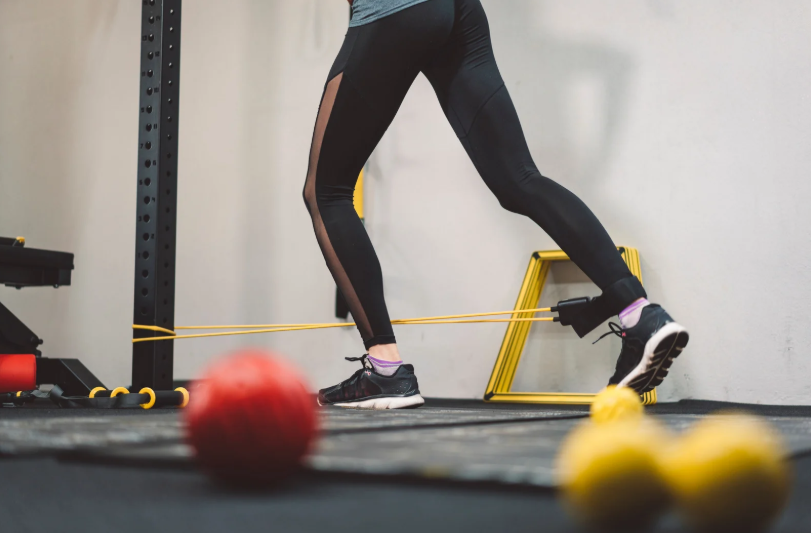
For many recreational runners, the challenge is not simply running more, but running more consistently while avoiding recurring discomfort in the knees, hips, calves, or lower back that often appears when training loads increase too quickly. Resistance bands for runners are simple, portable, and highly effective tools for improving control, stability, and muscle activation without turning training into a complicated gym session.
When used correctly, mini bands and power bands help incorporate targeted exercises for running injury prevention, especially when the goal is to improve hip alignment, knee control, and muscular response during foot strike. They are not a substitute for professional assessment when pain is present, but they can become a valuable part of the routine of runners who want to move more efficiently, with greater awareness and less guesswork.
Why Resistance Bands Are Useful for Runners
The Role of Complementary Strength Training in Running
Running is a repetitive movement that may seem natural, but it requires the ability to absorb and generate force with every step. When certain muscle groups work inefficiently or activate too late, other areas compensate, increasing the risk of overload. Resistance band exercises for runners make it possible to target commonly neglected muscles such as the glutes, hip abductors, stabilizers, and posterior chain. The benefit lies in the elastic resistance itself, which challenges movement control and more closely reflects the dynamic demands of running than many static exercises.
Mini Bands and Power Bands: Practical Differences for Runners
Mini bands are ideal for activation drills, lateral control exercises, and hip stability work because they can easily be positioned around the knees, ankles, or feet. Power bands, on the other hand, provide broader and more progressive resistance, making them useful for strength development, assisted mobility work, and controlled pulling movements. For motivated recreational runners, both options can be valuable. Mini bands are practical before a run or during short exercise circuits, while power bands are better suited to complementary sessions performed away from demanding workouts. The choice should not be based solely on band resistance but also on the quality of movement that can be maintained.
Hip Stability and Knee Control
Gluteus Medius, Pelvic Stability, and Running Mechanics
An important aspect of running injury prevention is maintaining hip stability. When the pelvis loses control during foot strike, the knee may collapse inward and the foot may develop inefficient compensatory patterns. The gluteus medius plays a key role in keeping the pelvis, knee, and ankle aligned. Using a mini band during exercises such as lateral walks, controlled hip abductions, or partial squats helps runners improve awareness of this connection. Although these exercises may appear simple, they are often among the most effective for runners who experience instability or lateral fatigue during longer runs.
Resistance Band Exercises to Improve Alignment
A simple exercise consists of placing a mini band above the knees and performing controlled squats while keeping the knees aligned with the feet. The objective is not to squat deeply but to prevent the band from pulling the knees inward. Another useful exercise is the lateral band walk performed with a stable torso, short steps, and constant tension. A third option is the glute bridge with a resistance band, maintaining slight outward pressure on the knees throughout the movement. These hip exercises with resistance bands are most effective when performed slowly and with a focus on technique rather than muscular fatigue.
A Resistance Band Routine to Prevent Overuse Injuries
Activation Before Running
Before an easy run or a technical training session, resistance bands can be used for a short activation routine lasting six to eight minutes. A practical sequence may include glute bridges with a mini band, lateral walks, monster walks, and standing hip abductions. The goal is not to create fatigue but to activate the muscle groups responsible for stabilizing the pelvis and knees. For runners worried about aggravating existing discomfort through incorrect exercises, this phase should remain controlled, progressive, and free from abrupt movements. Movement quality always matters more than quantity.
Strength Work on Days Away from Intense Training
On days without intervals, long runs, or high-intensity sessions, resistance bands can be incorporated into a more complete strength workout. A power band can be used for assisted Romanian deadlifts, hip hinge exercises, controlled extension movements, and posterior chain development. A mini band can complement the routine with lateral and single-leg exercises such as supported single-leg squats or controlled step movements. This type of work does not guarantee automatic performance improvements, but it can support greater training consistency, which is often one of the most important factors for long-term progress.
Performance, Muscle Elasticity, and Training Consistency
How to Use Resistance Bands Without Increasing Injury Risk
Resistance bands create variable resistance: the more they are stretched, the more control they require. This characteristic can be beneficial, but it may also become problematic if a runner chooses excessive resistance and loses proper alignment. For this reason, it is advisable to begin with light or medium bands while maintaining controlled movements and steady breathing. During each exercise, the knees, pelvis, and feet should remain properly aligned without noticeable compensations. In cases of acute pain, swelling, or persistent discomfort, resistance band training should not be viewed as a stand-alone solution and should be evaluated by a qualified professional.
A Sustainable Progression for Recreational Runners
The best progression is one that allows exercises to be performed consistently over time. For many recreational runners, two weekly sessions lasting 15 to 20 minutes, combined with brief activation work before selected runs, can be sufficient. After the first few weeks, progression may involve slightly increasing band tension, adding extra sets, or introducing more challenging single-leg exercises. The key principle remains movement quality. If technique begins to deteriorate, progression is occurring too quickly. In this sense, resistance band exercises for runners become not only fitness tools but also valuable instruments for movement education.
Integrating Resistance Bands into Your Training Equipment
When to Choose Mini Bands and Power Bands
An effective setup for runners can begin with a light- or medium-resistance mini band and a moderately resistant power band. Mini bands are ideal for stability exercises, glute activation, and lateral control drills, while power bands provide more opportunities for strength and mobility training. Whether training at home, in a gym, or in a dedicated fitness area, resistance bands can easily complement other functional training equipment. Choosing durable materials and appropriate resistance levels is important because bands that are too light provide limited stimulus, while excessively strong bands may compromise technique.
The Value of a Simple and Consistent Routine
For runners, the true value of resistance bands does not lie in exercise complexity but in the ability to establish a sustainable routine. A few carefully selected movements performed consistently can improve body awareness, stability, and load management. This approach is particularly valuable for athletes seeking to reduce interruptions caused by recurring discomfort and maintain a more balanced training program. Within the Donatif functional training equipment range, mini bands and power bands can easily be integrated into simple, progressive workouts designed to meet the needs of runners, home gym users, and general athletic conditioning.
Comments (0)