
Trolley
You have no items in your shopping cart

 Budgets
 Dumbers
 Discs
Discs
 Benches
 Racks and Rigs
 Weights Holders
 Isotonic machines
 Calisthenics
 Cardio
 Kettlebells
 Flooring
 Gym Set
 Accessories
 Combat
 ARTI MARZIALI
 CONTAINER GYM
 Tug-Of-War
 Used Gym Equipment
 PILATES MACCHINARI
 GINNASTICA ARTISTICA
 CAMPI DA PADEL
 Prodotti in Pronta Consegna
 Informazioni
 IRONMAN
 Gift Card
- Donatif
- Sports products
- 0 I like it
- 1818 Views
- 0 comments
- stress reduction, improved self-esteem, physical and mental well-being, gym training
READING TIME: 5 MINUTES ➤➤
Streetlifting Parallettes: How to Choose the Right Ones for Stability and Safety
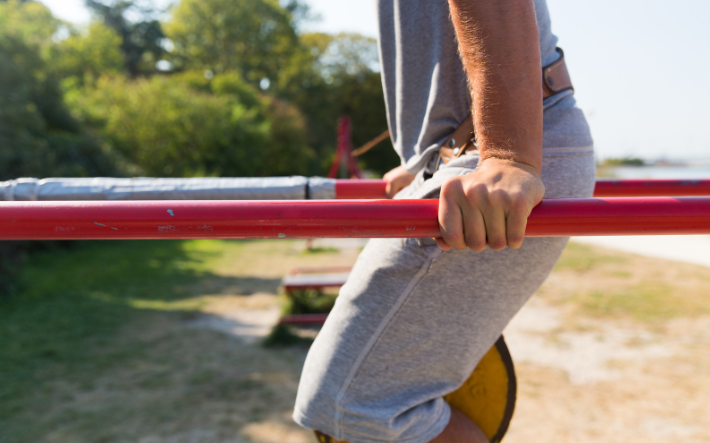
Streetlifting parallettes may seem like simple equipment, almost intuitive. In reality, it is precisely this apparent simplicity that leads to many wrong purchases. When evaluating bodyweight dips, progressive loading, and frequent use in a home gym, the difference between a reliable support and a mediocre one appears later: not when placing the order, but during training, when the structure begins to flex, move, or create an unstable feeling.
The point, therefore, is not simply choosing a pair of parallettes that “can hold the weight.” The real question is how well they hold it: with what lateral stability, what kind of ground contact, and how consistent they are with your training level. An unstable structure may seem acceptable while the load is low, but it quickly becomes a technical, mental, and practical limitation. In a BOFU context, the correct question is not which ones are the cheapest, but which parallettes are truly stable and allow you to train consistently with real safety margins.
When stability becomes the first selection criterion
The hidden risks of a light or poorly balanced structure
The term parallette stability refers to the ability of the structure to remain predictable under load, without noticeable oscillations, annoying torsion, or micro-movements on the floor. In streetlifting, this aspect matters more than it seems, because a dip never distributes weight perfectly statically. There are always lateral forces, small imbalances, torso adjustments, and rhythm variations that challenge the base of support.
An unstable parallette is not only uncomfortable. It reduces execution quality, creates compensations, lowers confidence, and can interrupt progression even before reaching muscular limits. People training at home often underestimate this aspect because they focus on dimensions and stated load capacity while ignoring base geometry, foot quality, and overall rigidity. The result is equipment that looks adequate on paper but never truly feels secure in practice.
Why initial savings can become a technical limitation
The phrase “they’re just parallettes” is a common mental shortcut. It works until the load is modest and the equipment is used occasionally. Then weighted dips, training volume, and technical repetitions come into play, and the initial savings lose their meaning. If the structure moves, flexes, or requires constant adjustments, the real cost is not financial but performance-related: training quality drops and progression becomes less consistent.
This is where the stability bias comes into play. Users realize that spending less does not necessarily mean spending better, especially when equipment directly affects joints, wrists, and shoulders. When choosing weighted dip parallettes, reliability is not a secondary feature—it is the foundation that gives meaning to everything else, from grip comfort to long-term durability.
Which construction features truly affect safety
Materials, welds, and structural rigidity
The term parallette materials means much more than simply “steel or not.” Tube thickness matters, weld quality matters, and the way the structure distributes load between uprights, crossbars, and base also matters. A well-designed parallette should provide noticeable rigidity from the very first use: no excessive elasticity and no uncertainty when the body slightly changes trajectory during eccentric or concentric phases.
Clean, consistent welds are an important sign of manufacturing care. Finishes also matter: overly slippery surfaces, rough paintwork, or neglected details can reveal a production logic focused on cost rather than quality. In a buying guide for home dip equipment, a useful rule is this: materials should never be evaluated in isolation, but in relation to rigidity, stability, and the overall feeling of structural solidity.
Base support, feet, and floor contact
A large part of safety is determined beneath the structure, not above it. The base support determines how well the parallette distributes weight and resists small lateral imbalances. A base that is too short or narrow can quickly become problematic when the user increases intensity and training frequency. For this reason, the real footprint and the quality of floor contact matter as much as the frame material.
Rubber feet are often underestimated. They must provide grip, partially compensate for uneven surfaces, and limit unwanted sliding. In a home gym, where floors are not always perfectly level like in professional facilities, this detail becomes crucial. A pair of stable parallettes can also be recognized by the fact that the base remains consistent on rubber flooring, finished concrete, or training surfaces without requiring constant adjustments between sets.
Low, high, and modular parallettes compared
When to choose low parallettes for control and compactness
Low parallettes have a clear advantage: they lower the overall center of gravity and often provide an immediate sense of control. They are particularly useful for those training in limited spaces, those who prefer compact equipment, and those who want something easy to manage in everyday training. In many home gym environments, this format offers a strong balance between limited footprint and perceived stability.
However, they are not automatically the right choice for everyone. A low parallette can feel less comfortable if mobility, body height, or execution style requires more clearance from the floor. Still, they remain a very practical solution for beginner and intermediate users looking for streetlifting parallettes focused on control, stability, and simple home use.
When to choose high parallettes for range of motion and comfort
High parallettes provide more usable space and can allow a more comfortable movement pattern, especially when the user already has solid technique and wants to train with a greater range of motion. However, increased height also makes structural quality even more important, because every oscillation becomes more noticeable and every lateral load is amplified.
For this reason, it is not enough to simply look for a “high” parallette. You must verify that the height is supported by a proportionate base, a rigid frame, and a stable ground contact. If these elements are missing, the ergonomic advantage quickly disappears. In comparative terms, high parallettes work well when they are designed for serious training rather than simply filling a low price category.
The role of modular solutions in home gyms
Modular parallettes address a real need: equipment that is easier to move, store, or integrate into an evolving home gym setup. Modularity can be a real advantage when it does not compromise the stability of the structure and when the assembly system maintains precision, rigidity, and structural consistency.
The critical point is simple: every additional joint requires accurate engineering. If the connection is imprecise or tolerances are too wide, the feeling of solidity quickly disappears. Modular solutions must therefore be evaluated carefully. They are excellent when they combine practicality with serious construction quality, but questionable when the space-saving promise sacrifices safety and reliability.
How to evaluate height, footprint, and real usage
Compatibility with weighted streetlifting and technical progressions
The term usage compatibility refers to the alignment between equipment, technical level, and training progression. Someone training only with bodyweight has different needs compared to someone regularly performing weighted dips. Once additional load enters the equation, the structure must remain predictable even in the final repetitions or on days when coordination is not perfect.
For those following structured progressions, the goal is not just to perform the movement once but to repeat it consistently over time. Weighted parallettes should provide the same solid feeling from the first set to the last without creating doubts about the stability of the support.
Available space, transport, and daily equipment management
Footprint should never be considered as an isolated metric. It must be evaluated together with training frequency, available space, and the presence of other equipment. A pair of parallettes may be technically excellent but become inconvenient in a small home gym if it constantly needs to be moved.
The best home gym parallettes are therefore not necessarily the smallest ones, but those that provide the best balance between structural stability, appropriate dimensions, and everyday practicality.
Which type to choose based on experience level
Beginner users: prioritize stability and simplicity
For beginners, the priority is not technical complexity but predictability. You need stable parallettes that are easy to position and provide a reassuring base of support. A simple but well-built structure is usually more effective than a complicated design with questionable stability.
A parallette with a balanced base, comfortable grip, and compact structure helps build confidence from the first sessions. When supported by solid construction quality, simplicity becomes a real safety factor.
Intermediate users: stability under load and versatility
Intermediate users start demanding more from their equipment. They want a structure capable of handling greater volume and increasing loads while maintaining consistency during more technical training sessions. At this stage, structural rigidity, finish quality, and correct height become essential criteria.
For this profile, it is advisable to choose models where materials, base design, and intended use are clearly aligned. A well-engineered structure reduces the risk of replacing the equipment too soon and supports long-term progression.
A good purchase can be recognized before the first workout
The concrete signs of a reliable parallette
A reliable pair of parallettes can be recognized through concrete details: compact structure, stable base, absence of play or movement, consistent finishes, and balanced proportions between height and base. These are not marketing slogans but real indicators of thoughtful design.
Anyone reading a parallette buying guide before purchasing should ask a simple question: does this equipment inspire confidence already on paper, or does it rely on hope that everything will work well?
Why a cautious choice protects training and long-term progress
Choosing the right parallettes does not mean buying the most expensive option. It means prioritizing the elements that matter when the body is suspended and the load increases. Safety is not an accessory concept—it is what allows consistent training without unnecessary doubts.
For beginner and intermediate home gym users, a thoughtful choice is almost always the most efficient one in the medium term. A well-designed parallette occupies the right amount of space, supports progression, and reduces risk. In short: stability comes first, because the risk is never worth the savings.
Comments (0)