
Trolley
You have no items in your shopping cart

 Budgets
 Dumbers
 Discs
Discs
 Benches
 Racks and Rigs
 Weights Holders
 Isotonic machines
 Calisthenics
 Cardio
 Kettlebells
 Flooring
 Gym Set
 Accessories
 Combat
 ARTI MARZIALI
 CONTAINER GYM
 Tug-Of-War
 Used Gym Equipment
 PILATES MACCHINARI
 GINNASTICA ARTISTICA
 CAMPI DA PADEL
 Prodotti in Pronta Consegna
 Informazioni
 IRONMAN
 Gift Card
- Donatif
- Sports products
- 0 I like it
- 1905 Views
- 0 comments
- stress reduction, improved self-esteem, physical and mental well-being, gym training
READING TIME: 5 MINUTES ➤➤
How to Design a Tatami Area in a Combat Center Without Improvising
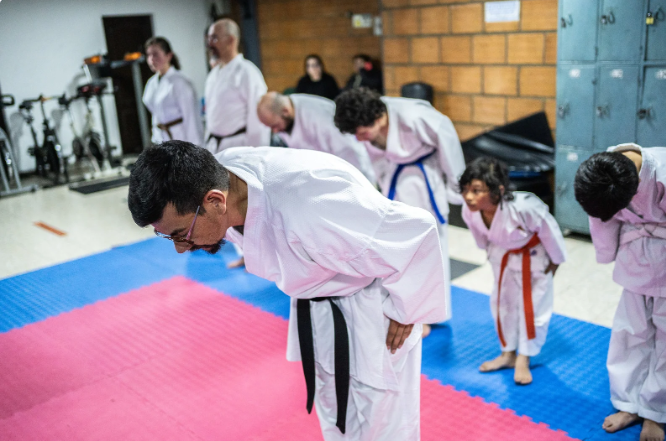
Designing a tatami area in a combat center requires a structured, conscious approach focused on operational continuity. Assuming that defining square meters and installing flooring is enough is one of the most common mistakes, leading to inefficiencies, management issues, and unexpected costs over time. Effective design instead starts from a broader vision that integrates real usage, workflows, safety, and maintenance.
For those making B2B decisions, such as gym owners or designers, it is essential to create a space aligned with the disciplines practiced and daily operational needs. A well-designed tatami area is not only functional but also ensures investment protection and long-term stability.
- Setting the design foundations
- Tatami area sizing
- Flow organization
- Material selection
- Maintenance and management
- Common mistakes to avoid
Where to start: setting the right design foundations
Every effective project begins with an initial analysis phase, often underestimated. Even before discussing tatami or materials, it is necessary to define which disciplines will be practiced, their intensity, and how classes will be organized. Judo, Brazilian Jiu-Jitsu, MMA, or striking all have very different requirements and need specific spatial configurations.
Defining these aspects helps avoid generic choices and allows you to build a truly functional area. A well-structured project reduces decision uncertainty and ensures a high level of operational control, preventing improvised adjustments over time.
Defining goals, disciplines, and real space usage
Design must start from a concrete understanding of how the tatami area will be used daily. It’s not just about how many people will use the space, but how they will use it, at what pace, and with what training methods.
A superficial analysis often leads to overload or underutilization, while accurate planning ensures a coherent and high-performing space. In this sense, design becomes a tool to reduce decision effort and improve efficiency.
Analyzing structural context and existing constraints
Every facility has structural characteristics that directly influence the project. Columns, ceiling heights, access points, and systems must be considered from the beginning to avoid incompatibilities.
Integrating these constraints into the design helps prevent later modifications and ensures greater operational continuity. Ignoring them, on the other hand, exposes you to real risks during installation and use.
Tatami area sizing: avoiding critical mistakes
Sizing is one of the most delicate aspects when designing a tatami area. Defining total surface alone is not enough: it is essential to consider the number of practitioners, movement dynamics, and safety requirements.
An error at this stage can compromise the entire project, causing operational issues and limiting future growth. For this reason, it is crucial to adopt clear criteria based on real usage.
Calculating surface based on flows and classes
The size must be proportionate to the number of users and the type of training. Crowded classes or high-contact disciplines require larger, well-distributed spaces.
An effective design also considers peak usage times and overlapping classes, avoiding congestion that could compromise safety and user experience.
Managing safety distances and accessory areas
In addition to the central area, it is essential to plan perimeter safety spaces and areas dedicated to supporting functions. These elements are often overlooked but significantly impact overall quality.
Ensuring adequate distances means protecting athletes and reducing the risk of accidents, strengthening the facility’s professional image.
Flow organization and operational functionality
A tatami area is not an isolated space but part of a broader system including changing rooms, entrances, and common areas. Managing flows is therefore a central element of the design process.
Properly organizing movement paths improves efficiency and reduces user interference, contributing to smoother and more controlled operations.
Entrances, exits, and athlete circulation
Access points must facilitate movement without creating overlaps or critical points. This is especially important during peak hours.
Well-designed circulation improves user experience and reduces management workload, contributing to a more organized and functional environment.
Separation between active and support areas
Clearly distinguishing training space from support areas is essential to maintain order and safety. Waiting areas, storage, and preparation zones must be integrated into the design.
This separation optimizes space usage and avoids interference that could compromise training effectiveness.
Choosing tatami flooring and materials
Material selection is a strategic element in the design process. Not all tatami are the same, and choosing the right solution requires specific expertise.
A well-designed system must ensure safety, durability, and discipline alignment, avoiding generic solutions that may prove inadequate over time.
System structure: subfloor and tatami modules
The tatami is not just the visible surface, but a multi-layer system. The subfloor plays a key role in stability and impact absorption.
Neglecting this aspect compromises overall performance and increases the risk of premature wear.
Consistency between discipline and technical features
Each discipline requires specific characteristics in terms of density, grip, and shock absorption. Choosing an unsuitable tatami can negatively affect user experience.
A conscious choice ensures high performance and strengthens the perceived quality of the facility.
Maintenance and operational continuity
Maintenance is often considered only after installation, but it should be an integral part of the design process. A difficult-to-manage area leads to long-term costs and inefficiencies.
Integrating maintenance into the project reduces operational impact and ensures longer flooring lifespan.
Cleaning, wear, and long-term management
Materials and solutions directly affect ease of cleaning and resistance to wear, especially in high-intensity environments.
Effective management maintains high quality standards and reduces the need for extraordinary interventions.
Impact of design on maintenance
Correct design choices simplify daily management and reduce the risk of issues. On the contrary, initial mistakes can create complexities that are difficult to fix.
Investing in design therefore means protecting the entire lifecycle of the tatami area.
Common mistakes in tatami area design
Many mistakes stem from a superficial approach or the belief that some aspects can be addressed later. In reality, every design decision directly impacts operations.
Recognizing these mistakes allows you to avoid them and build a more solid and reliable space.
Underestimating real usage and intensity
One of the most common mistakes is failing to consider actual usage intensity. This leads to undersized or inadequate solutions.
A proper initial analysis helps avoid critical issues and ensures greater long-term stability.
Focusing only on square meters
Reducing design to a matter of surface area is a strategic mistake. Space must be conceived as a complex system, not just a numerical value.
Only a structured approach allows for a coherent, efficient, and sustainable result over time.
Comments (0)