
Trolley
You have no items in your shopping cart

 Budgets
 Dumbers
 Discs
Discs
 Benches
 Racks and Rigs
 Weights Holders
 Isotonic machines
 Calisthenics
 Cardio
 Kettlebells
 Flooring
 Gym Set
 Accessories
 Combat
 ARTI MARZIALI
 CONTAINER GYM
 Tug-Of-War
 Used Gym Equipment
 PILATES MACCHINARI
 GINNASTICA ARTISTICA
 CAMPI DA PADEL
 Prodotti in Pronta Consegna
 Informazioni
 IRONMAN
 Gift Card
- Donatif
- Sports products
- 0 I like it
- 1355 Views
- 0 comments
- stress reduction, improved self-esteem, physical and mental well-being, gym training
READING TIME: 5 MINUTES ➤➤
Tatami, rubber or EVA: which material really works for a PT studio
When designing a space dedicated to training, one of the decisions that seems the simplest often turns out to be one of the most underestimated: choosing the sports flooring. Many start from a misleading assumption, that tatami, rubber and EVA are three almost equivalent options, to be distinguished only by price or aesthetics. In reality, that’s not the case. Each material conveys a different message, reacts differently under load, and directly affects both the client experience and the daily functionality of the space.
In a PT studio, an advanced home gym or a micro gym, flooring should not simply “cover the floor”. It must support mixed use, accommodate different exercises, be easy to manage and maintain a consistent image with the service offered. That’s why materials must be compared in real context, not as abstract equivalents. Understanding when tatami makes sense, when EVA is enough, and when rubber becomes the most logical choice helps avoid a purchase that is inconsistent, not durable or not professional.
- What flooring really needs to do in a PT studio
- When tatami is the most coherent choice
- When EVA works, and where it shows its limits
- Why rubber is often the most balanced solution
- How the choice changes between PT studio, advanced home gym and micro gym
- Which material really makes sense for a practical and professional space
What flooring really needs to do in a PT studio
A training space managed by a personal trainer almost always requires a surface capable of handling different activities throughout the same day. You move from mobility and activation to bodyweight exercises, from kettlebell or dumbbell work to metabolic circuits, up to one-to-one sessions where the client expects a clean, stable and well-organized environment. In this scenario, PT studio flooring must offer a precise balance between comfort, stability, durability and professional image. If it excels in just one aspect but fails in others, over time it becomes a visible compromise.
The key point is that the same material can look great in theory but prove inconsistent in practice. A surface that is too soft may feel pleasant during certain phases of training but less convincing when stable support is needed or when wear starts to show clearly. Similarly, a very robust but overly rigid or uninviting solution may work technically but fail to support the sense of care and versatility a PT studio should communicate. The real question, therefore, is not which material is “best” in absolute terms, but which one best fits the type of service delivered every day.
When tatami is the most coherent choice
Tatami is often considered when looking for a comfortable, tidy surface that is also pleasant for floor-based work. It has a strong visual identity and immediately communicates attention to movement quality, technical practice and user comfort. In a studio where bodyweight training, mobility, stretching, motor control work or prolonged floor contact are frequent, tatami can provide a very positive user experience. In these cases, it becomes a coherent choice because it enhances the qualitative side of training.
That said, tatami is not automatically the most balanced solution for every mixed-use space. When equipment, repeated loads, continuous movement and the need for long-term visual durability come into play, limitations may emerge in terms of marks, compression or a reduced sense of solidity compared to more technical surfaces for equipment-based training. For this reason, tatami works best when the core of the service is centered on controlled movement and comfort, but becomes less convincing if expected to deliver the same operational neutrality as rubber flooring in a highly multifunctional environment.
When EVA works, and where it shows its limits
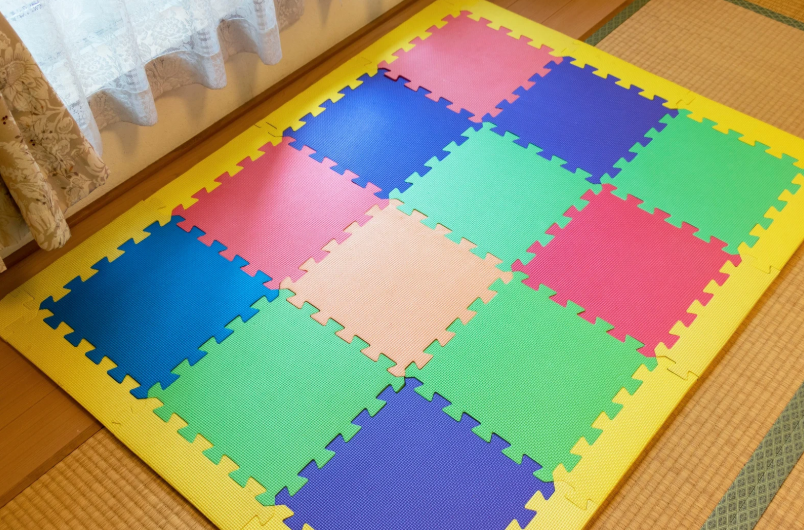
EVA is appreciated because it is accessible, lightweight, easy to install and quick to set up, even in spaces that need to be ready fast. In an advanced home gym or a personal environment where modularity, comfort and budget control are priorities, it can seem like a very rational solution. For light activities, floor exercises, non-intensive sessions and contexts where the flooring is not exposed to constant daily stress, EVA can perform adequately. Its main advantage is simplicity: it is easy to assemble, relatively quick to replace and allows a functional setup without complex interventions.
However, EVA shows its limits when used as a “universal” material in a space that must appear stable, mature and professional over time. Its lighter and more compressible nature can result in a less solid feel under certain loads and less reliability under repeated intensive use. Moreover, where visual order, durability and a more professional presence are required, EVA may convey a more domestic than consultative impression. It should not be dismissed, but properly positioned: it works best when the context accepts some compromises, and less so in a PT studio that aims to build trust also through the tangible quality of the environment.
Why rubber is often the most balanced solution
Rubber, especially in hybrid training environments, is often the option that manages to combine the greatest number of requirements without overemphasizing any single feature. It generally provides a more stable base, conveys a stronger sense of robustness and adapts well to mixed use including bodyweight training, technical work, circuits and free weights. In a space where different clients and sessions alternate, rubber tends to work because it reduces the feeling of over-specialization: it doesn’t feel “too soft”, doesn’t look improvised and does not compromise perceived solidity.
Its strategic advantage is that it also performs well in terms of positioning. Rubber flooring communicates a space that is ready for work, well-maintained yet practical, professional without being rigid. This makes it particularly suitable when the service needs to be versatile and reliable, which is exactly the case for many PT studios and micro gyms. This does not mean rubber is always perfect, but in a real comparison between tatami, rubber and EVA, it is often the material that best handles the complexity of a mixed-use space without creating inconsistencies between technical use, durability and client perception.
How the choice changes between PT studio, advanced home gym and micro gym
In a PT studio, the most sensible choice depends on how sessions are actually conducted. If the work is heavily focused on mobility, control, technique and constant floor interaction, tatami can be perfectly coherent. If instead the studio must smoothly handle a wide range of exercises, small equipment, moderate loads, continuous transitions and a strong professional image, rubber tends to offer a more convincing balance. In this scenario, EVA is harder to position as a primary solution, as it risks appearing too close to a domestic or temporary setup.
In an advanced home gym, on the other hand, EVA can regain relevance when the owner prioritizes comfort, practicality and ease of installation over a commercial-use logic. If the space is personal and well-managed, EVA’s compromises can be acceptable. In a micro gym, however, the focus shifts back toward rubber, as usage increases, variability grows and the need for long-term credibility becomes more important. Tatami remains excellent in specific sub-scenarios but requires stronger design coherence. Rubber, instead, tends to be the safest choice when the environment cannot afford operational ambiguity.
Which material really makes sense for a practical and professional space
The real answer to this comparison is not that one material wins over the others in absolute terms, but that tatami, EVA and rubber are not interchangeable. Tatami makes sense when comfort, technical work and floor-based movement are central to the service. EVA works when the context accepts a simpler, more budget-oriented and private solution. Rubber is the best choice when looking for the optimal balance between solidity, versatility, perceived durability and professional image. This distinction, more than price alone, is what prevents poor decisions.
For a space that truly needs to be practical, professional and versatile, rubber often emerges as the most rational solution, especially when the service is mixed and must remain consistent over time. Tatami remains a smart choice when the training format genuinely supports it, while EVA makes sense when its lighter positioning is consciously accepted. The best decision does not come from an abstract comparison between materials, but from the ability to align flooring with the service offered, the clients you want to reassure and the image you aim to build day after day.
Comments (0)