
Trolley
You have no items in your shopping cart

 Budgets
 Dumbers
 Discs
Discs
 Benches
 Racks and Rigs
 Weights Holders
 Isotonic machines
 Calisthenics
 Cardio
 Kettlebells
 Flooring
 Gym Set
 Accessories
 Combat
 ARTI MARZIALI
 CONTAINER GYM
 Tug-Of-War
 Used Gym Equipment
 PILATES MACCHINARI
 GINNASTICA ARTISTICA
 CAMPI DA PADEL
 Prodotti in Pronta Consegna
 Informazioni
 IRONMAN
 Gift Card
- Donatif
- Training and exercises
- 0 I like it
- 2758 Views
- 0 comments
READING TIME: 10 MINUTES ➤➤
Maintaining physical strength after the age of 60 does not mean becoming an athlete; it means remaining independent, stable, and fully engaged in everyday life. At this stage of life, the body undergoes significant changes: muscle mass decreases, joint mobility becomes more limited, and maintaining balance can become increasingly challenging. However, with a targeted routine, it is possible to counteract these effects and improve quality of life day by day.
You do not need hours at the gym or excessive effort. A few well-structured exercises combined with consistent practice are enough to regain a sense of control, stability, and confidence in your body. In this article, we explore how to build a sustainable routine to strengthen deep muscles, improve balance, and preserve independence through simple yet effective movements suitable for all ages.
Why functional strength is essential after 60
The importance of light but daily strength training
As the years pass, the body naturally loses muscle mass, a condition known as sarcopenia. However, maintaining basic functional strength is essential for continuing to perform everyday activities independently, such as getting up from a chair, carrying groceries, or walking safely. The goal is not lifting heavy weights but strengthening the muscles that support real-life movements.
This type of light, targeted, and mindful strength training helps reduce the risk of falls, improve posture, and approach daily movements with greater confidence. A body that feels strong and stable moves with more assurance, reducing the fear of injury and enhancing overall well-being.
Independence and quality of life in later years
Independence is a crucial value for people over 60. Preserving the ability to move, bend down, stand up, or simply walk without assistance is a direct indicator of quality of life. Targeted exercise helps maintain this independence while also supporting mental well-being.
An active body stimulates an active mind. Movement improves mood, boosts self-esteem, and strengthens the positive connection between body and mind. For this reason, a fitness routine designed for adults over 60 is not just a physical practice but an investment in overall balance and well-being.
Stability and control: the role of the core after 60
Deep muscles and posture: what you need to know
The “core” refers to the group of deep muscles of the abdomen, back, and pelvis. These muscles stabilize the body during movement, support the spine, and help maintain balance. As we age, weakening of these muscles is often responsible for poor posture and instability, increasing the risk of falls.
Training the core after 60 should therefore be a priority. It is a deep form of work that may not be as visible as strengthening the arms or legs, but it is essential for feeling stable and secure. A strong core also contributes to better breathing, digestion, and motor coordination.
How to train the core safely
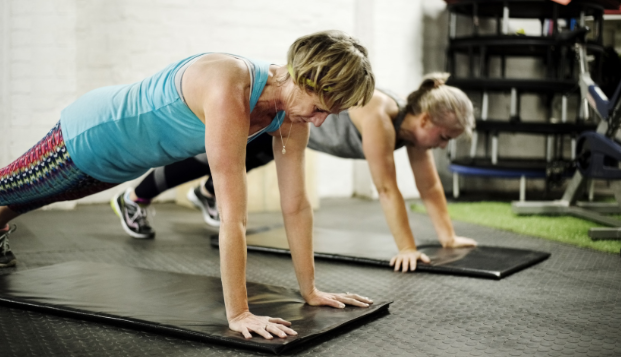
Complex exercises are not necessary. To strengthen the core safely, you can use controlled movements such as diaphragmatic breathing, modified planks, single-leg balance exercises, or seated abdominal contractions. The goal is not exhaustion but awareness and control of movement.
It is important to progress gradually, respect your body's limits, and choose exercises that involve minimal impact and risk. Professional guidance or reliable instructional videos can help ensure proper technique and prevent unnecessary strain or discomfort.
An exercise routine to maintain strength and independence
Simple yet effective movements for every day
A good daily routine may include exercises such as assisted squats, arm raises, leg extensions, or brisk walking. These movements engage major muscle groups and help maintain mobility and strength without the need for a gym membership.
Ideally, you should dedicate at least 20 minutes a day to these exercises, preferably at the same time each day to build consistency. Even small improvements, such as getting out of bed more easily or climbing stairs without fatigue, are meaningful signs of progress that encourage continued effort.
Stability exercises you can do at home
Improving stability requires very little equipment: a sturdy chair, an exercise mat, and perhaps a soft ball. Useful exercises include standing on one leg, transitioning from sitting to standing without support, and gentle torso rotations. These are low-impact movements that can easily be performed in limited spaces.
Incorporating these exercises into specific moments of the day, such as in the morning or before dinner, makes it easier to stay consistent over time. The goal is not perfection but consistency, which is the true key to lasting results.
Strategies for an active and independent life
Integrating movement into daily life
Staying active does not always require a formal workout. Walking every day, taking the stairs instead of the elevator, or carrying small loads while running errands are all effective forms of functional movement that help keep the body active and capable.
The most effective strategy is to integrate physical activity into daily routines, turning ordinary tasks into opportunities for exercise. Gardening, dancing, or taking a walk with friends can all contribute to maintaining strength, mobility, and vitality.
Preventing falls and managing balance
Falls are among the greatest risks for adults over 60, but they are also among the most preventable. Strengthening the core and improving balance significantly reduce this risk, but the environment also matters. Removing loose rugs, ensuring adequate lighting, and wearing supportive footwear can make a substantial difference.
It is equally important to recognize signs of instability. If you feel uncertain while walking or standing, it may be time to take action. Performing specific balance exercises, such as walking along an imaginary straight line or shifting weight from one foot to the other, can help restore body control and confidence.
Practical tips for getting started and staying consistent
How to build a sustainable routine
The key to getting started is simplicity. Choose a few well-selected exercises and perform them calmly and consistently. Avoiding overly ambitious programs at the beginning reduces the risk of frustration or giving up. It is better to start with 10 minutes a day and gradually increase both duration and intensity.
Creating a small ritual can also help: use the same space, wear comfortable clothing, and perhaps play relaxing music. This creates a positive association with physical activity and makes it easier to turn exercise into a long-lasting habit.
Motivation and gradual progression
Every small achievement deserves recognition. Feeling less tired, having better balance, or successfully performing a new movement are all signs that the body is responding positively. Tracking these improvements, perhaps in a journal, can help maintain motivation over time.
If difficulties arise, it is important not to push too hard. Recovery is part of training, just as listening to your body is. And when movement becomes integrated into your daily identity, exercise stops feeling like an obligation and becomes a natural and enjoyable part of life.
Comments (0)