
Trolley
You have no items in your shopping cart

 Budgets
 Dumbers
 Discs
Discs
 Benches
 Racks and Rigs
 Weights Holders
 Isotonic machines
 Calisthenics
 Cardio
 Kettlebells
 Flooring
 Gym Set
 Accessories
 Combat
 ARTI MARZIALI
 CONTAINER GYM
 Tug-Of-War
 Used Gym Equipment
 PILATES MACCHINARI
 GINNASTICA ARTISTICA
 CAMPI DA PADEL
 Prodotti in Pronta Consegna
 Informazioni
 IRONMAN
 Gift Card
- Donatif
- Training and exercises
- 0 I like it
- 2307 Views
- 0 comments
- stress reduction, improved self-esteem, physical and mental well-being, gym training
READING TIME: 5 MINUTES ➤➤
What type of training makes sense to do at home if you're starting from zero
When you start working out at home, the main difficulty is almost never a lack of motivation. More often, the issue is something else: there are too many options and no simple criteria to understand where to begin. Those starting from zero are faced with terms like strength, bodyweight, functional training, and light cardio without knowing which path is truly suited to their level. At this early stage, it’s easy to get confused, set unrealistic expectations, or choose a method that’s too difficult to sustain over time.
The good news is that you don’t need to find the perfect method. You need to find a starting point that is sustainable, clear, and consistent with your home environment. Someone living in an apartment, with limited space, no equipment, and years of inactivity should not follow the same approach as someone with a dedicated room and a decent fitness base. Understanding this helps avoid the most common mistake: starting with enthusiasm but no structure, only to quit after a few weeks.
- Where to really start when training at home
- Strength, bodyweight, functional or light cardio: what changes
- How to choose the right method without confusion
- Practical scenarios based on your home setup
- The minimum setup to start with a clear approach
Where to really start when training at home
The first thing to understand is that not all training methods are equally suitable for beginners. A beginner often tends to choose what they see most online, not what they can realistically manage. This leads to selecting programs that are too intense, too technical, or simply too far from daily routines. At home, especially in the beginning, compatibility with real life matters more than the theory behind the “best” method. A sensible workout must fit your space, your time, and your mental energy.
That’s why the first useful filter is not asking which method is “best” overall, but which one best fits your starting point. Do you have limited space? Do you live in an apartment? Do you get tired easily? Do you have twenty minutes or almost an hour? Can you handle coordinated movements or do you prefer simple exercises? These questions immediately create a smarter selection. Level, time, and space are the three criteria that help you avoid falling into the usual trap of random choices.
Strength, bodyweight, functional or light cardio: what changes
Strength training makes sense when you want to build a solid foundation from the start, improve body control, and make your progress more stable. It doesn’t mean lifting heavy weights or following complex routines right away. For beginners, strength can simply mean performing a few basic exercises with light dumbbells or resistance bands, focusing on technique and consistency. It’s especially useful for those who want to feel stronger, improve posture, and have a clear direction from the beginning.
Bodyweight training is often the most natural choice for beginners because it reduces initial friction. It requires little to no equipment, can be easily adapted, and helps you understand how your body moves. However, it shouldn’t be idealized: if your starting level is very low, even simple exercises can feel challenging. That’s why bodyweight training works best when simplified, with accessible variations and gradual progressions, without copying advanced routines.
Functional training can be helpful when the main goal is to regain confidence in movement in a dynamic and varied way. It suits those who get bored with rigid structures and prefer sessions that combine mobility, control, balance, and some resistance. However, the risk is starting with chaotic, fast-paced circuits that lack clarity. For beginners, functional training only makes sense if it remains simple, well-structured, and built around a few clear movements—not a random mix of exercises.
Cardio light training is often the most sustainable base for those who are very sedentary, have low tolerance for fatigue, or fear getting stuck early on. Brisk walking in place, controlled step movements, a stationary bike if available, or low-impact mini circuits can be a good entry point. It’s not a complete solution on its own, but it’s a sensible way to get moving again without creating resistance. When your starting level is very low, beginning with something simple and repeatable is often more effective than an “all-in-one” program that’s too hard to maintain.
How to choose the right method without confusion
The most useful rule when starting from zero is this: the easiest method to stick to beats the perfect one on paper. If someone chooses a path that is too technical, too long, or too intense, the likelihood of quitting increases quickly. On the other hand, a simple, understandable method that fits your routine is much more likely to become a habit. That’s why, in the beginning, the right question is not “what’s the best workout,” but “which workout can I repeat consistently over the next few weeks.”
Another key aspect is avoiding common beginner mistakes. The first is constantly switching methods, chasing novelty and different stimuli. The second is underestimating your home environment, choosing exercises that are noisy or impractical. The third is confusing fatigue with effectiveness, as if a good workout always has to be extreme. In reality, for beginners, the best choice is the one that creates clarity, reassurance, and autonomy. The more understandable the method, the easier it is to follow with confidence.
Practical scenarios based on your home setup
If you have limited space and no training habit, the most sensible choice is often a light mix of basic bodyweight exercises and low-impact cardio. In a small environment, simplicity matters a lot. A few linear movements, a short duration, and a clear structure are enough. The goal here is not to do everything, but to start building a routine that doesn’t feel mentally overwhelming. Short sessions, few exercises, manageable rest, and a sense of control at the end matter more than any ambitious program.
If you live in an apartment and need to limit noise, it’s best to avoid jumping, bouncing, and high-impact circuits right away. In this case, light strength work, controlled bodyweight exercises, mobility, and quiet cardio are more effective. This is a clear example of how context changes the method. A theoretically great workout can be impractical if it forces you to constantly hold back or makes you uncomfortable in your own space.
If you have little time but want consistency, the ideal method is not the most complete one, but the easiest to activate. Here, a simple structure often wins: a few exercises, repeated logic across sessions, and no complex setup. Even basic strength training can work well if kept essential. The advantage is reducing decision fatigue and lowering the barrier to entry. For those who tend to procrastinate, this makes a huge difference.
In general, beginners benefit from focusing first on choosing the right method rather than chasing fast results. First define a sustainable path, then build intensity, volume, and variety. Skipping this phase often leads to a messy start driven by hype rather than real criteria. At home, where everything depends on your autonomy, a simple system is far more valuable than a perfect but impractical plan.
The minimum setup to start with a clear approach
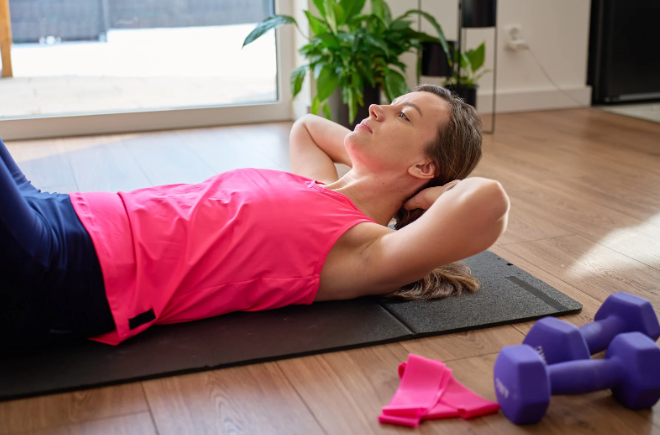
At the beginning, there’s no need to fill your home with equipment. In most cases, a minimal setup aligned with your chosen method is enough. A mat helps with floor work and mobility, resistance bands make many exercises more gradual and accessible, and a pair of light dumbbells allows you to introduce basic strength work. This kind of setup reduces friction, keeps initial investment low, and gives you time to understand what you actually need before buying more.
The key is that equipment should not be chosen randomly, but as an extension of the method. If you start with bodyweight and mobility, a mat and bands make more sense than complex tools. If your initial path is basic home strength training, light dumbbells become a logical first step. In this way, the setup is not the goal, but a support. For beginners, the most effective combination is almost always this: few tools, well chosen, within a simple and sustainable method. That’s how home training stops being a vague idea and becomes a concrete, structured, and truly achievable habit.
Comments (0)