
Trolley
You have no items in your shopping cart

 Budgets
 Dumbers
 Discs
Discs
 Benches
 Racks and Rigs
 Weights Holders
 Isotonic machines
 Calisthenics
 Cardio
 Kettlebells
 Flooring
 Gym Set
 Accessories
 Combat
 ARTI MARZIALI
 CONTAINER GYM
 Tug-Of-War
 Used Gym Equipment
 PILATES MACCHINARI
 GINNASTICA ARTISTICA
 CAMPI DA PADEL
 Prodotti in Pronta Consegna
 Informazioni
 IRONMAN
 Gift Card
- Donatif
- Training and exercises
- 0 I like it
- 2309 Views
- 0 comments
READING TIME: 5 MINUTES ➤➤
Calf Stretching for More Mobile Ankles
Ankle mobility is one of the most underestimated aspects of fitness and running, yet it has a direct impact on performance, injury prevention, and joint health. Limited dorsiflexion can compromise athletic movement, reduce the effectiveness of exercises such as squats, and increase the risk of overload in the knees and hips. But where does this stiffness actually come from? Often, the problem does not lie in the ankle itself, but in the calf muscles.
Understanding this cause-and-effect relationship is the first step toward addressing the issue effectively. Proper calf stretching not only improves flexibility but can literally “unlock” the ankle and restore fluidity to movement. In this article, we will explore why the calf becomes tight, how this affects dorsiflexion, and which exercises can make a real difference. :contentReference[oaicite:0]{index=0}
- A Tight Calf: A Hidden Limitation to Mobility
- How the Calf Influences the Ankle
- Improving Dorsiflexion with the Right Stretching
- More Flexibility, Better Performance
A Tight Calf: A Hidden Limitation to Mobility
Why the Calf Becomes Tight
The calf muscles, particularly the gastrocnemius, tend to shorten when they are neglected or repeatedly stressed in the same way. Activities such as running on hard surfaces, wearing rigid footwear, or simply neglecting stretching exercises can gradually lead to a loss of muscular elasticity. This shortening is not always associated with pain, but it often manifests as reduced ankle joint freedom.
A chronically tight calf becomes less responsive, less efficient, and more prone to strains. In addition, it restricts the natural extension of the leg, forcing the body to compensate incorrectly during complex movements such as jumping, squatting, or even walking downhill.
Signs That Your Calf Is Too Tight
There are several clear indicators of poor calf flexibility. One of the most obvious is difficulty keeping the heel on the ground during a deep squat or the inability to bend the ankle without lifting the heel. A constant sensation of tension behind the knee or along the Achilles tendon is another warning sign that should not be ignored.
Runners may notice a shorter stride length or a harsher heel strike. In the gym, stiffness often appears as compensatory movement patterns during deadlifts or lunges. Recognizing these signs early makes it possible to intervene with targeted stretching and mobility strategies. :contentReference[oaicite:1]{index=1}
How the Calf Influences the Ankle
The Direct Link Between the Calf Muscle and Dorsiflexion
Dorsiflexion is the movement that allows the tibia to move forward over the foot during weight-bearing activities. This seemingly simple action is heavily influenced by the length and mobility of the triceps surae, the muscle complex that forms the calf. If this muscle group is shortened, the tibia cannot move forward properly, causing the movement to stop prematurely.
A lack of dorsiflexion has consequences throughout the kinetic chain. To compensate, the knee may collapse inward or the hip may rise unnaturally. These alterations increase joint stress and compromise movement quality, both in running and in functional exercises.
A Stiff Ankle? The Problem May Not Be Where You Think
When people talk about a “stiff ankle,” they often assume the restriction comes from the joint itself. In reality, in most cases the limitation is caused by an excessively tight posterior muscle chain, with the calf being the primary culprit. A shortened calf acts as a mechanical brake that limits the ankle’s normal range of motion.
For this reason, mobilizing the joint alone is not enough. It is necessary to address the surrounding soft tissues, improving their elasticity and ability to glide effectively. Only then can functional and safe dorsiflexion be fully restored. :contentReference[oaicite:2]{index=2}
Improving Dorsiflexion with the Right Stretching
The Most Effective Exercises for Calf Stretching
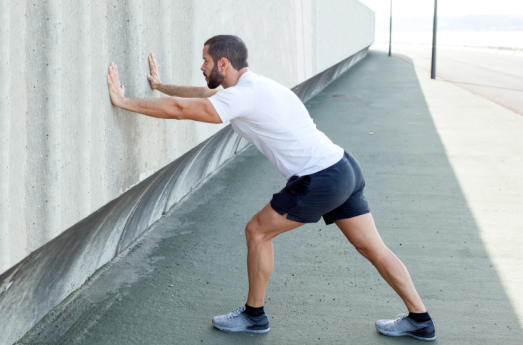
Traditional static stretching, such as the classic wall calf stretch, is a good starting point, but it is rarely sufficient on its own. The most effective exercises combine stretching, breathing, and foot activation. An ideal sequence includes movements such as the “knee-to-wall” drill, dynamic lunge mobilizations, and eccentric-loaded stretching, where the muscle lengthens while remaining active.
It is equally important to work on both major calf muscles: the gastrocnemius and the soleus. The soleus, often overlooked, plays a crucial role in dorsiflexion, especially when the knee is bent. Incorporating these exercises into a weekly routine can significantly improve mobility and movement quality.
When and How to Include Stretching in Your Routine
The best time to perform calf stretching is at the end of a workout or during a dedicated mobility session. At this point, the tissues are already warm and more receptive to lengthening. It is recommended to hold each stretch for at least 60 seconds while breathing slowly and deeply.
For runners and strength-training enthusiasts, a frequency of three to four sessions per week is often enough to produce noticeable improvements. In the early stages, combining stretching with myofascial release techniques such as foam rolling or massage can accelerate progress and enhance results. :contentReference[oaicite:3]{index=3}
More Flexibility, Better Performance
The Benefits for Running, Squats, and Everyday Mobility
A more flexible calf allows you to maximize propulsion while running, improve exercise execution in the gym, and reduce the risk of overload injuries. During a squat, for example, adequate dorsiflexion helps maintain an upright torso and distribute load more efficiently. In running, it improves stride elasticity and reduces impact forces on the ground.
These benefits also extend into everyday life. Climbing stairs, squatting down, or walking on uneven terrain become smoother and more natural movements. Flexibility is not only about aesthetics or performance—it is about joint functionality and long-term movement quality. :contentReference[oaicite:4]{index=4}
How to Maintain Results Over Time
Like any physical adaptation, flexibility must be maintained over time. Without continued stimulus, the body tends to revert to previous patterns. The most effective strategy is to integrate stretching into your weekly training schedule, varying the exercises and adapting them according to your needs and sensations.
In addition, paying attention to the quality of daily movement—such as standing posture, walking mechanics, and footwear choices—can help prevent regression. Consistency is the key: even short daily sessions can preserve your results and make your body more efficient, agile, and resilient. :contentReference[oaicite:5]{index=5}
Comments (0)