
Trolley
You have no items in your shopping cart

 Budgets
 Dumbers
 Discs
Discs
 Benches
 Racks and Rigs
 Weights Holders
 Isotonic machines
 Calisthenics
 Cardio
 Kettlebells
 Flooring
 Gym Set
 Accessories
 Combat
 ARTI MARZIALI
 CONTAINER GYM
 Tug-Of-War
 Used Gym Equipment
 PILATES MACCHINARI
 GINNASTICA ARTISTICA
 CAMPI DA PADEL
 Prodotti in Pronta Consegna
 Informazioni
 IRONMAN
 Gift Card
- Donatif
- General information
- 0 I like it
- 76 Views
- 0 comments
- gym flooring, safety flooring, gym safety, shock-absorbing materials
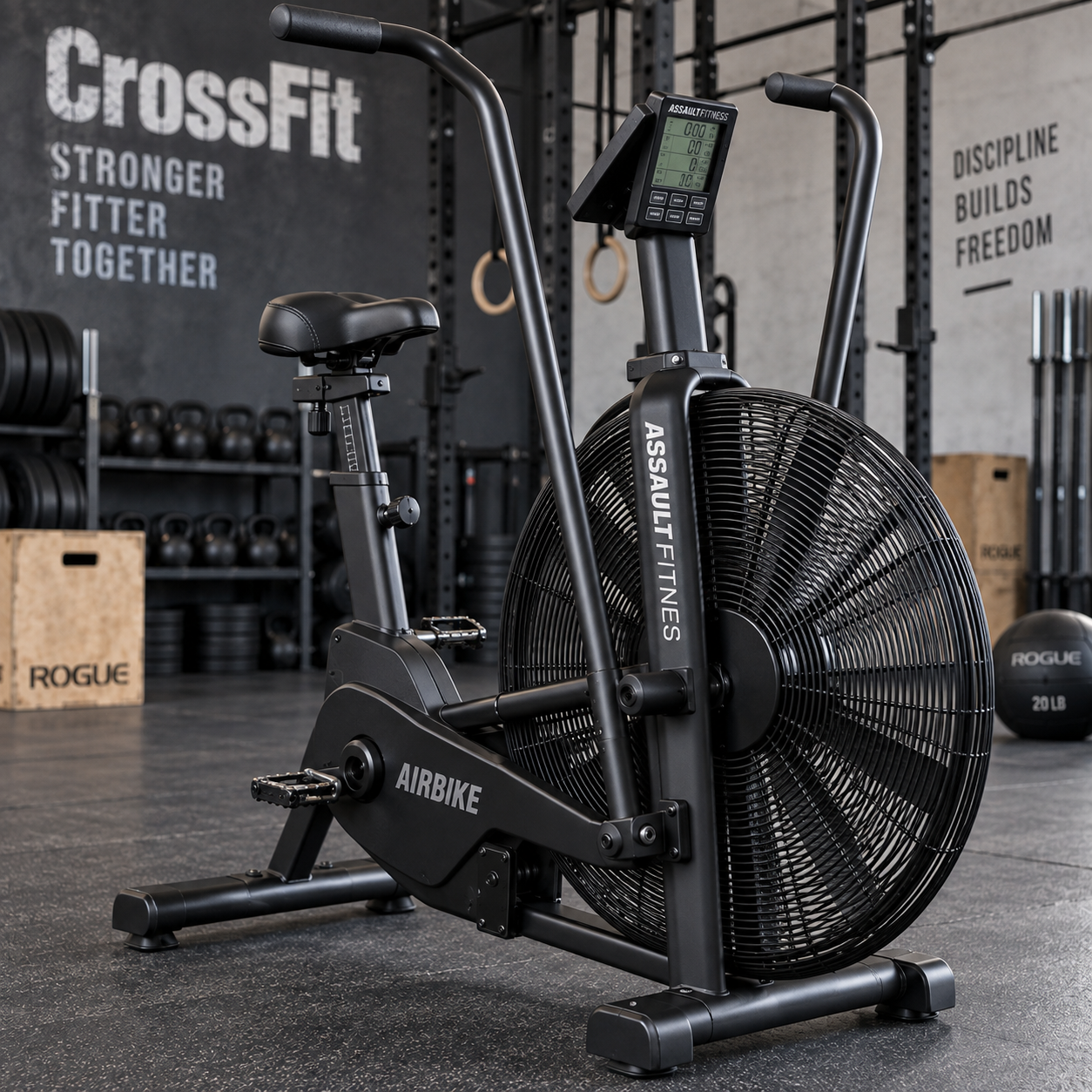
Air bike for CrossFit box: selection and setup criteria
An air bike for a CrossFit box must be chosen and configured to withstand high-intensity workouts, repeated daily use, and rapid transitions between athletes. The most effective solution comes from combining structural robustness, ease of adjustment, proper spatial arrangement, and a scheduled maintenance plan.
In CrossFit boxes, the air bike is used in numerous contexts, such as warm-ups, interval training, metabolic circuits, and high-intensity workouts. For this reason, the design of the dedicated area must guarantee fluid movements, safety during use, and ease of access even during the largest classes.
A well-thought-out configuration improves the box's operational management, reduces downtime between exercises, and helps preserve equipment over time. Choosing the position, flooring, and maintenance procedures is therefore an integral part of cardio area design.
- What requirements must an air bike for a CrossFit box meet?
- How much space should be dedicated to the air bike?
- How to set up the training area?
- How to use the air bike correctly?
- What safety aspects should be considered?
- How to organize maintenance?
- Design errors to avoid
- How to evaluate the investment
What requirements must an air bike for a CrossFit box meet?
An air bike intended for intensive use must offer a stable structure, components designed to withstand repeated sessions, and simple adjustments to make between users. Build quality directly affects operational continuity and equipment lifespan.
The presence of a reliable transmission, an intuitive adjustment system, and a fan designed for frequent use makes it possible to sustain continuous workouts without compromising user comfort.
Ease of maintenance is also an important criterion, especially in boxes that organize numerous classes throughout the day.
Structural robustness
A rigid frame helps maintain stability during the most intense workouts and reduces wear caused by continuous use.
Simplicity of adjustments
The saddle and handlebars should be quickly adjustable to adapt the position for users with different physical characteristics.
How much space does an air bike occupy?
The question of how much space an air bike occupies cannot be resolved by solely considering the machine's footprint. During design, it is also necessary to account for the space required to get on and off the equipment, comfortably use the moving handles, and allow other users to pass by.
The layout should maintain clear pathways between stations and facilitate the coach's supervision during group classes.
To define operational spaces, it is advisable to refer to the dimensions and clearances provided by the specific air bike manufacturer.
Layout organization
Stations should be distributed to avoid interfering with areas dedicated to barbells, kettlebells, and other circuit exercises.
Flooring
Stable flooring suited to the activity performed helps improve safety, comfort, and equipment durability. To explore dedicated solutions, you can consult the gym flooring category.
How to set up the dedicated area?
The configuration depends on the number of available air bikes, the size of the box, and the type of workouts proposed. Stations should be easily reachable and allow rapid transitions during workouts.
It is useful to keep the cardio area separate from heavy lifting zones, avoiding overlaps between pathways and operational spaces.
An orderly layout also facilitates cleaning operations and allows for quick inspection of all equipment before classes begin.
Group workouts
In large classes, the arrangement of air bikes should allow the instructor to easily observe all athletes.
Functional circuits
Placing the air bike near other cardio stations can make rotations smoother during circuit workouts.
How to use the air bike correctly?
Understanding air bike: how it works and what it is for is fundamental to harnessing its potential. Resistance is generated by the fan and increases progressively with the intensity of pedaling and the push exerted on the moving handles.
Before use, it is advisable to adjust the saddle and handlebars according to the manufacturer's instructions, verifying that all adjustments are properly locked.
The equipment can be used for warm-ups, aerobic work, interval training, and high-intensity metabolic sessions, adapting duration and intensity to training goals.
Warm up
The air bike represents an effective solution to prepare the body before technical or strength exercises.
Interval training
Alternating phases of intense work and recovery allows the machine to be used in numerous types of programming.
What safety aspects should be considered?
Every air bike should be installed following the manufacturer's instructions, verifying correct floor support and keeping the surrounding area clear.
It is important to regularly check structural stability, component tightening, and the proper functioning of adjustments before starting activities.
Users should get on and off the machine only when the pedals and handles have completely stopped.
Pre-use checks
A quick visual inspection makes it possible to spot any anomalies before starting the workout.
User instructions
Adjustments should be demonstrated by box staff to new users to reduce the risk of errors.
How to organize maintenance?
Preventive maintenance includes cleaning the machine, checking tightness, verifying moving parts and adjustments, and inspecting the fan to remove dust and debris that could compromise its operation.
The frequency of interventions depends on usage intensity and should follow the instructions in the manufacturer's technical manual.
Documenting checks facilitates the planning of maintenance activities and helps reduce equipment downtime.
Periodic cleaning
Keeping the fan, frame, and contact surfaces clean helps preserve machine performance.
Scheduled inspections
Technical checks make it possible to promptly identify worn components or incorrect adjustments.
What design errors should be avoided?
One of the most common errors consists of placing air bikes too close to each other or in areas that interfere with pathways used during functional workouts.
Other critical issues concern failing to plan maintenance, the absence of dedicated spaces for initial adjustments, and choosing flooring unsuited to the intended use.
It is also advisable to avoid configuring the layout without considering potential future box expansions or the addition of new cardio stations.
Stations placed too close together
An excessively compact distribution can reduce user comfort and make transitions during workouts less convenient.
Lack of planning
A project developed considering future growth and maintenance allows for more efficient facility management.
How to evaluate the investment?
An air bike for a CrossFit box represents an investment that should be evaluated considering robustness, ease of maintenance, spare parts availability, and consistency with the training model proposed by the box. A correctly designed configuration improves operational management and helps prolong equipment useful life.
Before purchasing, it is advisable to analyze available space, average users per class, frequency of use, and potential for future expansion. For dimensions, adjustments, installation, and maintenance, it is appropriate to refer to the manufacturer's manuals and technical documentation of the specific air bike, avoiding standard configurations that apply indiscriminately to every facility.
Comments (0)