
Trolley
You have no items in your shopping cart

 Budgets
 Dumbers
 Discs
Discs
 Benches
 Racks and Rigs
 Weights Holders
 Isotonic machines
 Calisthenics
 Cardio
 Kettlebells
 Flooring
 Gym Set
 Accessories
 Combat
 ARTI MARZIALI
 CONTAINER GYM
 Tug-Of-War
 Used Gym Equipment
 PILATES MACCHINARI
 GINNASTICA ARTISTICA
 CAMPI DA PADEL
 Prodotti in Pronta Consegna
 Informazioni
 IRONMAN
 Gift Card
- Donatif
- General information
- 0 I like it
- 531 Views
- 0 comments
- gym flooring, safety flooring, gym safety, shock-absorbing materials
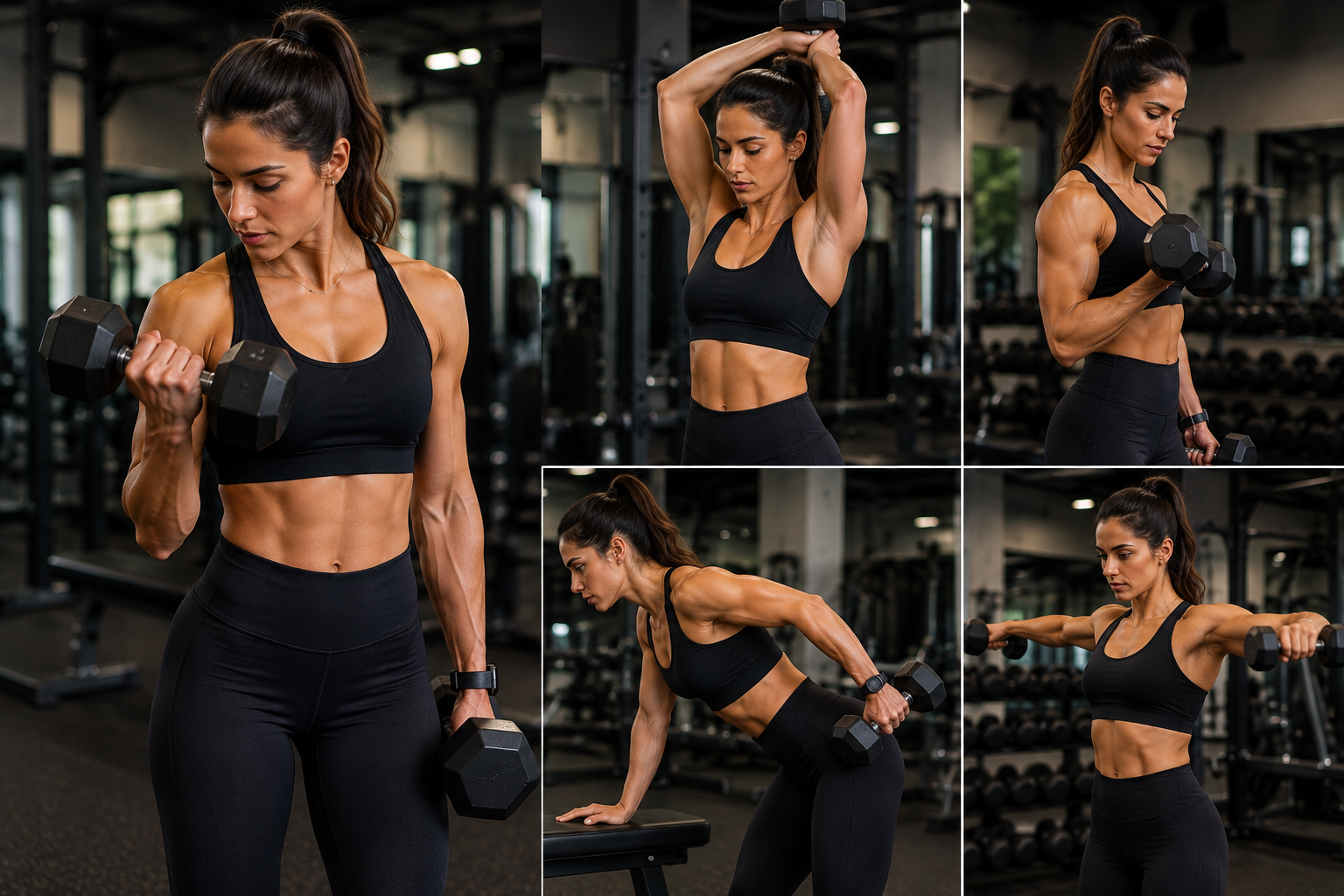
Dumbbell arm workout: complete protocol for biceps and triceps
Training your arms effectively does not simply mean performing many curl repetitions or choosing the heaviest load possible. To develop stronger, more voluminous, and proportionate biceps and triceps, it is necessary to use a strategy based on targeted exercises, movement control, and proper intensity management. A dumbbell arm workout program allows you to achieve excellent results even using only one type of equipment, taking advantage of the versatility of free weights.
Dumbbells offer the possibility of working each arm independently, improving muscle balance and control. Compared to many guided solutions, they require greater stabilization and allow you to adapt the movement trajectory to your own physical characteristics.
For those who have little time available but want to maximize the effectiveness of their training, techniques such as antagonistic supersets between biceps and triceps represent a particularly interesting solution. Alternating opposite muscle groups allows you to keep intensity high while reducing rest times and improving session density.
- Why train your arms with dumbbells
- Anatomy of biceps and triceps
- Principles of an effective arm workout
- Best bicep exercises with dumbbells
- Best tricep exercises with dumbbells
- Antagonistic supersets to maximize the pump
- Common mistakes in arm training
- Building strong arms with a single tool
Why train your arms with dumbbells
Dumbbells are one of the most effective tools for developing arm musculature because they allow for free and customizable work. Each side of the body must control the load independently, fostering a better mind-muscle connection.
This feature is particularly useful for those who have strength differences between their right and left arms. By working separately, it is possible to distribute the effort more evenly and improve overall symmetry.
Furthermore, dumbbells require greater involvement of the stabilizing muscles of the arm and shoulder joint, creating a more complete stimulus compared to overly restricted movements.
Advantages over other equipment
Barbells and machines can be useful tools, but dumbbells offer superior freedom of movement. This feature allows you to slightly modify angles and trajectories to find the most effective and comfortable position.
For a home gym, they also represent a practical solution because they allow you to train numerous muscle groups without taking up much space.
Efficiency for those with little time
Those with a busy routine can achieve excellent results by organizing short but intense sessions. Dumbbells allow you to move quickly from one exercise to another and integrate perfectly with techniques such as supersets.
Intelligent programming therefore allows you to maximize the work done in every available minute.
Anatomy of biceps and triceps
To build complete arms, it is important to understand the role of the main muscles involved. The arm is not composed only of the bicep: the tricep represents a significant part of the total volume and plays a fundamental role in elbow extension.
A balanced program must therefore dedicate attention to both flexion and extension movements.
Working both groups allows you to develop better proportions and greater functional capacity.
Bicep function
The bicep is mainly involved in elbow flexion and forearm supination. During dumbbell exercises, it is important to control both phases of the movement, focusing on both the contraction and the descent.
Controlled execution increases the quality of the muscle stimulus.
Tricep function
The tricep is primarily responsible for elbow extension and contributes significantly to the size of the arm. For this reason, neglecting it limits the overall development of the upper limb.
Specific dumbbell exercises allow you to effectively stimulate all components of the muscle.
Principles of an effective arm workout
An effective arm workout must combine adequate volume, intensity, and progression. Simply increasing the number of exercises does not guarantee better results if a precise strategy is missing.
Movement control, load selection, and the ability to create muscle tension are fundamental elements.
A well-structured program allows you to improve continuously without accumulating unnecessary fatigue.
Load selection and technique
Using a weight that is too heavy often leads to compensations with the shoulders and back, reducing the actual work on the arm muscles. A correct load instead allows you to maintain control throughout the entire set.
The quality of execution must always take priority over the number indicated on the dumbbell.
Importance of progression
To continue developing strength and muscle mass, it is necessary to gradually increase the stimulus. This can happen through heavier loads, more repetitions, or better management of rest periods.
Constant progression represents the principle behind any lasting improvement.
Best bicep exercises with dumbbells
Biceps respond very well to dumbbell exercises because it is possible to completely control the movement and focus on muscle contraction. The variety of exercises allows you to stimulate the muscle from different angles.
Alternating traditional flexion movements and neutral grip variants allows you to create more complete arm development.
Consistency and technical precision are more important than simply chasing the maximum load.
Dumbbell curl
The dumbbell curl is one of the fundamental exercises for training the biceps. The movement consists of elbow flexion while maintaining control of the negative phase.
Avoiding body momentum allows you to focus the work more on the target muscle.
Hammer curl
The hammer curl uses a neutral grip that involves the brachialis and brachioradialis more, contributing to the development of arm thickness.
It is a particularly useful exercise for building more complete and functional musculature.
Best tricep exercises with dumbbells
Triceps represent a fundamental component for increasing arm volume. A dedicated workout must include exercises capable of stimulating the muscle in different positions.
Dumbbells allow you to work with great freedom and adapt the movement to your own joint characteristics.
Proper tricep development also improves pushing capacity in upper body exercises.
Dumbbell French press
The dumbbell French press is a widely used exercise for training triceps through overhead elbow extension. This position allows you to emphasize the work of the long head of the tricep.
Control of the descent and ascent is fundamental to obtaining the maximum benefit.
Tricep extensions with dumbbells
Tricep extensions allow you to focus on the elbow extension action and can be performed in different variations.
They are simple but extremely effective exercises when performed with correct technique.
Antagonistic supersets to maximize the pump
Antagonistic supersets represent a very effective technique for training arms intensely while reducing training time. The principle consists of alternating exercises for opposite muscles, such as biceps and triceps, without a long break between the two movements.
This strategy allows you to increase session density and create a strong sensation of muscle work.
For those with little time, it represents a practical solution for obtaining a high stimulus in a limited duration.
How the bicep-tricep superset works
A classic example consists of performing a bicep curl followed immediately by a tricep extension. While one group works, the other partially recovers.
This allows you to keep intensity high without excessively prolonging the session.
Advantages for muscle pump
Alternating between antagonistic muscles promotes high muscle congestion and an intense perception of the work performed.
The pump is not the only indicator of effectiveness, but it can be a consequence of good volume and intensity management.
Common mistakes in arm training
Many people make mistakes that limit progress in arm training. The most frequent one consists of focusing exclusively on the weight used while ignoring technique and control.
A more reasoned approach allows you to achieve better results in the long term.
The quality of the stimulus must always be at the center of the programming.
Using momentum during exercises
Moving the body to help the dumbbell reduces the actual work of the target muscles. This often happens when the load is beyond one's capabilities.
Reducing the weight and improving control often leads to more effective results.
Neglecting recovery
Arm muscles also need recovery to adapt to the stimuli received. Training them too frequently without proper management can slow down progress.
Recovery is an integral part of the muscle growth process.
Building strong arms with a single tool
A complete arm program can be created using exclusively dumbbells, provided it is organized with criteria. The combination of bicep and tricep exercises, load progression, and techniques such as supersets allows you to obtain an effective stimulus even with little time available.
The versatility of dumbbells allows you to train your arms completely, improving strength, volume, and muscle control. The difference in results does not depend on the number of tools available, but on the quality of the programming and consistency in application.
Choosing reliable tools such as adjustable dumbbells allows you to create a flexible training solution, suitable for following the athlete's progression over time and supporting increasingly ambitious goals.
Comments (0)