
Trolley
You have no items in your shopping cart

 Budgets
 Dumbers
 Discs
Discs
 Benches
 Racks and Rigs
 Weights Holders
 Isotonic machines
 Calisthenics
 Cardio
 Kettlebells
 Flooring
 Gym Set
 Accessories
 Combat
 ARTI MARZIALI
 CONTAINER GYM
 Tug-Of-War
 Used Gym Equipment
 PILATES MACCHINARI
 GINNASTICA ARTISTICA
 CAMPI DA PADEL
 Prodotti in Pronta Consegna
 Informazioni
 IRONMAN
 Gift Card
- Donatif
- General information
- 0 I like it
- 651 Views
- 0 comments
- gym flooring, safety flooring, gym safety, shock-absorbing materials
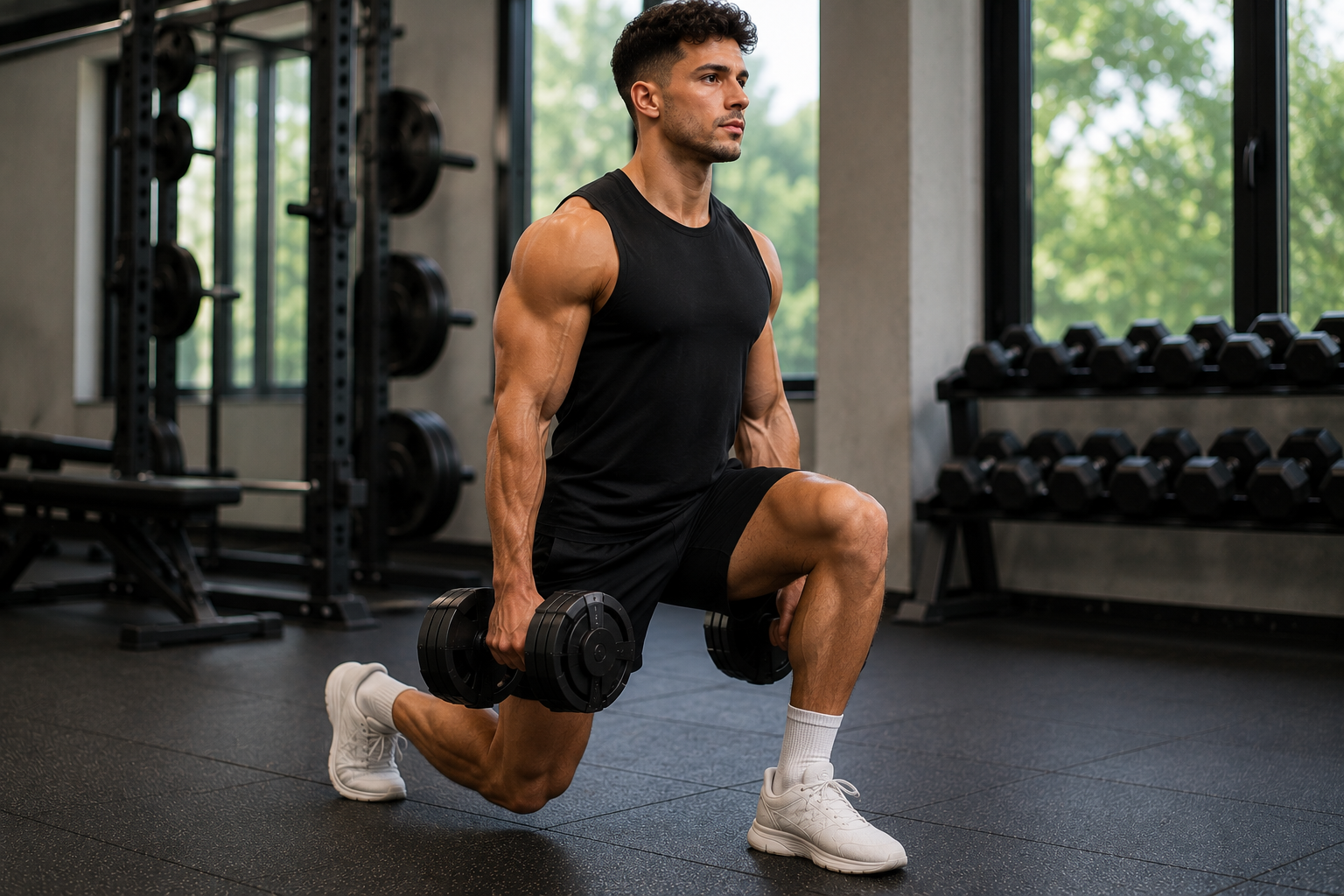
Dumbbell lunges: train legs and glutes even in small spaces
Training your legs effectively does not necessarily require large machines, professional racks, or a full gym. Dumbbell lunges represent one of the most versatile exercises for developing strength, balance, and muscle mass using only a pair of weights and a small space. For those who want to build a compact home gym or train at home without sacrificing the quality of work on the lower limbs, lunges offer an extremely effective solution.
This movement simultaneously involves the glutes, quadriceps, hamstrings, and stabilizer muscles, requiring body control and coordination. The ability to perform numerous variations also allows you to modify the training stimulus based on your goals: increasing strength, improving stability, or focusing more on glute activation.
Lunges are often considered a simple accessory exercise, but in reality, they can become the heart of a complete leg program. Through proper technique, load progression, and an intelligent choice of variations, it is possible to achieve significant results even without using barbells or bulky machines.
- Why dumbbell lunges are a fundamental exercise
- Muscles involved in dumbbell lunges
- Correct technique for dumbbell lunges
- Dumbbell lunge variations
- Dumbbell walking lunges and performance
- Home glute training with lunges
- Common mistakes in dumbbell lunges
- Building strong legs in small spaces
Why dumbbell lunges are a fundamental exercise
Lunges are one of the most complete movements for training the lower body because they replicate a pattern very close to natural movements. Walking, climbing stairs, changing direction, and shifting body weight require skills similar to those developed during this exercise.
Using dumbbells increases the difficulty because it adds an external load that the body must control during every phase of the movement. Unlike exercises performed on guided machines, lunges require greater stability and also involve muscles responsible for balance.
For those training at home, they represent an extremely practical solution because they allow you to obtain a high stimulus while occupying very little space.
Benefits of unilateral work
One of the most important aspects of lunges is unilateral work, that is, the ability to train one leg at a time. This allows you to reduce any strength differences between limbs and improve muscle symmetry.
In bilateral exercises, in fact, the stronger side can compensate for the weaker one. With lunges, each leg must contribute independently.
Efficiency for the home gym
An effective home gym must use equipment capable of offering many possibilities with a small footprint. Dumbbell lunges perfectly respect this principle because they allow you to train multiple muscle groups with a single movement.
This feature makes them ideal for those who have limited space but want to achieve professional results.
Muscles involved in dumbbell lunges
Lunges involve numerous lower limb muscles and require continuous collaboration between strength and stability. The distribution of the stimulus changes based on step length, torso position, and the chosen variation.
Understanding which muscles are working allows you to better choose the technique and adapt the exercise to personal goals.
Correct execution allows for a complete workout for legs and glutes.
Glutes and quadriceps in lunges
The quadriceps participate mainly in the upward phase through knee extension, while the glutes contribute to hip thrust and pelvic stabilization.
The body position can modify the involvement of the two muscle groups, allowing you to emphasize a specific area more.
Hamstrings and stabilizer muscles
The hamstrings also participate in the movement, contributing to the control of the descent and the stability of the joint. Furthermore, the core works constantly to keep the trunk in the correct position.
This makes lunges a complete exercise from a functional point of view.
Correct technique for dumbbell lunges
Technique in dumbbell lunges is fundamental because the movement requires balance and control. Inaccurate execution can reduce the effectiveness of the exercise and increase stress on the joints.
The first goal must be to learn the movement with a manageable load, progressively increasing the weight only when the technique is consolidated.
The quality of the repetition must always take priority over the amount of load used.
Starting position and descent
The starting position involves an upright body, dumbbells held at the sides, and a stable base. During the descent, the knee must follow a controlled trajectory while the body lowers vertically.
Controlling the negative phase increases the muscle stimulus and improves the safety of the movement.
Push and ascent
In the upward phase, it is important to push through the foot of the front leg while maintaining control of the pelvis. The movement must be fluid without using torso momentum.
A correct push allows for greater involvement of the glutes and quadriceps.
Dumbbell lunge variations
One of the main advantages of lunges is the great variety of executions available. By modifying direction, step width, and movement dynamics, it is possible to create different stimuli while maintaining the same basic pattern.
This versatility allows you to build complete programs even using only dumbbells.
Each variation has specific characteristics and can be chosen based on the athlete's goals.
Front dumbbell lunges
Front lunges involve a step forward followed by the descent of the body. They are one of the best-known variations and allow you to work on strength, balance, and coordination.
They require control because the body weight must be managed during the change of position.
Rear dumbbell lunges
Rear lunges involve moving the leg backward. This variation may be easier to control for many people because it allows you to keep the starting position more stable.
They are particularly useful for those who want to focus on technique and movement quality.
Lateral dumbbell lunges
Lateral lunges introduce a movement on the frontal plane, involving more of the muscles responsible for lateral hip stability.
This variation helps improve mobility and the ability to move in different directions.
Dumbbell walking lunges and performance
Dumbbell walking lunges represent a dynamic variation that combines strength, coordination, and muscular endurance. Unlike static lunges, they require continuous changes of support and greater ability to control space.
They are widely used in functional training because they simulate movements closer to sports and daily activities.
Their effectiveness derives from the combination of muscle work and cardiovascular demand.
Benefits of dynamic lunges
Walking while holding dumbbells increases the demand for stability and forces the body to continuously manage weight transfer.
This improves motor control and the ability to maintain a correct position during prolonged movements.
Load management in walking lunges
The load used in walking lunges must be chosen carefully because the balance component increases compared to static variations.
An adequate weight allows you to maintain technical quality for the entire duration of the exercise.
Home glute training with lunges
Lunges are one of the most effective exercises for those who want to develop their glutes while training at home. Their ability to involve hip extension and pelvic stabilization makes them particularly useful for creating a complete stimulus.
Included within a well-organized program, they can contribute to the development of strength and muscle tone even without specific machines.
Load progression and the choice of variations allow you to adapt the training to different levels of experience.
Increasing glute activation
A greater controlled inclination of the torso and an adequate step can modify the distribution of the stimulus towards the glutes.
The technique must, however, remain stable and safe.
Integrating lunges into the home routine
Lunges can be combined with squats, Romanian deadlifts, and other movements to create a complete leg workout.
Their versatility allows them to be included both in strength-oriented programs and in more dynamic circuits.
Common mistakes in dumbbell lunges
Like any complex exercise, lunges can also be performed ineffectively if attention to technical details is lacking. The most common mistakes concern balance, load choice, and position control.
Correcting these aspects allows you to obtain greater benefits and reduce the risk of overloading.
Technique must always be the starting point.
Step too short
An excessively short step can limit the depth of the movement and increase stress on the knee. An adequate distance, on the other hand, allows for better distribution of work between the involved joints.
The position must be adapted to individual characteristics.
Using excessive load
Too much weight can compromise balance and control, especially in dynamic variations.
Gradual progression allows you to improve without sacrificing the quality of the movement.
Building strong legs in small spaces
Dumbbell lunges prove that you don't need large equipment to build strong legs and develop glutes and quadriceps. Through different variations, it is possible to create a complete, adaptable workout suitable even for the smallest spaces.
Their value derives from the combination of muscle effectiveness, unilateral work, and the demand for body control. This makes them one of the smartest exercises for a results-oriented home gym.
Choosing versatile equipment like adjustable dumbbells allows you to build a compact and progressive training solution, capable of accompanying the athlete's evolution over time.
Comments (0)