
Trolley
You have no items in your shopping cart

 Budgets
 Dumbers
 Discs
Discs
 Benches
 Racks and Rigs
 Weights Holders
 Isotonic machines
 Calisthenics
 Cardio
 Kettlebells
 Flooring
 Gym Set
 Accessories
 Combat
 ARTI MARZIALI
 CONTAINER GYM
 Tug-Of-War
 Used Gym Equipment
 PILATES MACCHINARI
 GINNASTICA ARTISTICA
 CAMPI DA PADEL
 Prodotti in Pronta Consegna
 Informazioni
 IRONMAN
 Gift Card
- Donatif
- General information
- 0 I like it
- 8 Views
- 0 comments
- gym flooring, safety flooring, gym safety, shock-absorbing materials
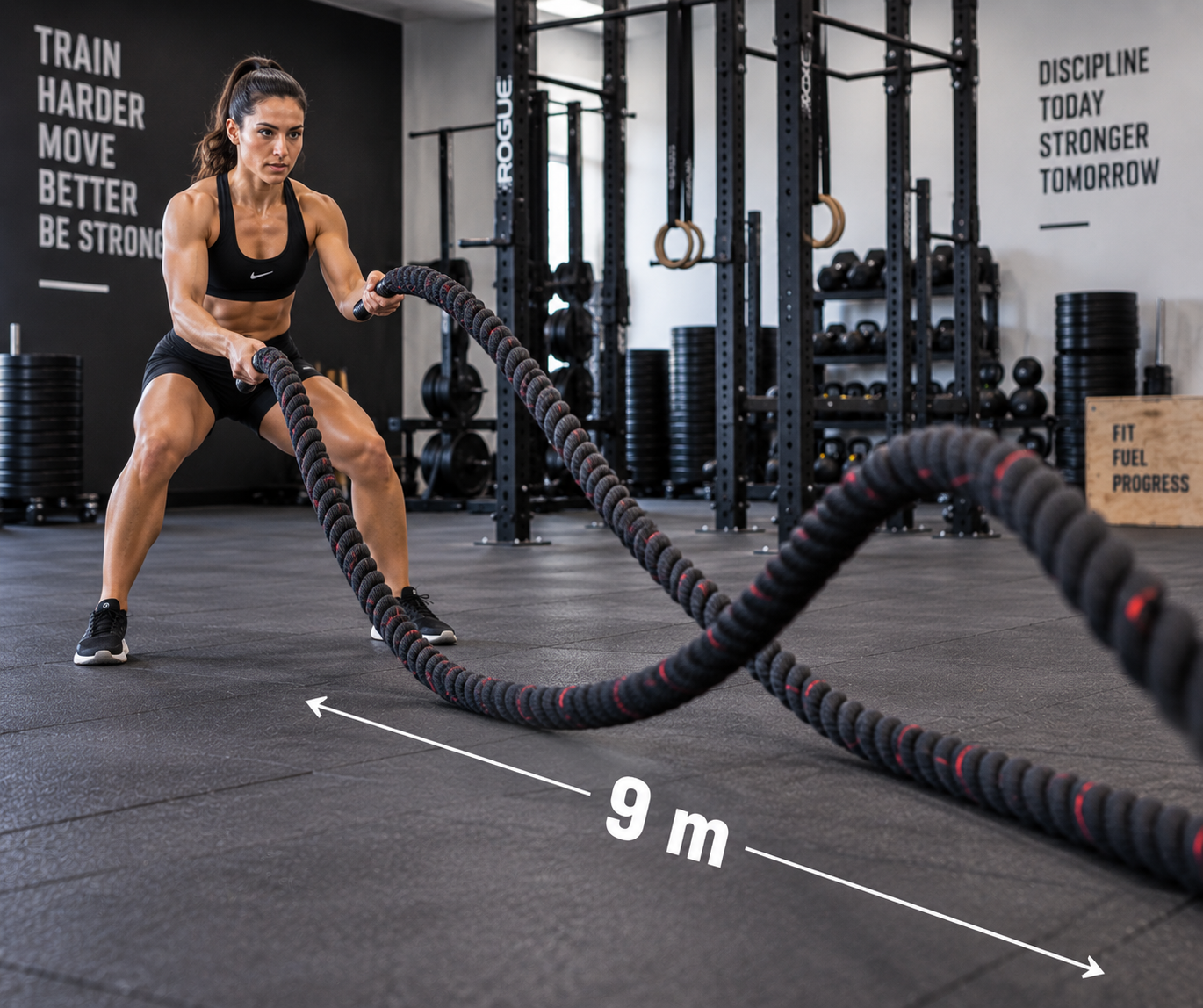
Battle rope 9 m vs 12 m: which one to choose?
The 9-meter and 12-meter battle ropes meet different needs. The 9-meter version favors ease of use, wave control and a smaller footprint, while the 12-meter version increases the rope's inertia and makes exercises more demanding for the same technique. The choice depends on the user's level, available space and training goals.
There is no single best measurement in absolute terms. A longer rope does not automatically guarantee superior results, just as a shorter rope does not necessarily represent a solution intended for beginners. Each configuration offers specific benefits that must be evaluated within the context of use.
Before purchasing, it is therefore useful to compare length, diameter, work intensity and required space, avoiding basing the decision exclusively on the rope's weight or price.
- Quick answer
- What are the main differences
- Comparison table
- When to choose a 9-meter battle rope
- When to choose a 12-meter battle rope
- Diameter 38 mm vs 50 mm
- Choice mistakes
- FAQ
- How to evaluate the investment
Battle rope 9 m or 12 m: which is better?
A 9-meter rope generally represents the most versatile solution for home gyms, personal training studios and users who want a good balance between intensity and control. The 12-meter version, on the other hand, is recommended when looking for greater resistance while generating waves and when adequate space is available.
Both are normally anchored at the center point, so each hand works on half of the total length. The difference therefore concerns the amount of rope to put into motion during each repetition.
To make the correct choice, it is advisable to consider technical level, type of training and configuration of the available area together.
What is the most important criterion?
The main criterion is not the rope's weight but the user's ability to maintain correct technique throughout the set.
Does experience level matter?
Yes. An experienced athlete can better exploit the inertia of a longer rope, while beginners often benefit more from a more manageable solution.
What are the differences between 9 and 12-meter battle ropes?
The most obvious difference concerns the rope's inertia. A greater length requires a larger amount of force to generate continuous and controlled waves.
The operating space also changes significantly. A 12-meter rope requires a wider area to work without limitations and without interfering with other equipment.
From a technical standpoint, both allow you to perform the same exercises, but they modify the level of effort required during each movement.
Wave behavior
The 9-meter rope favors a quicker response during the wave technique, while the 12-meter version generates slower movements and a greater muscular demand.
Space influence
Before purchasing, it is advisable to verify that the available area is compatible with the rope length and the anchor point.
Comparison table
The following table summarizes the main decision-making criteria.
| Feature | Battle rope 9 m | Battle rope 12 m |
|---|---|---|
| Recommended level | Beginner and intermediate | Intermediate and advanced |
| Wave control | Easier | More demanding |
| Perceived intensity | Medium | Higher |
| Required space | More compact | Wider |
| Typical use | Home gyms and studios | Gyms and functional areas |
| Technical progression | Gradual | Requires more experience |
The table highlights that the choice depends primarily on the context of use and not exclusively on the rope's characteristics.
How to interpret the comparison
When multiple criteria seem equivalent, it is advisable to prioritize available space and the quality of technical execution.
Which parameter weighs the most?
For most users, the combination of rope length and training area represents the most important decision-making factor.
When to choose a 9-meter battle rope?
The 9-meter version is recommended when looking for a versatile rope, easily manageable and suitable for different training programs.
It is often used in home gyms, personal training studios and functional areas with limited space.
It also allows you to develop good technique before moving on to more demanding configurations.
Main advantages
Greater control, better management of wave speed and a smaller footprint represent the main strengths.
Who is it recommended for
It is a balanced choice for those who alternate individual exercises and metabolic circuits without the need to increase the rope's inertia.
When to choose a 12-meter battle rope?
The 12-meter version is intended for those who want to increase the effort required during training while maintaining the same execution technique.
The higher inertia requires greater participation of the upper limb and core musculature.
To fully exploit its characteristics, it is advisable to have a sufficiently large area available.
Why choose a longer rope
The greater length increases difficulty without changing the type of exercises.
Where it is used most often
It finds application above all in professional gyms and centers dedicated to functional training.
Diameter 38 mm vs 50 mm
In addition to length, it is also important to evaluate the rope's diameter. Models of about 38 mm are generally easier to grip and allow a high wave frequency.
Versions of about 50 mm instead require a stronger grip and increase forearm involvement throughout the set.
Length and diameter should always be chosen together to obtain a configuration consistent with the user's level.
When to choose 38 mm
It is recommended for those who prioritize speed, control and metabolic workouts.
When to choose 50 mm
It is suitable for those who want to increase the work of the grip and the entire upper muscle chain.
What mistakes are best avoided?
The most common mistake is believing that a 12-meter rope is automatically better in any situation.
Another inefficient choice is buying a long rope without checking the actually available space.
Ignoring the diameter can also compromise comfort and training quality.
Choosing based only on length
Length must be evaluated together with diameter, technique and the configuration of the training area.
Neglecting flooring
A shock-absorbing gym flooring helps protect both the rope and the floor during continuous use.
FAQ
Is a 12-meter battle rope always more difficult?
Generally yes, because the greater length increases the mass to be put into motion during exercises.
Is the 9-meter rope also suitable for trained individuals?
Yes. It can be an effective choice even for experienced users who prioritize speed and control.
Does the diameter change the difficulty?
Yes. A larger diameter normally requires a more demanding grip and increases forearm work.
Is it possible to use both in functional circuits?
Yes. The choice depends mainly on the available space and the level of the users who will use the station.
How to evaluate the investment before purchasing
Comparing a 9-meter and a 12-meter battle rope means evaluating the entire context of use and not just the length of the rope. Technical level, area configuration, type of training and diameter constitute more reliable decision-making criteria than simply comparing weight.
For professional facilities, it can be useful to provide both configurations to meet the needs of users with different levels of experience. In home gyms, on the other hand, a versatile solution generally allows you to cover a greater number of training programs.
Analyzing these elements before purchasing allows you to choose the most suitable battle rope, optimize available space and create an effective setup for both individual work and continuous functional training.
Comments (0)