
Trolley
You have no items in your shopping cart

 Budgets
 Dumbers
 Discs
Discs
 Benches
 Racks and Rigs
 Weights Holders
 Isotonic machines
 Calisthenics
 Cardio
 Kettlebells
 Flooring
 Gym Set
 Accessories
 Combat
 ARTI MARZIALI
 CONTAINER GYM
 Tug-Of-War
 Used Gym Equipment
 PILATES MACCHINARI
 GINNASTICA ARTISTICA
 CAMPI DA PADEL
 Prodotti in Pronta Consegna
 Informazioni
 IRONMAN
 Gift Card
- Donatif
- General information
- 0 I like it
- 571 Views
- 0 comments
- gym flooring, safety flooring, gym safety, shock-absorbing materials
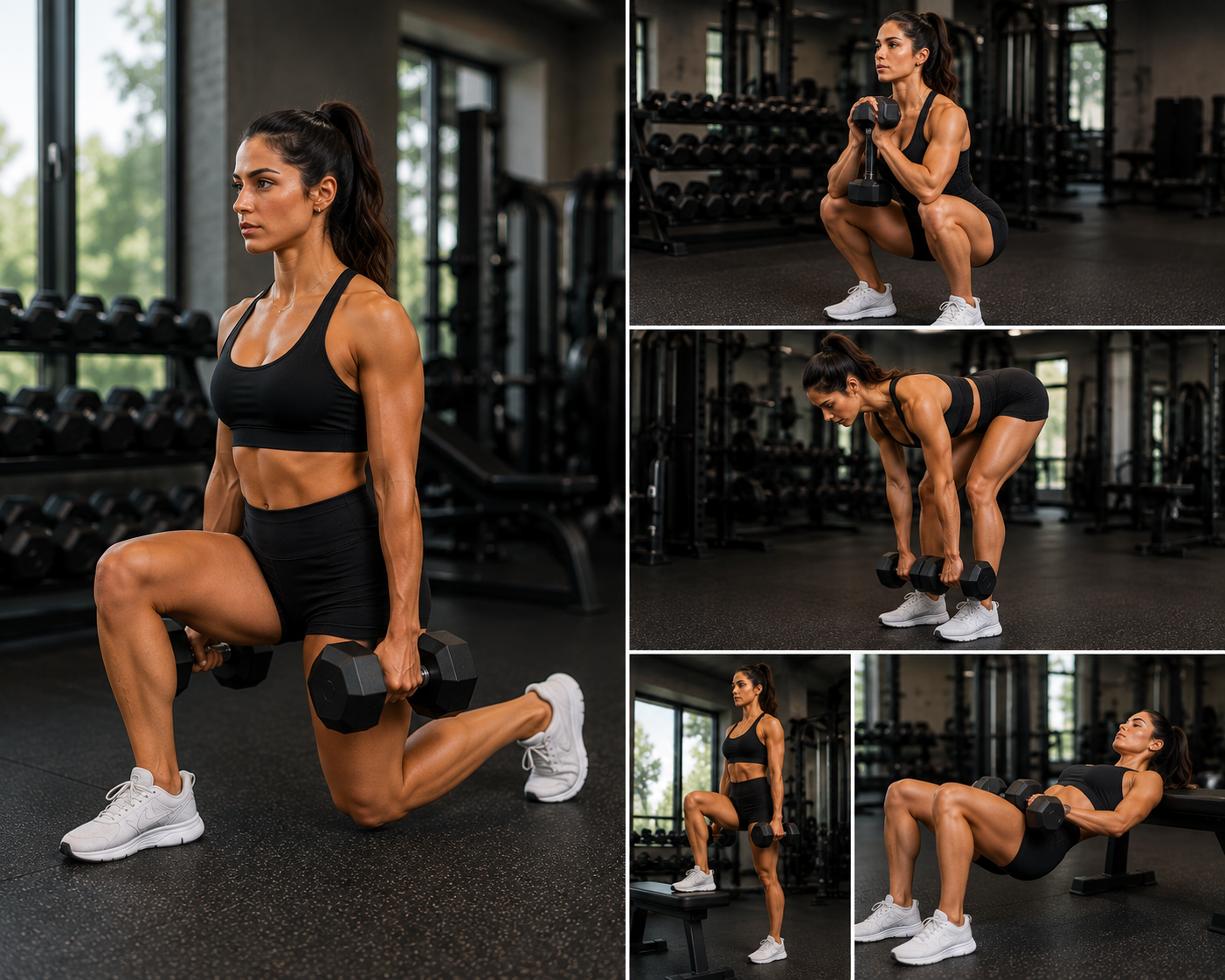
Leg exercises with dumbbells: 6 movements for glutes and quadriceps
Training your legs completely does not necessarily require a professional rack, an Olympic barbell, or a fully equipped weight room. With a well-chosen pair of dumbbells, it is possible to build an effective program to develop strength, muscle mass, and movement control even within a compact home gym. Dumbbell leg exercises represent an extremely versatile solution for those who want to achieve results without depending on bulky machines.
Dumbbells allow you to work on the lower limbs through natural movements, increasing the involvement of stabilizer muscles and offering the possibility to correct any differences between one leg and the other. Unilateral work, in particular, represents one of the most interesting aspects because it forces the body to develop balance, coordination, and symmetry.
For those who cannot use a barbell or prefer to train in small spaces, exercises like the Bulgarian split squat, Romanian deadlift, goblet squat, and dumbbell lunges allow you to create a stimulus comparable to that of a traditional gym. The key is to choose the exercises correctly, manage the load, and apply constant progression over time.
- Why train your legs with dumbbells
- Advantages of unilateral work with dumbbells
- Bulgarian split squat with dumbbells for glutes and quadriceps
- Romanian deadlift with dumbbells for the posterior chain
- Goblet squat and lunges with dumbbells
- Programming a leg workout with dumbbells
- Common mistakes in dumbbell leg exercises
- Building strong legs without a barbell
Why train your legs with dumbbells
The legs are composed of some of the largest and most powerful muscle groups in the body. Quadriceps, glutes, hamstrings, and stabilizer muscles work together during many daily and sports movements. For this reason, an effective lower limb workout must focus not only on increasing strength but also on improving motor control.
Dumbbells offer an important advantage over some more constrained solutions because they leave greater freedom of movement. The athlete must independently control the trajectory, balance, and body position, creating a more complete stimulus.
This characteristic makes dumbbell exercises particularly useful for those who want to develop functional legs as well as aesthetically balanced ones.
Training without a rack and barbell
Many people give up on leg training because they think professional equipment is essential. In reality, a well-constructed program with dumbbells can offer numerous possibilities even without a rack and barbell.
The choice of multi-joint movements allows for the involvement of large amounts of muscle mass using small spaces.
Developing strength and hypertrophy with limited space
A compact home gym can become an effective environment for muscle growth if versatile tools are selected. Dumbbells take up little space and allow you to easily modify the difficulty level.
Load progression and execution quality remain the main elements for achieving results.
Advantages of unilateral work with dumbbells
One of the most interesting aspects of leg training with dumbbells is the ability to work one leg at a time. This approach allows you to highlight any strength differences and improve body symmetry.
In bilateral exercises, in fact, the stronger side can unconsciously compensate for the weaker one. Unilateral work reduces this possibility and forces each limb to contribute independently.
For this reason, many athletes use single-leg exercises to improve stability and control.
Improving balance and stability
When a single leg supports the movement, the body must activate the muscles of the pelvis, core, and involved joints more. This increases the demand for motor control.
The result is an improvement in the ability to maintain a stable position even during complex movements.
Reducing muscle imbalances
Differences between limbs are common and can stem from daily habits, sports practiced, or previous injuries. Unilateral work allows you to dedicate specific attention to each leg.
Greater symmetry can help improve the overall quality of movement.
Bulgarian split squat with dumbbells for glutes and quadriceps
The dumbbell Bulgarian split squat is one of the most complete exercises for training the lower limbs without using a barbell. The position with one rear leg raised increases the demand for balance and concentrates the work on the front leg.
This movement mainly involves the quadriceps and glutes, but also requires a significant contribution from the stabilizer muscles. Its effectiveness derives from the combination of load, range of motion, and body control.
For many athletes, it represents a valid alternative to traditional barbell exercises.
Correct technique for the Bulgarian split squat
During execution, it is important to keep the torso stable, control the descent, and push through the foot of the front leg. The movement must be fluid, avoiding compensations or loss of balance.
Technical quality allows you to better exploit the muscle stimulus and reduce unnecessary stress.
How to progress with the Bulgarian split squat
The difficulty can be increased by gradually increasing the weight of the dumbbells, improving control, or increasing the training volume.
A gradual progression allows you to continue improving without compromising technique.
Romanian deadlift with dumbbells for the posterior chain
The dumbbell Romanian deadlift is a fundamental exercise for developing hamstrings, glutes, and muscles responsible for hip extension. Unlike knee-dominant movements, this exercise focuses more on the posterior chain.
Using dumbbells allows for great freedom of movement and allows you to better perceive muscle work during the descent phase.
It is a particularly useful exercise for those who want to build strength without using a barbell.
Hip movement and eccentric control
The main characteristic of the Romanian deadlift is the hip flexion and extension movement. The eccentric phase must be controlled while maintaining tension on the posterior thigh muscles.
Correct execution increases the effectiveness of the exercise.
Benefits for glutes and hamstrings
Training the posterior chain is fundamental for developing general strength and improving athletic ability. Glutes and hamstrings contribute to many sports and daily gestures.
The dumbbell Romanian deadlift allows you to stimulate these muscles in a controlled way.
Goblet squat and lunges with dumbbells
Among the most accessible exercises for training legs with dumbbells are the goblet squat and lunges. Both allow you to develop strength and coordination without the need for complex equipment.
They are movements suitable for both beginners and experienced athletes because they can be easily adapted by increasing load and difficulty.
Their simplicity should not lead one to underestimate the value of the stimulus produced.
Goblet squat for quadriceps and core
The goblet squat involves holding the dumbbell in front of the chest during the squat. This position promotes a more vertical posture and increases core involvement.
It is a very useful exercise for learning the correct squat motor pattern.
Lateral lunges with dumbbells and mobility
Dumbbell lateral lunges allow you to work on the frontal plane, involving muscles often less stimulated by traditional movements.
This exercise improves strength, hip mobility, and the ability to move laterally.
Programming a leg workout with dumbbells
An effective program must combine different exercises to stimulate all the main functions of the legs. Alternating knee-dominant and hip-dominant movements allows for more complete work.
The programming must also consider experience level, goals, and recovery capacity.
There is no need to use many exercises: it is more important to choose effective movements and perform them consistently.
Choosing sets, repetitions, and load
The number of sets and repetitions depends on the goal. For hypertrophy, it is important to create sufficient muscle tension while maintaining correct technique.
The load must be challenging enough to stimulate adaptations, but always manageable.
Progression over time
Gradually increasing weight, repetitions, or exercise difficulty allows the body to continue adapting.
Progression is the fundamental principle for improving strength and muscle mass.
Common mistakes in dumbbell leg exercises
Even the simplest exercises can be performed ineffectively if attention to technique is lacking. The most common mistakes concern load choice, movement control, and lack of progression.
Correcting these aspects allows you to achieve better results and train more safely.
A conscious approach is fundamental, especially when working without supervision.
Using excessive loads
Too much weight can compromise balance and control, especially in unilateral exercises. The load must always be compatible with the athlete's technical capacity.
Movement quality comes before the amount of weight lifted.
Neglecting mobility
Good joint mobility allows you to perform exercises more effectively. Limitations in the ankle, hip, or pelvis can influence movement.
Integrating mobility work improves training quality.
Building strong legs without a barbell
Training legs with dumbbells proves that you don't need to own a full gym to achieve significant results. Through exercises like the Bulgarian split squat, Romanian deadlift, goblet squat, and lunges, it is possible to create a complete program for glutes and quadriceps.
Unilateral work represents a distinctive element because it allows you to improve stability, symmetry, and body control. This characteristic makes dumbbells extremely effective tools for those seeking complete physical preparation.
Choosing versatile equipment like adjustable dumbbells allows you to build a compact home gym capable of supporting significant progression over time.
Comments (0)