
Trolley
You have no items in your shopping cart

 Budgets
 Dumbers
 Discs
Discs
 Benches
 Racks and Rigs
 Weights Holders
 Isotonic machines
 Calisthenics
 Cardio
 Kettlebells
 Flooring
 Gym Set
 Accessories
 Combat
 ARTI MARZIALI
 CONTAINER GYM
 Tug-Of-War
 Used Gym Equipment
 PILATES MACCHINARI
 GINNASTICA ARTISTICA
 CAMPI DA PADEL
 Prodotti in Pronta Consegna
 Informazioni
 IRONMAN
 Gift Card
- Donatif
- General information
- 0 I like it
- 4 Views
- 0 comments
- gym flooring, safety flooring, gym safety, shock-absorbing materials
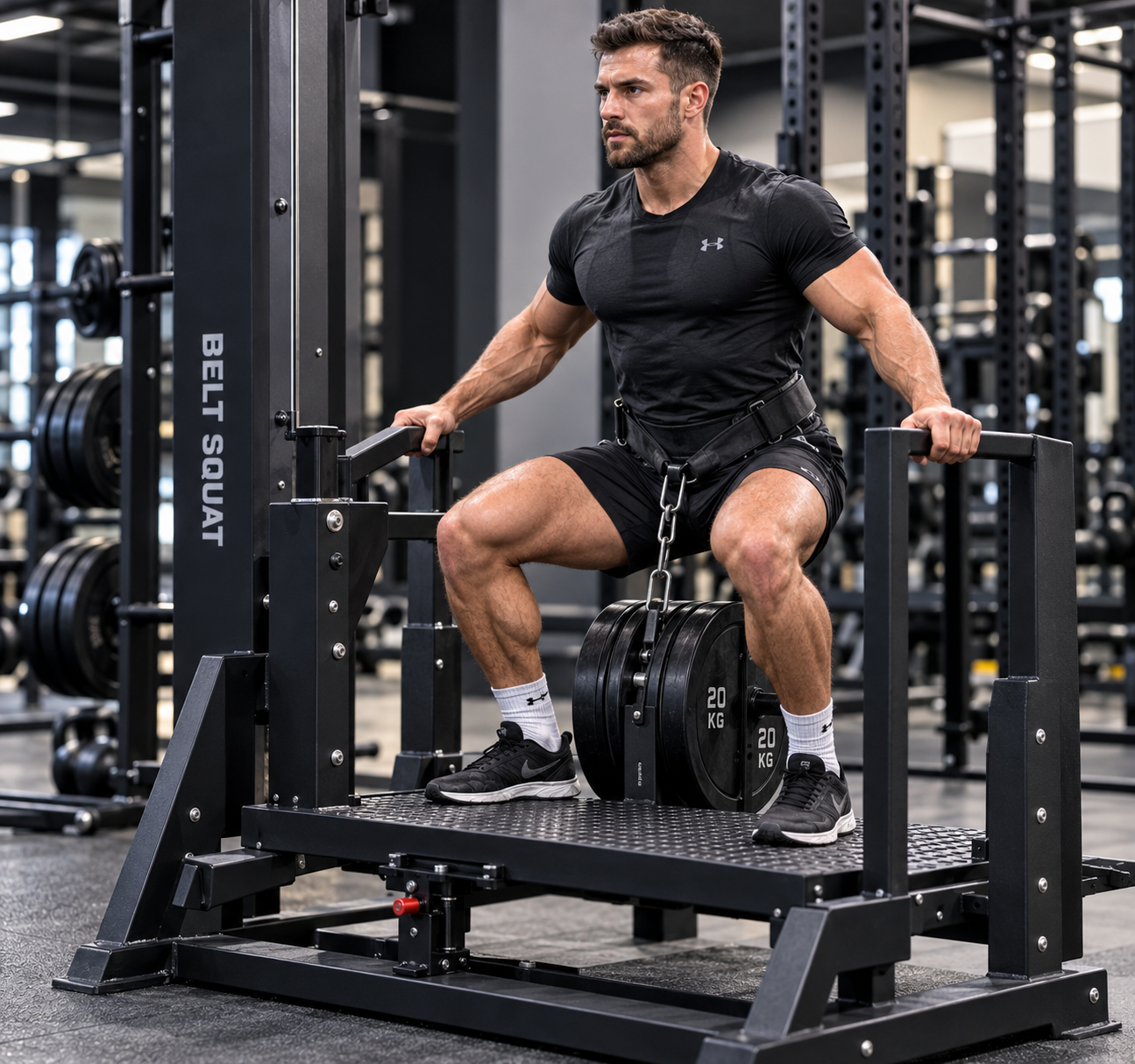
Belt squat: what it is and how it works
The belt squat is a machine designed to perform squats by transferring the load through a belt connected to a mechanical system rather than directly on the shoulders via a barbell. This setup makes it possible to train the lower limbs using a different loading method while maintaining the squat movement as the main exercise.
In recent years, the belt squat has found a place in commercial gyms, athletic preparation centers, and personal training studios thanks to the possibility of integrating it into programs dedicated to strength development and physical conditioning. The presence of different construction systems makes it important to understand how it works before choosing and using it.
Knowing how a belt squat works means properly evaluating adjustments, usage modes, technical features, and safety criteria. Conscious use of the machine allows for an organized workout that is consistent with programming goals.
- Quick answer
- What is the belt squat
- How it works
- How to use the machine correctly
- Practical criteria for use
- Errors to avoid and safety
- Why choose a belt squat
What the belt squat is in brief
The belt squat is a machine that allows you to perform squat exercises by applying the load through a belt connected to a lever or cable system. To use it correctly, you must adjust the belt, check the loading system, and maintain a controlled technique throughout the entire movement by following the manufacturer's instructions.
The correct use of the machine depends on the quality of the initial adjustment, load progression, and the ability to maintain stable technical execution during every repetition.
Before increasing training intensity, it is advisable to become familiar with how the machine works by using loads appropriate for your level of preparation.
Decision-making criteria
The main criteria concern the machine's build quality, lever or cable system, belt adjustment, platform stability, movement fluidity, and compatibility with the training program.
Technical references
To use the machine correctly, you should consult the manufacturer's manual and follow the instructions regarding installation, adjustments, and maintenance. For fitness equipment, EN ISO 20957 series standards may also represent a reference when applicable.
What is the belt squat
The belt squat belongs to the category of machines dedicated to lower limb strength training. The operating principle consists of applying the load to the pelvis via a belt connected to a mechanical system, allowing the squat movement to be performed without directly supporting a barbell on the shoulders.
Available models can use different construction solutions, such as lever systems or systems with cables and pulleys. Although the general principle remains the same, the kinematics of the movement can vary depending on the machine's design.
For this reason, it is important to analyze the technical characteristics of the chosen model and verify that it meets the needs of the user or the sports facility.
Main components
A belt squat generally includes a load-bearing structure, platform, load transmission system, attachment points, belt, and dedicated supports for loading weights when provided.
Construction systems
Lever and cable models present differences in the load transmission method and maintenance operations, while sharing the same general principle of use.
How the belt squat works
To use the machine, the athlete puts on the belt and connects it to the loading system. After adjusting the initial position and verifying the correct attachment, it is possible to perform the squat movement while keeping the load applied through the machine's mechanism.
During execution, it is important to maintain continuity in the movement, avoiding sudden accelerations or abrupt stops. A gradual progression of the load allows for greater control of the technique.
The adjustment of the belt and foot position represents a fundamental phase of exercise preparation.
Initial adjustment
Before starting, it is advisable to check the correct positioning of the belt, the attachment system, and the stability of the machine according to the manufacturer's specifications.
Movement execution
The movement should be executed while maintaining control of the range of motion, a stable posture, and continuity throughout the entire descent and ascent phase.
How to use the machine correctly
Adequate preparation includes checking the equipment, a progressive warm-up, and choosing a load consistent with the user's technical level. Before each session, it is useful to check the condition of the belt, the connection systems, and the moving components.
During training, it is preferable to prioritize the quality of movement over a rapid increase in load. A stable technique allows for greater continuity in execution.
At the end of the session, it is good practice to unload the machine, reposition the accessories, and verify that the area remains tidy for subsequent users.
Load progression
Gradually increasing the load allows you to improve technical control while avoiding sudden increases in training intensity.
Pre-use checks
A visual check of the belt, attachment points, moving systems, and platform helps identify any anomalies before starting the exercise.
What practical criteria to follow
The choice of configuration depends on the user's level, preparation goals, and equipment availability. In a commercial gym, ease of adjustment and machine robustness may take on greater importance, while in an athletic preparation center, a more versatile configuration may prove useful.
Space planning also contributes to the efficiency of the training area. An orderly layout facilitates access to the machine and reduces interference with other weight room stations.
The support surface represents an additional element to consider during machine installation.
Space organization
An anti-shock flooring improves the stability of the area dedicated to strength training and helps protect the floor. To learn more about available solutions, you can consult gym anti-shock flooring.
Compatibility with the program
The belt squat should be integrated into a programming consistent with the athlete's goals and other planned exercises.
Errors to avoid and safety
One of the most frequent errors consists of neglecting belt adjustment or using the machine without verifying the correct operation of the loading system. Increasing the weight too quickly can also compromise the quality of execution.
It is also advisable to avoid modifications not foreseen by the manufacturer and to neglect routine maintenance of cables, pins, and connection systems.
Safety depends on the combination of equipment quality, correct adjustments, periodic maintenance, and execution technique.
Approximate adjustments
An incorrectly positioned belt can reduce comfort and control during the exercise.
Neglected maintenance
Periodically checking mechanical components, fastenings, and connection systems helps keep the machine efficient over time.
Why choose a belt squat
The belt squat represents an interesting solution for gyms, fitness centers, and facilities dedicated to athletic preparation that want to expand their strength training possibilities with a machine specific for the squat movement.
A conscious choice should consider build quality, ease of adjustment, maintenance, space availability, and compatibility with the facility's or athlete's goals.
Analyzing technical specifications, following the manufacturer's instructions, and correctly organizing the installation area allows you to use the belt squat effectively, safely, and consistently with structured training programming.
Comments (0)