
Trolley
You have no items in your shopping cart

 Budgets
 Dumbers
 Discs
Discs
 Benches
 Racks and Rigs
 Weights Holders
 Isotonic machines
 Calisthenics
 Cardio
 Kettlebells
 Flooring
 Gym Set
 Accessories
 Combat
 ARTI MARZIALI
 CONTAINER GYM
 Tug-Of-War
 Used Gym Equipment
 PILATES MACCHINARI
 GINNASTICA ARTISTICA
 CAMPI DA PADEL
 Prodotti in Pronta Consegna
 Informazioni
 IRONMAN
 Gift Card
- Donatif
- General information
- 0 I like it
- 15 Views
- 0 comments
- gym flooring, safety flooring, gym safety, shock-absorbing materials
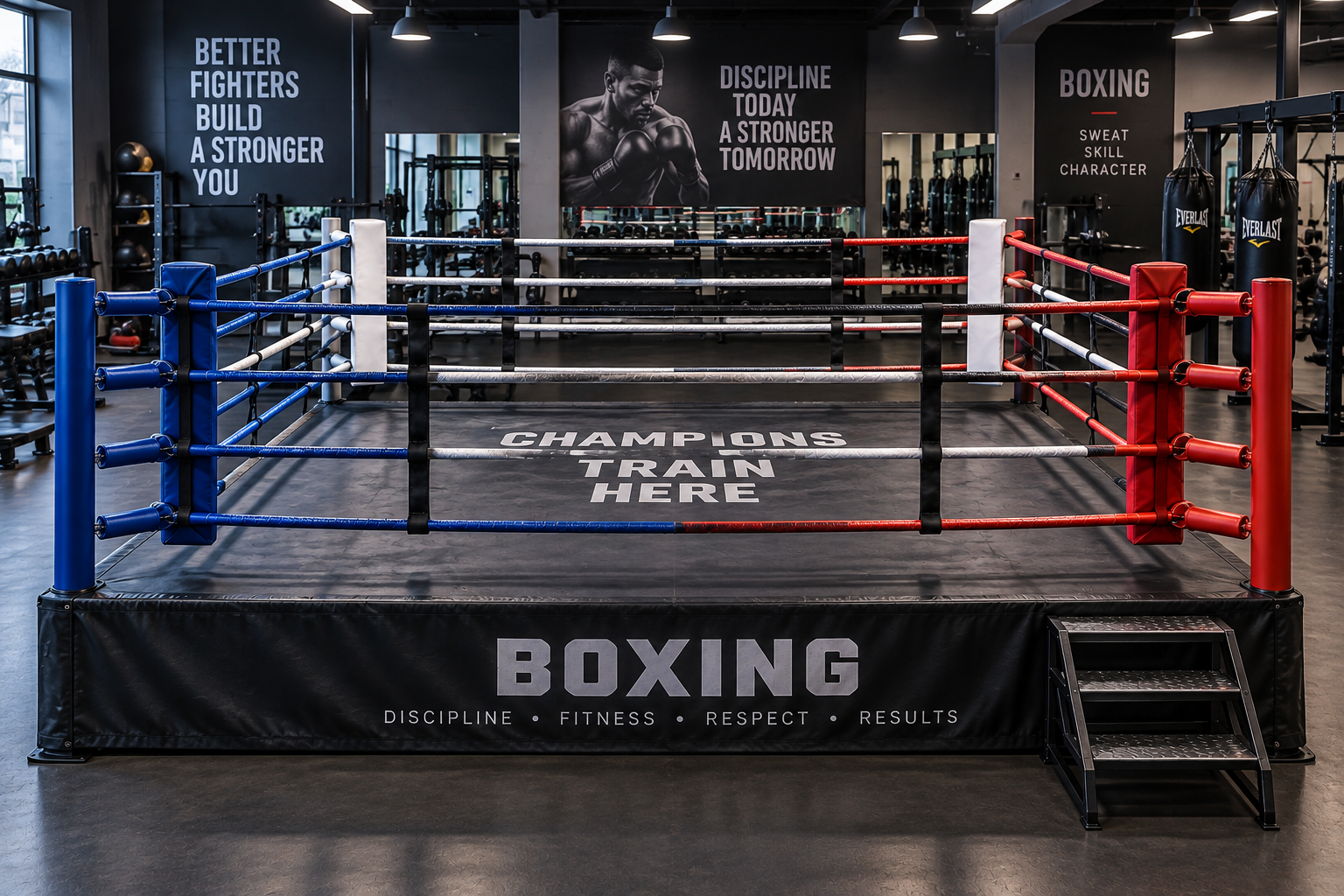
Boxing ring in a professional gym: installation, layout and documentation
Installing a boxing ring in a professional gym requires a design that takes into account available space, structure configuration, intended use and technical documentation provided by the manufacturer. A well-planned project facilitates the organization of daily activities, simplifies maintenance and allows the ring to be integrated with the rest of the combat sports area.
Every gym has different characteristics. A center dedicated exclusively to boxing may adopt different solutions compared to a multi-sport facility or a multi-functional room. Before purchasing, it is therefore advisable to analyze the layout, access paths, flooring characteristics and expected usage methods during normal activity.
Technical documentation represents the main reference to verify installation requirements, assembly methods, maintenance and periodic checks. For this reason, every design decision should be consistent with the manufacturer's official instructions.
- Quick answer
- What requirements must the space have?
- How to design the gym layout
- How to configure the ring
- Safety and maintenance
- Design errors to avoid
- Manuals and technical documentation
- FAQ
- Evaluating the investment
How to design a professional boxing ring?
A professional boxing ring should be designed by evaluating structure dimensions, surrounding space, installation methods, flooring characteristics, intended use and the manufacturer's technical documentation. Proper planning allows you to better organize the training area and facilitate future maintenance operations.
The most suitable configuration depends on the number of users, the activities carried out and the space actually available.
Before installation, it is advisable to verify that the room meets all the requirements indicated in the technical documentation.
Define objectives
It is useful to establish whether the ring will be used primarily for technical training, sparring, athletic preparation or sporting events.
Analyze expected usage
Number of classes, frequency of sessions and simultaneous presence of athletes affect the configuration of the structure.
What requirements must the space have?
The available space must allow the correct positioning of the ring and guarantee a free area for the passage of athletes, coaches and maintenance staff.
It is also necessary to verify that accesses, doors and internal paths allow the transport of components during assembly.
To design a complete area dedicated to combat sports, you can consult the range of combat sports equipment.
Operating area
The surrounding space must remain free of obstacles and allow orderly management of training sessions.
Access paths
The dimensions of accesses must be compatible with the transport and assembly of the ring components.
How to organize the gym layout?
A well-designed layout allows the ring to be integrated with other areas dedicated to warm-up, physical preparation and technical work.
The arrangement of equipment should favor user circulation while avoiding interference between different activities.
It is advisable to provide dedicated areas for instructors, accessories and athlete preparation.
Internal paths
Passage paths should remain separate from the operational areas dedicated to training.
Support areas
Storage rooms, technical areas and spaces intended for accessories should be easily accessible.
How to correctly configure the ring?
The configuration must be chosen considering the type of use, available space and the characteristics of the sports facility.
Before purchasing, it is useful to compare installation methods, maintenance requirements and construction characteristics reported by the manufacturer.
The choice between a floor-level and a raised ring must also be evaluated based on the overall gym project.
Platform height
The platform height influences accessibility, usage methods and the organization of the surrounding space and must be evaluated according to the intended use.
Rope system
The ropes must be installed and maintained following the procedures provided by the manufacturer for the chosen model.
How to manage safety and maintenance?
Preventive maintenance helps keep the ring efficient and promptly identify any structural anomalies.
Checks should include fastening systems, platform, ropes, protective coverings and components subject to wear.
Every intervention should be recorded in a maintenance plan, especially in professional facilities.
Periodic checks
Scheduled checks allow you to monitor the state of the structure throughout its usage cycle.
Ring cleaning
Regular cleaning facilitates the inspection of surfaces and helps keep materials in good condition.
What design errors to avoid?
One of the most frequent errors consists in considering exclusively the footprint of the ring without providing for the surrounding operational spaces.
Another critical issue concerns the failure to verify the paths necessary for transporting components during installation.
It is also advisable to avoid structural modifications not foreseen by the manufacturer's technical documentation.
Underestimating space
The design must include both the ring and the areas necessary for use, maintenance and circulation.
Ignoring documentation
Manuals and technical instructions constitute the main reference for installation and maintenance.
Manuals and technical documentation
Before installation, it is advisable to consult the manufacturer's manual to verify assembly methods, space requirements and maintenance plan.
It is also useful to keep documentation relating to components, spare parts and checks carried out over time.
When applicable, the manufacturer's instructions and current regulations regarding sports equipment must be respected.
Installation manual
The manual contains official instructions relating to the assembly, checks and maintenance of the ring.
Inspection log
Documenting interventions facilitates maintenance scheduling and monitoring of the structure's condition.
FAQ
Is a floor-level or raised ring better?
The choice depends on the intended use, the gym layout and the characteristics of the project. It is advisable to compare the manufacturer's specifications with the operational needs of the facility.
How much space should be left around the ring?
The free space must be defined following the manufacturer's instructions and evaluating accessibility, maintenance and safety during training.
What documents are useful to keep?
Installation manual, maintenance instructions, technical documentation and intervention log represent the main documents to be archived.
Why design the boxing ring correctly
Accurate design allows the boxing ring to be integrated into the gym in a functional way, facilitates installation and maintenance and improves the daily management of the combat sports area. Evaluating available space, configuration, construction characteristics and the manufacturer's technical documentation allows you to make an investment consistent with the operational objectives of the facility and long-term usage needs.
Comments (0)