
Trolley
You have no items in your shopping cart

 Budgets
 Dumbers
 Discs
Discs
 Benches
 Racks and Rigs
 Weights Holders
 Isotonic machines
 Calisthenics
 Cardio
 Kettlebells
 Flooring
 Gym Set
 Accessories
 Combat
 ARTI MARZIALI
 CONTAINER GYM
 Tug-Of-War
 Used Gym Equipment
 PILATES MACCHINARI
 GINNASTICA ARTISTICA
 CAMPI DA PADEL
 Prodotti in Pronta Consegna
 Informazioni
 IRONMAN
 Gift Card
- Donatif
- General information
- 0 I like it
- 1 Views
- 0 comments
- gym flooring, safety flooring, gym safety, shock-absorbing materials
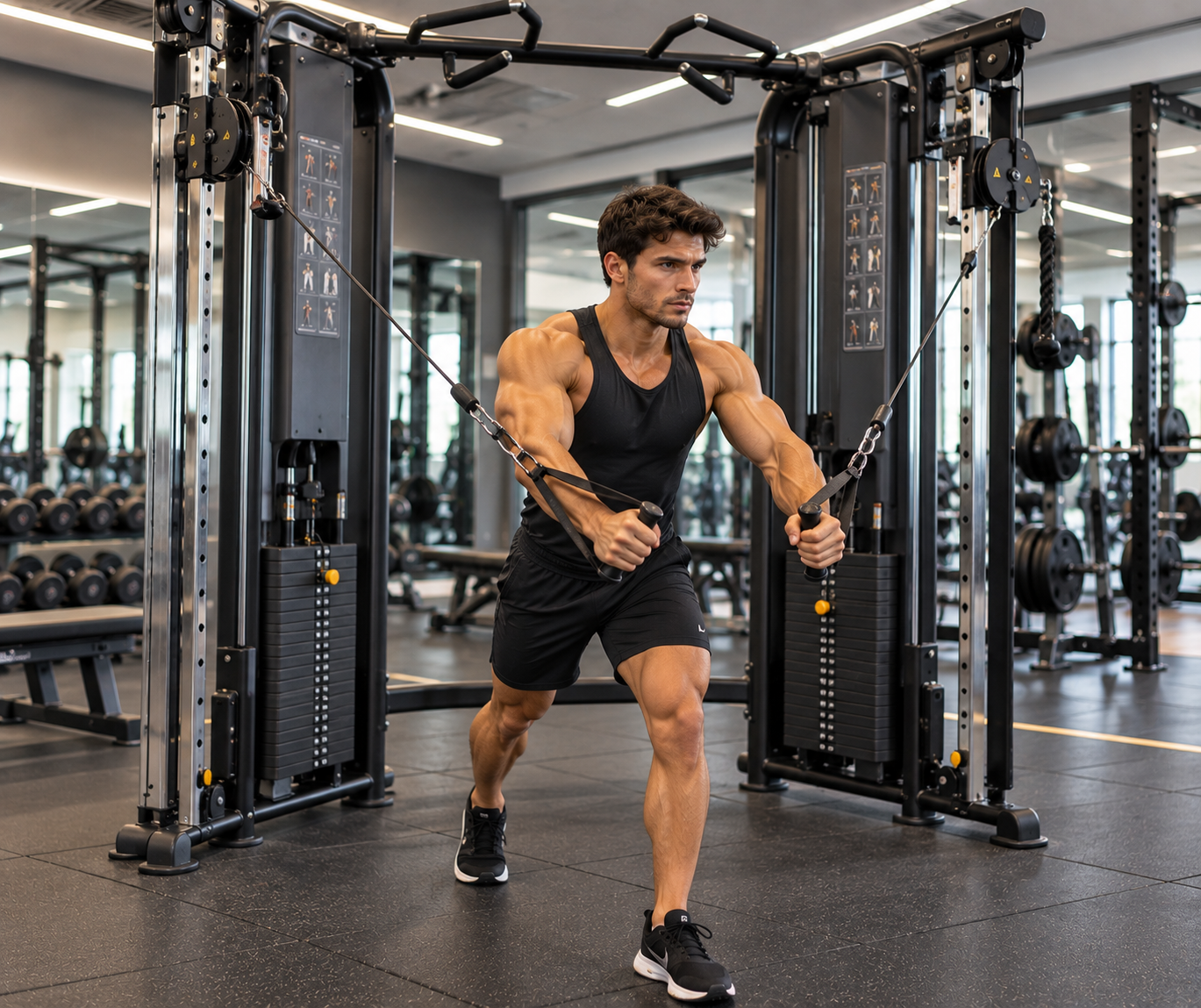
Cable crossover machine vs functional trainer: differences and usage criteria
The comparison between a cable crossover machine and a functional trainer is one of the most frequent when designing a weight room or personal training studio. Both equipment types use cable and pulley systems, but they feature configurations, modes of use, and purposes that can differ depending on the model and the facility's project.
To choose the most suitable solution, it is useful to compare verifiable criteria such as pulley configuration, required operating area, adjustment possibilities, compatibility with intended exercises, and overall space organization. Basing the decision exclusively on the machine's commercial name can lead to inaccurate evaluations.
This guide compares the cable crossover machine and functional trainer, providing practical criteria to understand their operational differences without delving into the machine's mechanics or the selection criteria of individual models, which are covered in dedicated articles.
- Quick answer
- What are the main differences?
- Comparison table
- How to choose between the two solutions
- Usage scenarios
- Mistakes to avoid
- FAQ
- Which approach best maximizes the investment?
Cable crossover or functional trainer: which solution to choose?
The choice depends on training goals, gym setup, and user types. A cable crossover machine is generally designed for cable exercises with a wide lateral range of motion, whereas a functional trainer normally prioritizes adjustment versatility and the execution of numerous functional movements. However, characteristics must always be verified against the technical documentation of the individual model.
Each machine should be evaluated by considering the entire weight room project.
The manufacturer's technical datasheets represent the most reliable reference for comparing different models.
What is the main criterion?
Analyze the exercises that will be performed most frequently and verify which configuration best meets the facility's needs.
Is the commercial name sufficient?
No. Different manufacturers may use different definitions for machines with similar characteristics. Therefore, it is always advisable to compare technical specifications.
What are the main differences?
The two types share numerous construction elements but may be designed with different purposes.
Understanding these differences facilitates a more informed choice.
Every evaluation should be carried out on the actual configuration of the machine.
Characteristics of the cable crossover machine
The cable crossover machine is generally characterized by two side columns with adjustable or fixed pulleys that allow users to perform cable crossovers, rows, presses, and numerous standing exercises by exploiting a wide distance between the traction points.
Characteristics of the functional trainer
The functional trainer is normally designed to offer rapid pulley adjustments, high versatility, and the ability to easily adapt the machine to very different training programs.
Comparison table
The comparison must be based on objective and verifiable parameters.
| Criterion | Cable crossover machine | Functional trainer |
|---|---|---|
| Configuration | Generally two columns dedicated to cables | Configuration oriented towards versatility |
| Pulley adjustment | Variable according to the model | Generally wide |
| Functional exercises | Possible according to configuration | Normally very numerous |
| Operating area | Requires adequate space for movements | To be verified according to the model |
| Accessories | Variable compatibility | Generally wide availability |
How to interpret the comparison?
The characteristics shown represent general criteria. It is always necessary to compare the manufacturer's technical data relating to the specific model.
Which specifications to compare?
Pulley configuration, adjustment system, weight stacks, compatible accessories, dimensions, and operating area represent more significant parameters than the commercial name alone.
How to choose between cable crossover and functional trainer?
The choice must be consistent with the gym's goals and available layout.
A preliminary evaluation allows for better integration of the machine with the rest of the equipment.
The users' level also represents an important element.
Define training goals
Programs oriented toward cable exercises with a wide range of motion can make the most of a cable crossover machine, while workouts requiring frequent configuration changes can benefit from the typical features of a functional trainer.
Analyze space and organization
Before purchasing, it is advisable to verify that the machine can be fitted while keeping the operating area clear and ensuring correct circulation within the weight room. To complete a professional workstation, you can also consider the range of isotonic machines.
In which contexts is each solution most suitable?
Needs change depending on the type of facility.
The same gym can integrate both types of equipment to expand training possibilities.
The important thing is to maintain a coherent design.
Personal training studio
A versatile machine facilitates rapid transitions between different exercises and makes it easy to adapt the workstation to different clients.
Professional weight room
A large gym can include both a cable crossover machine and a functional trainer to offer different training modes to its users.
What mistakes to avoid?
Many unsatisfactory purchases stem from incomplete comparisons.
A structured evaluation reduces the risk of choosing a machine that is poorly suited to real needs.
It is useful to prepare a checklist before purchasing.
Stopping at the commercial name
The machine's name does not guarantee identical characteristics across different manufacturers. It is always necessary to compare configuration and technical specifications.
Neglecting the room layout
Installing a machine without evaluating the available operating area can limit numerous exercises and reduce the overall functionality of the gym.
FAQ
Are cable crossover and functional trainer the same machine?
No. They may share numerous construction elements but are generally designed with different configurations and purposes that must be evaluated on the individual model.
Which machine offers greater versatility?
It depends on the specific configuration. Versatility must be verified by analyzing adjustments, available accessories, and the manufacturer's technical documentation.
Is it possible to install both in the same gym?
Yes. Many professional facilities integrate both types to offer a greater variety of exercises and adapt to different training programs.
Why compare the two solutions using objective criteria?
Analyzing the cable crossover machine and functional trainer through verifiable technical characteristics allows you to design a weight room that is more functional and consistent with users' needs.
Comparing configuration, adjustments, operating area, accessories, and technical documentation allows for a more informed choice, avoiding evaluations based solely on the machine's name.
A structured approach also facilitates future gym expansions and allows for the integration of new equipment while maintaining an efficient organization of training spaces.
Comments (0)