
Trolley
You have no items in your shopping cart

 Budgets
 Dumbers
 Discs
Discs
 Benches
 Racks and Rigs
 Weights Holders
 Isotonic machines
 Calisthenics
 Cardio
 Kettlebells
 Flooring
 Gym Set
 Accessories
 Combat
 ARTI MARZIALI
 CONTAINER GYM
 Tug-Of-War
 Used Gym Equipment
 PILATES MACCHINARI
 GINNASTICA ARTISTICA
 CAMPI DA PADEL
 Prodotti in Pronta Consegna
 Informazioni
 IRONMAN
 Gift Card
- Donatif
- General information
- 0 I like it
- 712 Views
- 0 comments
- gym flooring, safety flooring, gym safety, shock-absorbing materials
The hypoxic chamber for endurance: adaptation mechanisms and performance
Endurance is one of the disciplines in which the body's ability to use and distribute oxygen represents a decisive factor for performance. Cyclists, runners, and athletes engaged in endurance sports continually seek strategies capable of improving physiological efficiency and sustaining prolonged efforts with greater effectiveness.
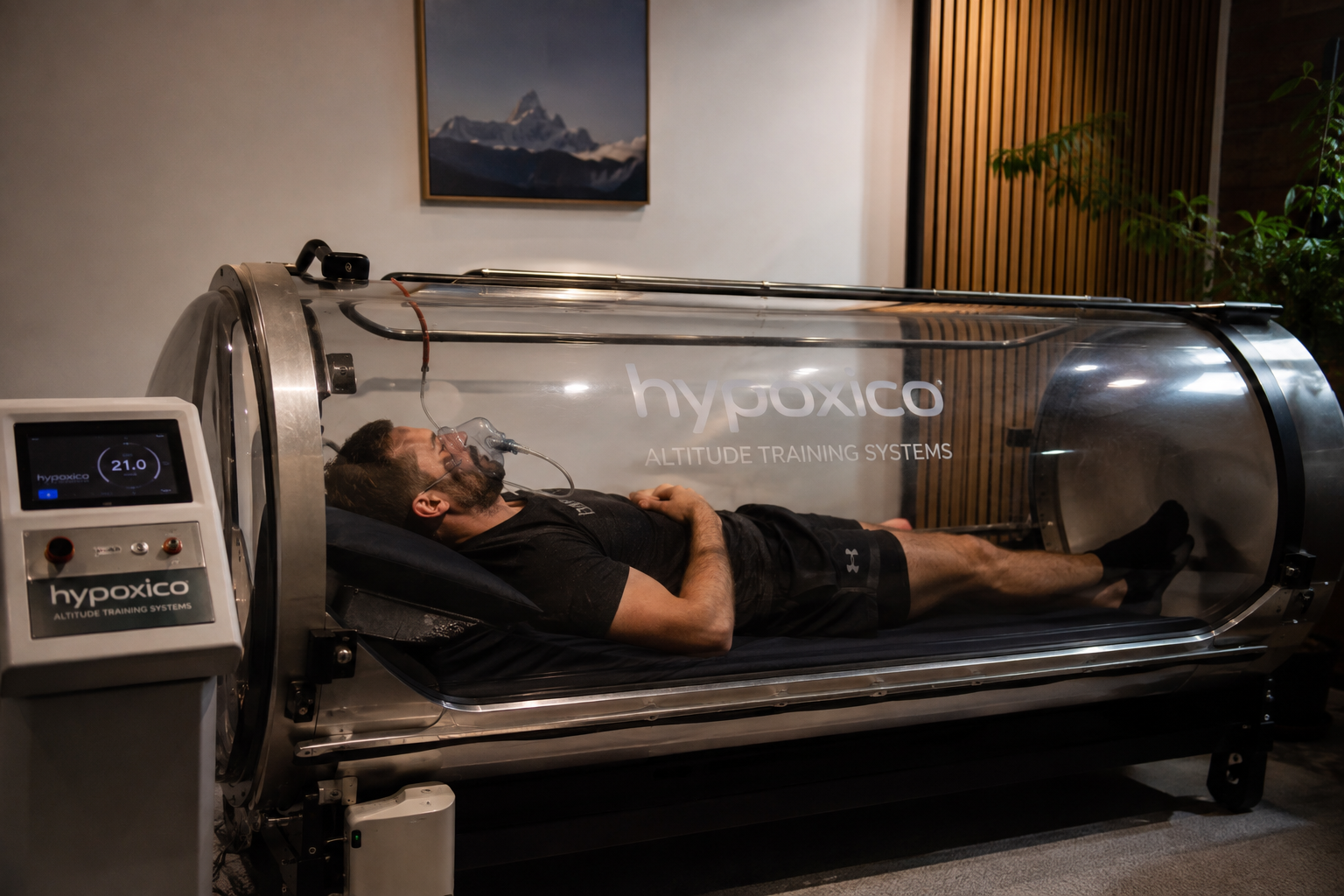
Among the most interesting technologies in this field, we find the hypoxic chamber, a system that allows for the simulation of environmental conditions similar to high altitude through controlled management of oxygen availability. This approach makes it possible to introduce a specific stimulus without necessarily having to transfer the entire preparation process to the mountains.
Understanding how the hypoxic chamber works means analyzing the relationship between reduced oxygen availability, physiological adaptations, and the body's response. From the stimulation of mechanisms linked to erythropoiesis to changes at the muscular and metabolic levels, simulated altitude training represents a tool that can be integrated into the most advanced endurance pathways.
- How the hypoxic chamber works in endurance training
- The body's response to simulated altitude
- From the natural EPO mechanism to blood adaptation
- Increase in red blood cells and oxygen transport
- Mitochondrial density and muscular adaptations
- Applications of hypoxia for cyclists and runners
- Altitude training: benefits and stimulus management
- The hypoxic chamber as a tool for endurance preparation
How the hypoxic chamber works in endurance training
A hypoxic chamber is a controlled environment in which the composition of the breathed air is modified through dedicated technological systems. The fundamental principle consists of reducing the relative availability of oxygen, creating a condition similar to the one the body encounters during stays at high altitudes.
In endurance sports, this stimulus is particularly interesting because performance largely depends on the ability to transport, use, and distribute oxygen during prolonged activities. The hypoxic chamber therefore makes it possible to add an environmental variable to traditional programming.
The main advantage compared to simply experiencing the mountains is the ability to precisely control the duration, intensity, and frequency of exposure. The athlete can integrate simulated altitude into their routine while maintaining control of the path.
The role of technology
The operation of the chamber depends on the integration between the hypoxia generator, sensors, control systems, and air distribution.
These components work together to maintain stable environmental conditions during sessions.
Importance of environmental control
For endurance athletes, the repeatability of the stimulus is a fundamental element.
A controlled environment makes it possible to schedule consistent exposures and compare responses over time.
The body's response to simulated altitude
When the body is exposed to lower oxygen availability, it activates a series of adaptive mechanisms designed to improve the management of oxygen itself. These processes involve the respiratory, cardiovascular, and muscular systems.
The physiological goal of adaptation is to maintain a balance between energy demand and oxygen availability. In endurance sports, this aspect is particularly relevant because performance depends on the ability to sustain high intensities for long times.
Controlled hypoxic exposure makes it possible to stimulate these mechanisms within an organized program, avoiding relying exclusively on natural high-altitude conditions.
The stimulus of reduced oxygen availability
Hypoxia represents a signal that the body interprets as a request for adaptation.
The response depends on the duration of the exposure, the level of hypoxia, and individual characteristics.
Progressive adaptation over time
Adaptations do not occur immediately, but require repeated exposures and proper recovery management.
For this reason, programming represents a central element in endurance protocols.
From the natural EPO mechanism to blood adaptation
One of the best-known mechanisms associated with hypoxic exposure concerns the natural production of erythropoietin, commonly referred to as EPO. This hormone is involved in the regulation of red blood cell production and represents one of the physiological responses to reduced oxygen availability.
During exposure to hypoxic conditions, the body can increase certain internal signals connected to the need to improve oxygen transport. This process is part of the natural mechanisms of altitude adaptation.
It is important to emphasize that hypoxic chamber training utilizes the body's natural adaptive capacity through a controlled environmental stimulus.
The role of erythropoietin
Erythropoietin plays an important function in the regulation of red blood cell production.
This process represents one of the most studied elements in the context of altitude adaptation.
Managing blood adaptations
Blood adaptations must be considered within a complete strategy that includes training, nutrition, and recovery.
The quality of the pathway depends on the ability to correctly integrate all these elements.
Increase in red blood cells and oxygen transport
One of the most discussed aspects of hypoxic exposure concerns the relationship between oxygen availability and the blood's capacity to transport it. Red blood cells play a fundamental role because they contain hemoglobin, the protein responsible for binding with oxygen.
The concept of natural red blood cell increase is often associated with altitude adaptations. In the context of controlled training, the goal is to promote a physiological response through programmed stimuli.
For endurance athletes, improving the efficiency of the oxygen transport system represents a central element of preparation.
From blood to muscles
The oxygen transported by the blood must be used effectively by the tissues involved in the effort.
Endurance performance depends on the interaction between different physiological systems.
Improving aerobic efficiency
Altitude adaptations can be integrated into broader strategies oriented toward aerobic efficiency.
Programming remains essential to transform the stimulus into concrete improvement.
Mitochondrial density and muscular adaptations
In addition to blood-related adaptations, hypoxia can also influence processes that occur directly inside muscle cells. Mitochondria represent the structures responsible for cellular energy production and have a central role in endurance sports.
The muscle's ability to use available oxygen is in fact decisive for sustaining prolonged activities. Cellular adaptations therefore represent another interesting element in the study of simulated altitude training.
For cyclists and runners, the combination of oxygen transport and efficient utilization at the muscular level represents one of the most important aspects of endurance performance.
The role of mitochondria
Mitochondria transform energy resources into energy usable by the muscle.
Their efficiency influences the ability to sustain prolonged efforts.
Adaptations at the cellular level
Hypoxic exposure represents a stimulus that involves different levels of the organism.
The muscular response must be considered together with other physiological adaptations.
Applications of hypoxia for cyclists and runners
Hypoxia for cyclists and runners represents one of the most common applications of simulated altitude in the endurance world. Endurance athletes use this approach to introduce an additional element into their preparation and simulate certain conditions typical of mountain training.
The ability to perform controlled sessions makes it possible to integrate hypoxia even when travel to high-altitude areas is not feasible.
For advanced amateur athletes and professionals, the hypoxic chamber can become a complementary tool within broader planning.
Cycling and altitude adaptation
In cycling, the ability to sustain high power outputs for prolonged periods is closely linked to oxygen management.
Training in a hypoxic environment can be integrated into strategic periods of preparation.
Running and aerobic endurance
In running, the aerobic component represents a fundamental base of performance.
Simulated altitude can be used as an additional element in programming.
Altitude training: benefits and stimulus management
Altitude training benefits must be evaluated by considering the complete context in which hypoxia is inserted. The hypoxic chamber does not replace the fundamental principles of training, but adds an environmental stimulus that can be integrated with traditional strategies.
The quality of the result depends on the correct management of session duration, the level of exposure, and the necessary recovery.
A personalized approach makes it possible to use technology more effectively and consistently with the athlete's goals.
Programming exposure
Programming allows the stimulus to be distributed at the most useful moment of preparation.
Each phase of the year may require different strategies.
Balance between stimulus and recovery
Recovery represents an essential component of improvement.
Correct management avoids excessive fatigue accumulation.
The hypoxic chamber as a tool for endurance preparation
The hypoxic chamber currently represents a technological solution that allows endurance athletes to integrate altitude simulation within their preparation. The main value lies in the possibility of controlling the stimulus and adapting it to individual needs.
From mechanisms linked to blood oxygenation to muscular and metabolic adaptations, hypoxia involves various systems that contribute to the capacity to sustain effort.
For cyclists, runners, and advanced endurance enthusiasts, using a hypoxic chamber means bringing into their routine a controlled environment capable of supporting more structured preparation, based on the knowledge of physiological mechanisms and intelligent management of the stimulus.
Comments (0)