
Trolley
You have no items in your shopping cart

 Budgets
 Dumbers
 Discs
 Benches
 Racks and Rigs
 Weights Holders
 Isotonic machines
 Calisthenics
 Cardio
 Kettlebells
 Flooring
 Gym Set
 Accessories
 Combat
 ARTI MARZIALI
 CONTAINER GYM
 Tug-Of-War
 Used Gym Equipment
 PILATES MACCHINARI
 GINNASTICA ARTISTICA
 CAMPI DA PADEL
 Prodotti in Pronta Consegna
 Informazioni
 IRONMAN
 Gift Card
- Donatif
- General information
- 0 I like it
- 158 Views
- 0 comments
- gym flooring, safety flooring, gym safety, shock-absorbing materials
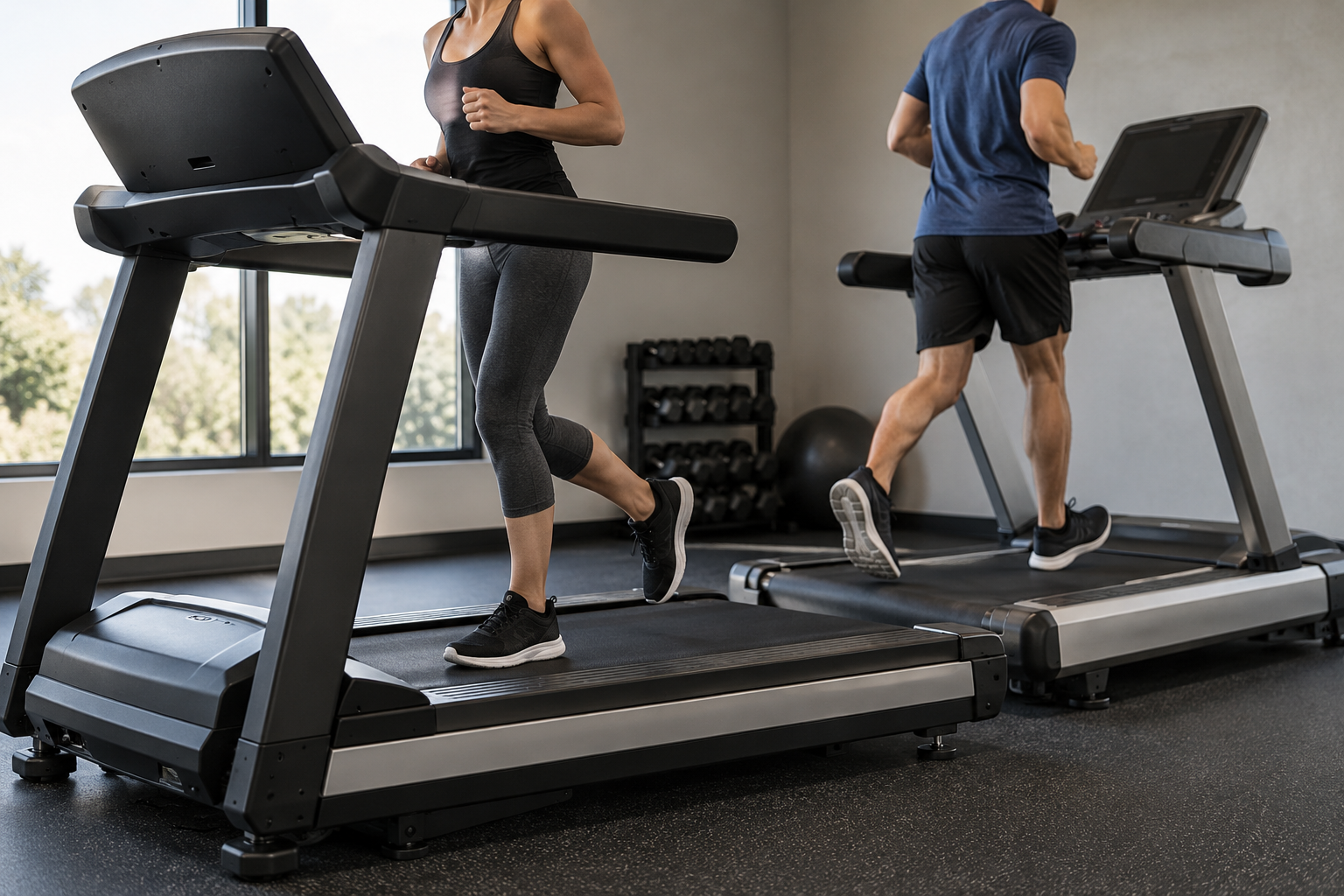
How to compare treadmills for home and professional use
Comparing home and commercial treadmills means establishing the use for which each model was designed. Console appearance or a high maximum speed does not prove suitability for a gym, studio or home. Declared intended use, frequency, user characteristics and room conditions matter.
A home machine may suit individual sessions, while a shared facility may need different service continuity. These distinctions do not justify classifying every model solely by price or the word professional in a description. Compare the actual product's information and limits through documentation and supply conditions.
This guide covers intended use, running surface, drive system, space, features, safety, maintenance and total cost. It does not propose universal dimensions or power figures. Manufacturer manuals and specifications remain the reference for installation and operation; requirements depend on the project.
- Which intended use should you compare?
- How do you assess running surface and comfort?
- How should motor, speed and incline be read?
- How much installation space is actually needed?
- Which console functions are genuinely useful?
- How do safety and accessibility compare?
- What maintenance does each model need?
- How do you assess total cost and decide?
Which intended use should you compare?
Define who will use the treadmill, for which activities and how often. One person walking at home has different demands from many users alternating running and walking throughout the day. A small studio can also differ from a gym open for long hours. Compare the commercial description with manufacturer-permitted use. Do not infer shared-facility suitability from an apparently sturdy build alone. Ask for any operating limits to be explicit before selection rather than discovering incompatibility after installation. The useful question is whether the model covers the actual service, not whether its styling resembles equipment seen in another facility.
Document realistic use
Describe sessions, user turnover and required availability. Predicting every workout precisely is unnecessary, but distinguishing occasional from regular shared operation helps. Ask for model-specific confirmation when documentation leaves a point unclear. Warranty conditions may differ by application and should be read alongside intended use. A home purchase does not automatically become appropriate for a studio when its location changes. Follow actual activity rather than delivery address or the number of people living in the building. This description also gives suppliers a clear basis for confirming whether their proposed machine fits the project.
How do you assess running surface and comfort?
The usable surface must suit the activity and intended users. No dimension is perfect for everyone: walking, running, body size and familiarity affect selection. Compare stated usable length and width separately from overall dimensions. A trial, where possible, lets you observe stride, control access and movement feel. Do not choose a surface only because it reduces room occupancy. Available space must be considered together with the ability to perform the activity under control. A compact footprint cannot compensate for a running area that does not suit the intended task or population.
Cushioning without generic promises
Different cushioning systems may feel different, but a marketing description does not automatically establish an individual benefit or absence of risk. Assess stability, belt consistency and comfort for the actual activity. Personal preference does not replace model limits. Do not label a product better solely because its deck feels softer or its frame is larger. Compare trial conditions: different footwear, speeds and durations change the experience. Where personal requirements are specific, assess the choice with someone who understands the user's circumstances. A general product description cannot answer every individual suitability question.
How should motor, speed and incline be read?
Assess the drive system in the configuration and conditions declared. An isolated power figure does not describe service duration, control quality or compatibility with intended use. Distinguish how manufacturers present data and ask for clarification if figures are not comparable. Speed and incline should also relate to actual activity. A higher maximum may be unnecessary when it will not be used. The useful comparison concerns the needed range and behaviour under expected conditions, rather than competition between advertising numbers. Establishing the task first prevents an impressive specification from becoming a requirement without a practical reason.
Adjustments during exercise
Check how speed and incline are changed and whether controls remain understandable while moving. A function available in a menu may be less practical than a readily accessible control. Review manufacturer-specified starting, transition and stopping behaviour. Two machines sharing maximum speed do not necessarily offer identical operation. Experience also depends on consistency between commands, display and response. Choose functions for real users and avoid a complex console making simple daily actions difficult. A demonstration should include ordinary use, not only advanced features that may seldom be selected during the machine's actual service.
How much installation space is actually needed?
Account for the open machine, operating clearance, access and maintenance. Required free spaces must come from model documentation and applicable site conditions. A folding treadmill can occupy less room in storage, but still needs its full operating configuration during use. Check delivery access too: doors, stairs, lifts and handling possibilities influence the project. Do not select first and measure the route afterwards. Product dimensions alone do not describe every space needed to transport and use the machine. Include the points where it must turn or be assembled, not only the final area shown on a plan.
Floor and power supply
Check mass, support points and floor compatibility according to manufacturer information and required site assessment. Electrical supply must meet machine and installation specifications; avoid improvised adaptations. In an apartment, consider noise and vibration in the actual setting instead of assuming a mat solves everything. The room must permit use and unobstructed access to connections. A shared facility also needs circulation routes and separation from other activities so the station does not interfere with passage or cleaning. These requirements belong to the comparison because an otherwise suitable model may not fit the available installation.
Which console functions are genuinely useful?
Start with user needs: clear startup, adjustments, readable information and relevant programmes. Screens, connectivity and entertainment can be welcome, but do not replace mechanical and operational suitability. Features may depend on accessories, applications, services or additional conditions. Establish what is included and what requires more. Simplicity can be valuable with many different users, while home selection may reflect individual preferences. Do not compare programme counts without understanding whether they support the intended activity. A feature list should help the decision rather than obscure the basic actions that will be performed every day.
Information and comparisons
Displayed estimates should not be treated as exact personal measurements just because they appear on screen. Understand which parameters are measured and which are calculated by the system. Consistent settings and conditions can help track exercise. When comparing models, separate display quality, information availability and the meaning of values. More numbers do not automatically make operation clearer. Also consider whether the machine remains straightforward when a connected function is unavailable, using its intended operating modes. The assessment should cover normal independent operation as well as the connected demonstration shown during a sales presentation.
How do safety and accessibility compare?
Examine access to the moving surface, available supports, control reach and specified stopping systems. Users should understand starting and stopping before beginning. Do not bypass a safety device for convenience. In shared settings, clear instructions and station management form part of the service alongside product features. Consider actual users and assistance needs rather than assuming a machine suited to one person is automatically accessible to everyone. A comparison should identify whether the intended population can use the station as designed, including getting into position and finishing the activity with a clear stopping procedure.
Daily procedures
Follow the manual for getting on, starting, stopping and leaving. Do not use the moving surface to enter or exit in unintended ways. Keep surrounding space clear and avoid objects that may fall or obstruct controls. A gym needs a way to report faults and prevent use when intervention is required. Safety does not depend on one console feature: installation, information, behaviour and maintenance all contribute. Assess whether these tasks can be managed consistently in the chosen setting. A machine's features matter most when the facility can support the procedures required for their correct use.
What maintenance does each model need?
Compare manufacturer-prescribed tasks, frequency and responsibility. Cleaning, belt checks and other procedures are not identical across all machines. Do not apply lubricants or adjustments using another model's instructions. Ask which tasks belong to the user and which require technical assistance. Parts access and spare availability influence management, especially when downtime interrupts a shared service. Neglected equipment does not become reliable merely because it was sold as commercial. Assess whether the planned maintenance can actually be carried out with the available staff, access and support rather than assuming the classification removes the need for attention.
Support and documentation
Check contact procedures, service coverage and conditions applying to the model and location. A commercial warranty is not a promise of immediate intervention. Keep manuals, identification and documents needed to report problems accurately. For unusual noise, irregular belt movement or visible damage, follow the specified process rather than continuing just to finish exercise. Selection should make maintenance sustainable over the machine's life. An attractive initial price can lose value if parts and interventions do not match service needs. Compare these practical conditions alongside the machine rather than treating assistance as an issue to address only after a fault.
How do you assess total cost and decide?
Compare purchase, delivery, assembly, site preparation, maintenance and additional services. Ensure offers include equivalent items before comparing totals. A more expensive machine is not necessarily more suitable, but an inexpensive proposal is not equivalent if essential project work is excluded. Define requirements first, then preferences. The {{LINK}} category can help explore alternatives, which must be checked using individual model information and actual supply conditions. Keep the comparison specific enough to identify why a price differs. This avoids assuming that every difference reflects better construction when the included services or accessories may also have changed.
Choose consistently with actual use
Summarise permitted application, usable surface, site requirements, necessary features and service management for each candidate. Record missing information as open questions rather than filling gaps with assumptions. A suitable model should be justifiable through real use. Comparing home and commercial equipment is not about selecting the most prestigious label. It is about a configuration that can be installed, operated and maintained under expected conditions. A clear project limits unnecessary purchases and makes it easier to check that delivery and installation match the agreement. The final decision should remain understandable after the sales presentation has ended.
Comments (0)