
Trolley
You have no items in your shopping cart

 Budgets
 Dumbers
 Discs
 Benches
 Racks and Rigs
 Weights Holders
 Isotonic machines
 Calisthenics
 Cardio
 Kettlebells
 Flooring
 Gym Set
 Accessories
 Combat
 ARTI MARZIALI
 CONTAINER GYM
 Tug-Of-War
 Used Gym Equipment
 PILATES MACCHINARI
 GINNASTICA ARTISTICA
 CAMPI DA PADEL
 Prodotti in Pronta Consegna
 Informazioni
 IRONMAN
 Gift Card
- Donatif
- General information
- 0 I like it
- 99 Views
- 0 comments
- gym flooring, safety flooring, gym safety, shock-absorbing materials
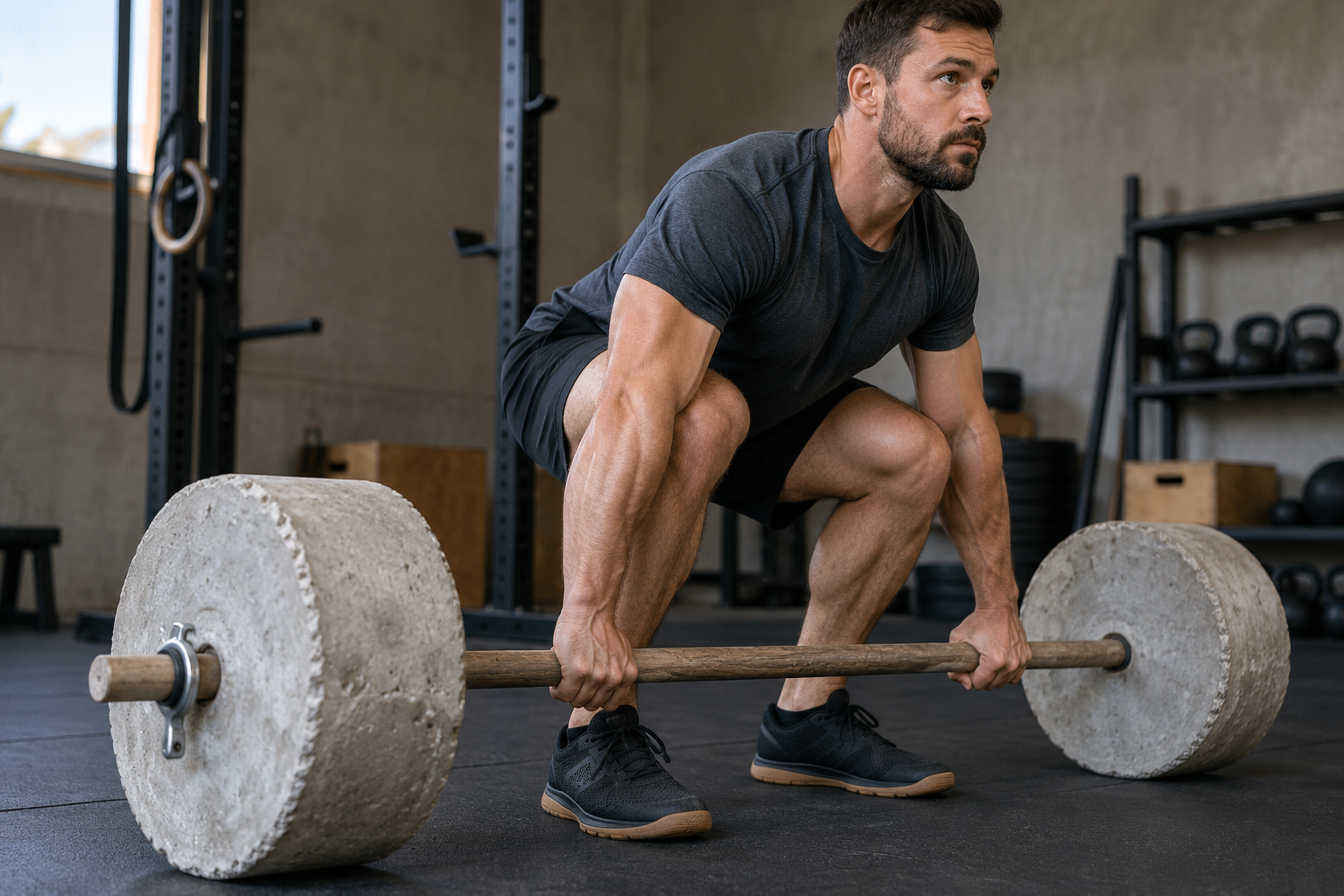
Risks of DIY CrossFit Equipment
DIY CrossFit equipment can appear inexpensive, but a home-built structure is not proven suitable for training simply because it holds a person or a weight once. Jumping, swinging and repeated loading challenge equipment differently from a stationary load.
The risks depend on the item: a jump box can tip, a pull-up bar can detach and an improvised weight can spill its contents. This guide identifies the main failure points and the information needed before considering use. It does not provide construction specifications or load ratings.
- Why is a static test not proof of safety?
- What can fail around bars and anchors?
- What are the risks of a homemade jump box?
- Why are improvised weights a concern?
- How should you judge materials and connections?
- Which costs can DIY equipment hide?
- When should equipment be taken out of use?
- When is purpose-built equipment the better option?
Why is a static test not proof of safety?
Holding a weight once does not establish how a structure will respond to impacts, swinging or repeated use. Force direction and how the force is applied matter as well as the weight itself. An informal test is not a design assessment.
Dynamic loading
Kipping movements, jumps and dropped loads can stress connections and supports. Do not assign a load rating based on how sturdy something feels or on a video demonstration.
Consider the difference between supporting a bar resting on hooks and catching it after an uncontrolled movement. The latter can apply force quickly, away from the expected line or at a concentrated point. Load distribution also matters: equal loading on two uprights does not represent every training situation. Adding an arbitrary margin to the user's body weight is therefore not a design method. A credible assessment needs to define permitted activities, load directions, connection details and verification criteria. If those details are unavailable, acknowledge the uncertainty. The fact that a structure has not yet failed during a few controlled repetitions is an observation about those repetitions, rather than evidence covering every intended workout.
What can fail around bars and anchors?
A strong bar does not prove that its bolts, plates, wall or ceiling are suitable. The installation works as a system: a weak support may fail even when the bar does not bend. The supporting structure must be part of the assessment.
Suspended exercises
If a person is hanging from equipment, failure can cause a fall. Avoid unknown or improvised fixings and have the installation assessed by an appropriately qualified professional.
A wall can have a solid-looking finish without providing the structural support an installation needs. Suitable fixings depend on the actual substrate, its condition and the requirements of the fastening system. Proximity to edges, openings and other fixings can also require specific assessment. A photograph cannot establish a universal solution. Rings, ropes and bars introduce different geometries and directions of pull, even when they occupy the same corner. Reliable information about the location and intended use is needed before installation, followed by a check that assembly matches the plan. Anyone assessing the installation needs to know the exercises being proposed, not just the body weight of the person who will use it.
What are the risks of a homemade jump box?
A box can slide, tip or separate at its joints. Slippery surfaces, damaged edges and nearby obstacles can also affect foot contact and landing space. A bulky appearance does not rule out these failure modes.
Floor contact
Inspect stability and surface condition without treating a visual check as certification. If the structure is uncertain, choose an alternative designed for the intended activity.
Box height is not solely a measure of jump difficulty. The setup needs a usable contact surface, a clear surrounding area and a way to step away without obstacles. A box appropriate for controlled step-ups is not automatically suitable for repeated jumping or other activities. Adding a padded cover to an uncertain structure does not establish its strength. When planning the area, consider where the user may move after a missed landing, rather than looking only at the box footprint. Stored equipment, walls and other participants should not occupy the same working area. Assess the space with the actual activity in mind, including transitions, instead of assessing only the stationary object.
Why are improvised weights a concern?
Containers, handles and fillers may not be designed for swinging, dropping or overhead movements. Moving contents can shift the balance, and a closure or handle may fail without an obvious warning. Weight alone does not establish suitability.
Intended use
Do not assume an object is appropriate for lifting or throwing because its mass is known. Commercial equipment also needs to be used only in ways permitted by its manufacturer.
A container filled with sand or another material can behave differently when accelerated or rotated. Total mass says little about content distribution, closure strength or handle quality. A carrying handle should not automatically become an attachment for dynamic exercise. Similarly, a surface that feels easy to hold when dry may become slippery with sweat or wear. Assessment needs to consider the intended movement, the possibility of dropping the item and how it will be stored between sessions. If the object was not designed for the proposed action, reducing the number of repetitions does not resolve the uncertainty about its construction. Choose equipment whose stated use covers the task rather than treating familiar appearance as sufficient evidence.
How should you judge materials and connections?
Welds, bolts, screws and joints are essential parts of the structure. Corrosion, cracks, deformation and looseness require attention, but their absence does not prove a sound design. External appearance is only one part of the picture.
Compare documented alternatives
The professional racks category provides dedicated structures to compare. For each model, request intended-use limits, assembly instructions, anchoring requirements and maintenance information.
A connection can feel firm initially and develop movement over time. Contact surfaces may wear, fasteners may move and moisture can change material condition. Inspection needs to include less visible areas through a plan appropriate to the structure. Avoid alterations that change the load path without reassessment: drilling an upright, extending a lever or adding another station is more than a cosmetic change. Keep model identification and current instructions for purpose-built products. With undocumented equipment, recognise that a visual examination cannot recreate every missing design detail. A clean finish or fresh paint may make inspection harder if it covers signs of damage, so appearance should never replace information about the assembly beneath it.
Which costs can DIY equipment hide?
Materials and tools are only part of the cost. Design, assessment of supports, fabrication, maintenance and possible replacement also matter. A low starting price does not make an unassessed risk acceptable.
Compare equivalent uses
Compare equipment intended for the same activity. A structure for controlled repetitions is not automatically suitable for swinging movements or several people using it at once.
To compare costs fairly, describe the intended service first. A station used occasionally by one person and a shared class area differ in management, inspection and availability needs. Include installation time, access to replaceable parts and the availability of support. Time spent keeping the equipment usable is not free simply because no external invoice is issued. A solution requiring constant correction can interrupt training and occupy floor space without providing the expected function. Suitability still comes before cost comparison. An inexpensive proposal is not equivalent to a documented one when nobody can establish which activities it supports or what limitations apply. Record exclusions as carefully as the features included in an offer.
When should equipment be taken out of use?
Stop using equipment if it develops unusual noises, loose connections, deformation, instability or signs of failure. Prevent others from using it until it has been assessed. Tightening a connection or hiding a crack may not address the cause.
Checks over time
Record faults and interventions. Repairs must suit the structure and its intended use. Do not resume training solely because the defect is no longer visible.
Decide in advance how faults will be reported and who can authorise a return to use. In a shared setting, moving equipment aside or leaving a small note may not prevent another person from using it. A fault record should identify the affected item, observed defect and date, rather than saying only that something needs fixing. Do not test an uncertain connection by hanging a person from it. After repair, assessment should address the cause and the wider condition, not just the replaced component. If there is no reliable basis for repair or verification, replacement may be more appropriate than repeated experiments. Keep the equipment unavailable while that decision remains unresolved.
When is purpose-built equipment the better option?
If the design, capacity, connections and operating conditions cannot be verified, there is insufficient information to rely on the structure. Purpose-built equipment with documentation and support makes assessment easier, while still requiring correct installation and ongoing checks.
Make the decision before training
For bars, racks and equipment supporting people or substantial loads, prioritise demonstrable requirements. Establish the equipment's limitations before a workout rather than discovering them through failure.
Documentation makes precise questions possible. Is the equipment intended for domestic or commercial use? Which movements are permitted? What requirements apply to floors and anchors? How are replacement parts identified? Answers need to refer to the actual model and configuration. Brand reputation or a photograph of somebody using a product does not establish suitability for every possible setup. Apparently compatible accessories also need checking when they change loading or support. A well-founded decision retains instructions and supplier information, identifies limitations and assigns routine checks. This helps distinguish an assembly problem, a maintenance need and an activity that was outside the intended use from the start, instead of treating every issue as a minor adjustment.
Comments (0)