
Trolley
You have no items in your shopping cart

 Budgets
 Dumbers
 Discs
 Benches
 Racks and Rigs
 Weights Holders
 Isotonic machines
 Calisthenics
 Cardio
 Kettlebells
 Flooring
 Gym Set
 Accessories
 Combat
 ARTI MARZIALI
 CONTAINER GYM
 Tug-Of-War
 Used Gym Equipment
 PILATES MACCHINARI
 GINNASTICA ARTISTICA
 CAMPI DA PADEL
 Prodotti in Pronta Consegna
 Informazioni
 IRONMAN
 Gift Card
- Donatif
- General information
- 0 I like it
- 124 Views
- 0 comments
- gym flooring, safety flooring, gym safety, shock-absorbing materials
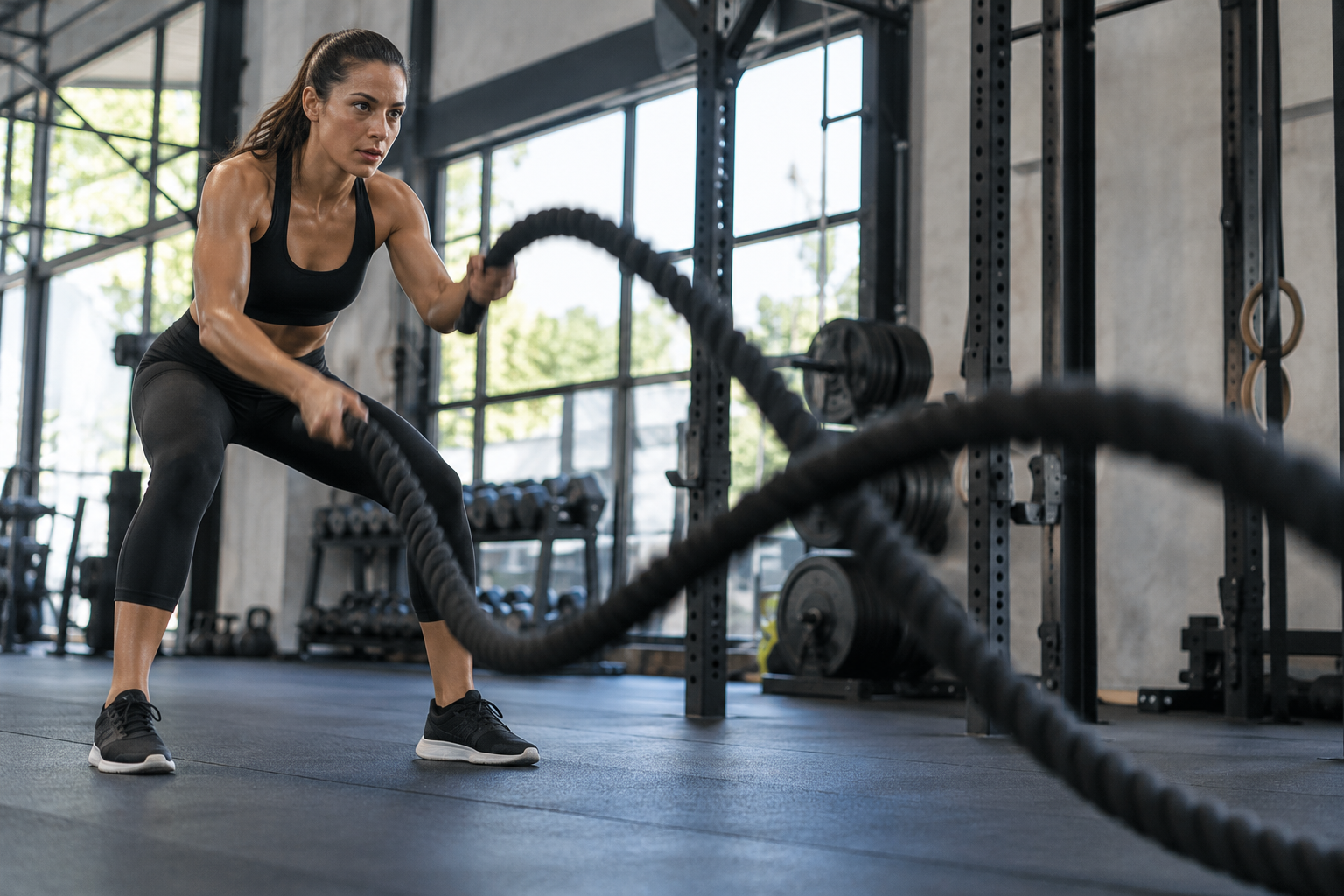
Battle Ropes: Technique, Waves and Training Progressions
Battle ropes are training ropes that let you create waves and powerful downward movements by moving their free ends. The action looks simple, but changes considerably with rhythm, amplitude, stance and the characteristics of the rope. Your arms and shoulders move the ropes, while your legs and trunk help maintain a stable base throughout the effort.
Using them effectively means first learning to control the movement, then deciding how it fits into your session. Alternating waves, double waves and slams require different coordination patterns and do not all need to be performed at maximum intensity. This guide takes you from setting up the station to progressing your training, with practical advice on identifying mistakes and organising the work.
The manufacturer's instructions remain the reference for anchoring, permitted surfaces and maintenance. Exercise selection should suit individual ability and, where necessary, be discussed with an instructor.
- Prepare the space and anchor
- Set your stance and grip
- Learn alternating waves
- Understand double waves and slams
- Add variations
- Organise work and recovery
- Correct mistakes
- Choose and store your rope
How should you prepare the space and anchor?
A battle-rope station includes the rope, a compatible fixing and the entire area covered by its waves. Before starting, make sure nobody needs to walk between you and the anchor. Clear the sides too: some variations move the ropes horizontally and can occupy more space than your first vertical attempts.
Check the fixing point
Use an anchor designed for the equipment and installed according to its instructions. Do not wrap the rope around a machine simply because it looks heavy: the equipment could slide, tip over or damage the rope covering. Check fasteners, connections and the contact area before the session. A fixing that moves or shows abnormalities needs assessment before use.
The floor should provide stable footing and be compatible with rope friction. Adjust your distance from the anchor without pulling the rope completely taut: it needs enough freedom to create waves. The correct position depends on the system used, so there is no universal distance that applies to every model.
Which stance and grip should you use?
Start with your feet approximately shoulder-width apart and your knees slightly bent. Distribute your weight so you do not fall forward when the rope changes direction. Keep your trunk controlled and look ahead. Your position should allow you to breathe and move your arms without tensing your entire body.
Hold firmly without overgripping
Take one end in each hand, generally with your palms facing inward. Your grip should prevent slipping, but excessive squeezing can quickly tire your forearms. Keep your wrists comfortable and check that the handles are dry, intact and suitable for the size of your hands.
Avoid repeatedly shrugging your shoulders towards your ears during the movement. Some contribution from the body is normal, but increasingly large rocking movements can indicate that you are compensating for fatigue. Before increasing speed, find a position you can repeat without losing balance or arching your back.
How do you learn alternating waves?
In alternating waves, one hand rises as the other lowers. This creates a succession of waves travelling towards the anchor. Start slowly with a manageable range of movement. Aim for continuity and a recognisable rhythm, rather than immediately trying to move your arms as fast as possible.
Watch what happens to the rope
The waves provide immediate feedback: if one side repeatedly breaks down, try slowing down and making your movements more regular. The waves do not need to be identical down to the millimetre. It is more useful to see whether both hands can sustain the task while your feet and trunk remain controlled.
You can briefly practise one arm at a time to understand its path, then coordinate both sides. Stop before the movement becomes a series of jerks. During your first sessions, repeating a simple variation well helps you understand the rope's response more than continually changing exercises.
What is the difference between double waves and slams?
In double waves, both hands rise and fall together. This shared rhythm changes the stability demands compared with alternating waves. Keep the movement controlled and choose a range that does not require you to rock your trunk forwards and backwards with every repetition.
Perform slams with control
Slams involve a larger movement directed downwards. Before trying them, learn to raise and lower the ropes without losing your position. The intention to put energy into the ropes should not turn into uncontrolled back movement. Also check that the rope, fixing and surface are suitable for this type of use.
Do not automatically add a jump or a deep squat. These are different combinations, with additional coordination and space requirements. A more complex variation makes sense when it serves the session's purpose and can still be performed with recognisable technique during the final repetitions.
When should you introduce lateral waves and combinations?
Lateral waves move the ropes horizontally and require a wider clear area. Before starting, check their path near your feet and your distance from other people. Reduce the pace until you can guide the ropes without losing your footing or sending them into shared walkways.
Arm circles also change the path of the ropes. Introduce one new element at a time and practise while your grip is still effective. If you add a lunge or a step, check the leg movement separately before combining it with the waves. Difficulty should not prevent you from understanding which element you are training.
For a beginner, a reasonable progression is to establish alternating waves, try double waves and then consider slams or lateral movements. This sequence is a learning approach rather than a requirement for everyone. An instructor can adjust it according to the person's experience and response.
How should you organise work, recovery and progression?
First decide whether the ropes are for learning technique, completing a circuit or conditioning. If you are learning, schedule your attempts while you can still concentrate. If you use them after other exercises, consider the fatigue already accumulated in your shoulders, arms and grip.
Choose repeatable intervals
Alternate work and recovery periods that allow you to maintain the movement. The appropriate duration depends on the person, rope and chosen intensity. Begin with short attempts, stopping when quality deteriorates. Before restarting, check whether you can regain your stance, breathing and grip without excessive breathlessness.
Record the variation, work duration, recovery and perceived difficulty. Once you can repeat the same performance with control, change one variable: more time, a different pace or an additional interval. Increasing everything at once makes it difficult to understand why the session becomes too demanding. Compare sessions under similar conditions and allow recovery between workouts.
Which execution mistakes should you recognise?
Common mistakes include holding your breath, tensing your neck, arching your back and continuing when your hands no longer control the ends. Progressively smaller waves can also indicate that the demand exceeds your ability to maintain the intended task. Reduce the pace or end the interval before losing your grip.
Correct one element at a time
If your trunk rocks, try a shorter interval or a simpler variation. If your forearms tire immediately, reassess your grip and the rope's characteristics. An instructor's observation can help distinguish ordinary fatigue from compensations. Pain means stopping the movement and seeking appropriate assessment, rather than trying to push through by increasing effort.
How do you choose and store battle ropes?
Length, diameter, material and handles affect handling and effort. A more demanding rope is not necessarily better: it needs to allow your planned exercises and suit your grip. To compare available options, you can consult the gym accessories category, checking anchor compatibility and the permitted environment separately.
Before use, examine the covering, ends and section near the anchor. Report fraying, damaged fasteners or unstable handles. Clean and store the rope according to the manufacturer's instructions; do not assume every material can remain outdoors. After the session, put it away outside walkways, avoiding loops that could become obstacles. An orderly station makes it easier to resume training with attention to technique.
In a shared room, establish how people access the station and where they wait for their turn. Someone recovering should not stand beside moving ropes. Before changing users, let the ropes stop completely and check that the next person has space to get into position. Even during a fast circuit, the changeover should remain orderly.
To compare progress, choose a simple reference: the same rope, the same variation and a similar starting position. Observe whether you can maintain rhythm and footing throughout the planned period. If you change both equipment and duration, greater fatigue does not necessarily demonstrate improvement. Recording these differences helps you interpret the session without relying solely on how you feel at the end.
When finished, tidy the area and report any problems to the gym manager. A damaged rope should be clearly identified so another user does not pick it up without knowing about the issue discovered during training, before the next scheduled session.
Comments (0)