
Trolley
You have no items in your shopping cart

 Budgets
 Dumbers
 Discs
 Benches
 Racks and Rigs
 Weights Holders
 Isotonic machines
 Calisthenics
 Cardio
 Kettlebells
 Flooring
 Gym Set
 Accessories
 Combat
 ARTI MARZIALI
 CONTAINER GYM
 Tug-Of-War
 Used Gym Equipment
 PILATES MACCHINARI
 GINNASTICA ARTISTICA
 CAMPI DA PADEL
 Prodotti in Pronta Consegna
 Informazioni
 IRONMAN
 Gift Card
- Donatif
- General information
- 0 I like it
- 50 Views
- 0 comments
- gym flooring, safety flooring, gym safety, shock-absorbing materials
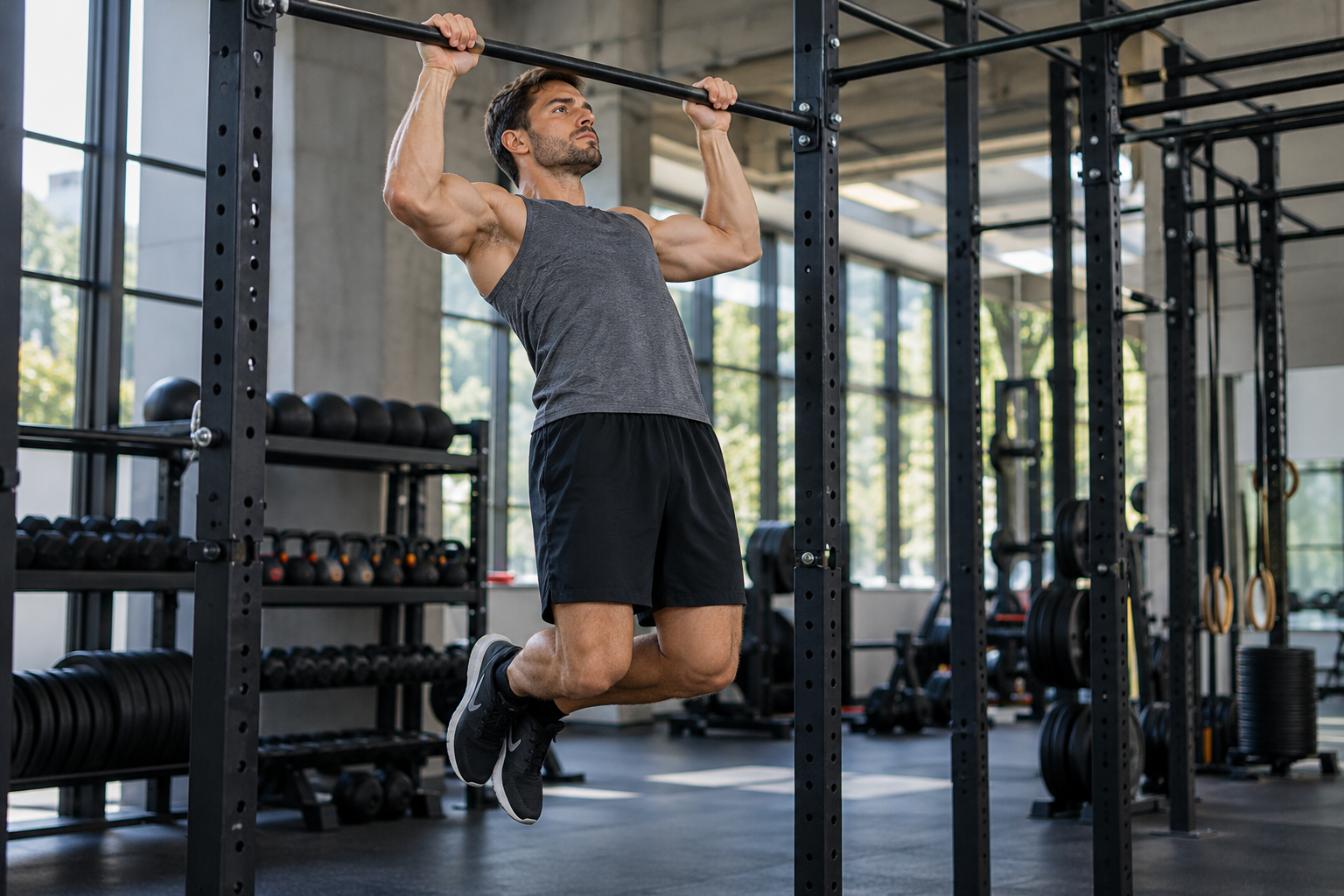
Vertical Pulling: Movement, Muscles and Machine Setup
In gym training, vertical pulling describes movements where a handle is pulled from overhead towards the torso, or the body moves towards an overhead grip. Lat pulldowns and pull-ups belong to this family but organise the work differently. The term therefore describes neither a single machine nor one identical technique for every situation.
Understanding the movement helps distinguish muscular work from the sensation of fatigue. The number on the weight stack alone does not establish execution quality, and hand position does not turn the exercise into complete isolation. Shoulders, elbows, shoulder blades and torso work together, with contributions varying by movement and individual.
This guide presents general principles and criteria for using a machine according to its instructions. It does not replace individual assessment or practical instruction. Learn the specific machine's settings, intended path and operating conditions before selecting load and training method.
- What identifies a vertical pull?
- Which muscles contribute?
- Setting up the machine
- Controlled movement and range
- Grip and variations
- Selecting load and progression
- Machine, pull-up bar and assisted options
- Include vertical pulling in a programme
What identifies a vertical pull?
On a pulldown machine, the user typically starts with arms directed overhead and moves the handle towards the upper torso along the permitted path. During a pull-up, the grip stays fixed and the body moves. Vertical describes the predominant pulling direction, not a requirement that every segment follows a perfectly vertical line. Lever machines may have their own paths, so manufacturer instructions and movement coaching must be considered together.
Difference from rowing exercises
A rowing exercise pulls predominantly in a more horizontal direction relative to the torso. The two families share muscle groups but organise movement differently. They need not be absolute alternatives: a programme can include both where appropriate to goals and abilities. Comparison helps distribute training rather than establish that one movement automatically replaces all functions of the other. Body position also changes the task.
Which muscles contribute?
The latissimus dorsi contributes to arm movements involved in pulling, alongside other shoulder and shoulder-girdle muscles. Elbow flexors, including biceps brachii and brachialis, contribute as the elbow bends. Muscles controlling the shoulder blades coordinate their position while the torso maintains an appropriate posture. This does not mean every muscle works equally in all variations, nor does it justify universal activation percentages.
Avoid the idea of complete isolation
Changing grip or path can alter leverage and sensation but does not completely exclude other participating groups. Feeling the arms does not prove an error, just as strongly feeling the back does not certify correct technique. Assess control, repeatability and absence of unintended compensations. A practical demonstration is more useful for understanding the movement than rigid classifications of exercises as working only one muscle.
Setting up the machine
Identify seat, any thigh restraints, handles and load-selection system before starting. Adjust the station as instructed so the intended supports are reachable without forcing a position. A thigh restraint, where present, must perform its designed function rather than serve as an improvised block. Check that adjustments and weight-stack pin are fully engaged. Do not modify the machine to obtain a range outside its intended design.
Access and starting position
Choose an entry method that does not require jerking to reach the handle. If the starting position is unmanageable with the available settings, ask for help checking fit and adjustment. Maintain the prescribed supports and organise the start before the set. Do not add unauthorised platforms, weights or accessories to adapt the seat. A seemingly simple machine can have instructions different from another model.
Controlled movement and range
The pull should follow a controlled sequence compatible with the equipment. Avoid turning the set into repeated torso swings to move an excessive load. Recovery deserves as much attention as pulling: allowing the weight to drag the arms suddenly changes the task and may disrupt position. Choose range according to the intended path and user capabilities rather than seeking one universal endpoint for every machine and body.
Coordinate shoulder blades, arms and torso
Scapular control does not mean fixing the shoulder blades in an extreme position throughout every repetition. Their movement should coordinate with the arms under the taught variation. A slight planned torso inclination differs from increasing swings used to complete the load. Observe whether repetitions remain similar and the torso stays controlled. If quality changes substantially, review load, recovery and setup with the instructor.
Grip and variations
Pronated, supinated and neutral grips describe different hand orientations where provided. Width and handle shape affect wrist and elbow position and may alter comfort. No grip guarantees the same result for everybody or is compulsory for training the back. Choose from the machine's intended options without forcing joints to imitate a photograph. Variations should serve a purpose in the programme rather than simply add complexity.
Difficulty is not quality
A wider grip is not automatically more effective, nor does an unusual attachment make the exercise more advanced. Before changing, establish that you understand and can repeat the movement. Behind-the-neck pulling is not a necessary progression and should not be introduced merely because it looks harder. A sensible choice prioritises a manageable path consistent with the machine, with individual adaptations assessed competently.
Selecting load and progression
Initial load should allow learning and control over the planned work. Directly comparing kilograms shown on different machines is unhelpful because transmissions and levers can change the resistance experienced. Record machine, settings and execution method alongside completed work. Increasing weight is one option, but more stable technique and better programme management also provide meaningful information.
Change training deliberately
Avoid changing every variable at once without a reason, which makes improvements or difficulties harder to interpret. Consider experience, recovery and other weekly activity. This guide does not prescribe identical sets and repetitions for everyone. If technique deteriorates or unexpected symptoms occur, stop the set and review training with an appropriate professional. Pain must not be used as a measure of effectiveness.
Machine, pull-up bar and assisted options
A lat machine allows load selection under its own system, while pull-ups require managing the suspended body. Assisted machines alter the task using a designed support. These differences can make each option useful without creating a compulsory hierarchy. A user can train productively with one solution without immediately progressing to another. Select according to goals, movement skill and facility conditions.
Check equipment before use
Visually inspect handles, accessible connections and adjustments according to gym procedures. Report damaged components, unusual movement or new noises rather than improvising repairs. Bars and machines have their own installation and maintenance requirements. Staff should retain documentation and arrange manufacturer-prescribed inspections. Programme effectiveness does not compensate for equipment outside its required operating condition.
Include vertical pulling in a programme
Vertical pulling can contribute to upper-body training within a coherent programme. It is not a single solution for posture, body composition or individual problems. Consider other exercises, total volume and recovery rather than stacking many similar variations merely to increase fatigue. Clear progression connects gym work with realistic, assessable goals.
Combine documents and practice
The Donatif catalogue can help explore equipment for comparison, but a commercial name alone does not establish programme suitability. Examine configuration, settings, dimensions and intended use of the actual model. Connect this information with a trial or demonstration where possible. Effective setup brings together appropriate equipment, movement learning and workload management rather than simply increasing the stack weight.
Comments (0)