
Trolley
You have no items in your shopping cart

 Budgets
 Dumbers
 Discs
 Benches
 Racks and Rigs
 Weights Holders
 Isotonic machines
 Calisthenics
 Cardio
 Kettlebells
 Flooring
 Gym Set
 Accessories
 Combat
 ARTI MARZIALI
 CONTAINER GYM
 Tug-Of-War
 Used Gym Equipment
 PILATES MACCHINARI
 GINNASTICA ARTISTICA
 CAMPI DA PADEL
 Prodotti in Pronta Consegna
 Informazioni
 IRONMAN
 Gift Card
- Donatif
- General information
- 0 I like it
- 133 Views
- 0 comments
- gym flooring, safety flooring, gym safety, shock-absorbing materials
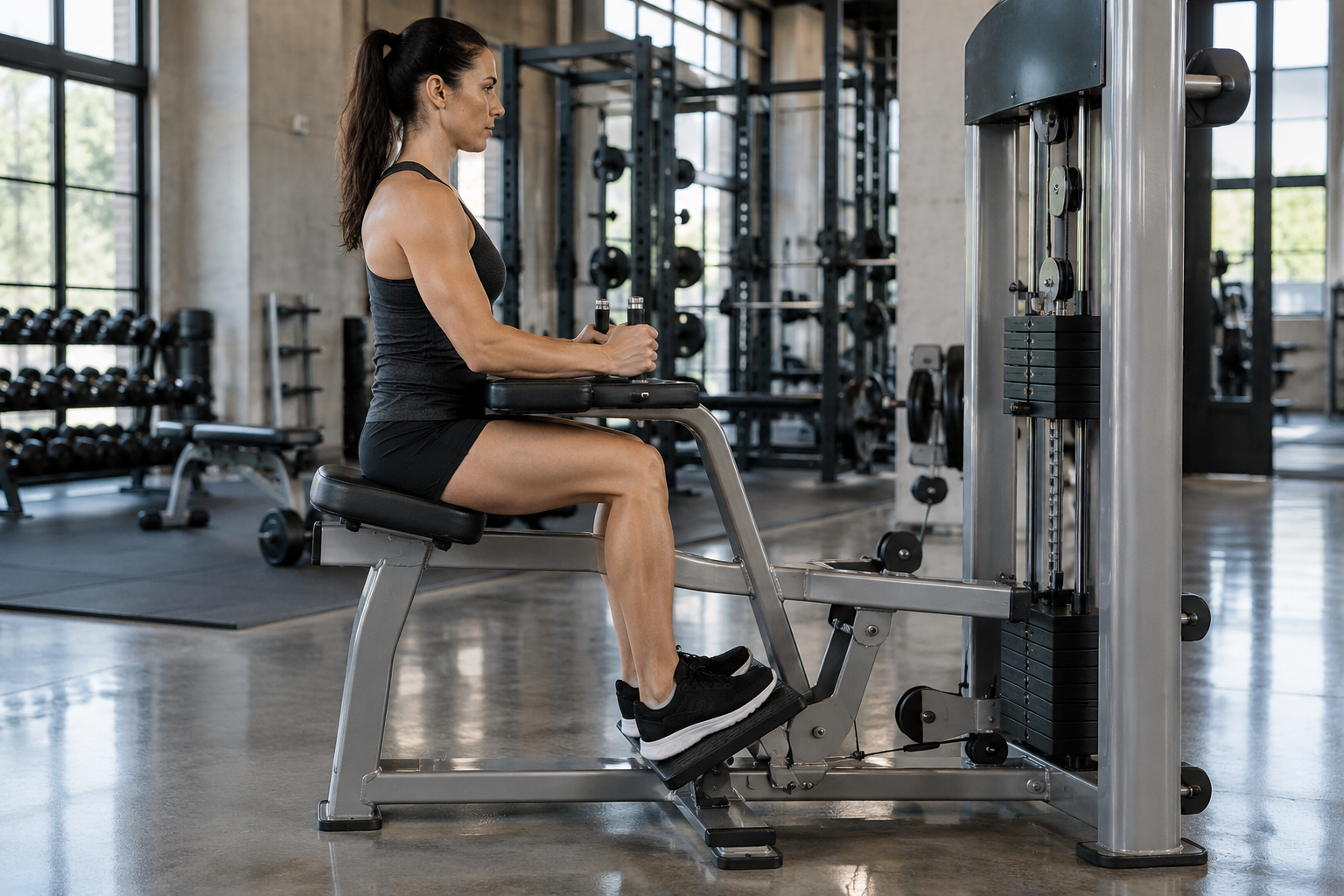
Correct technique for using the calf press machine
A calf press machine trains the calf through ankle plantar flexion: the forefoot presses into the platform as the heel rises relative to its starting position. The action should come mainly from the ankle rather than from repeated knee bends or bouncing.
The name calf press covers different machine layouts. A dedicated calf station and a leg press used for calf work may have different adjustments and safety stops. Identify the model first and check that the manufacturer allows the exercise you intend to perform.
This guide explains body support, foot placement, movement control, loading and common mistakes. Exact adjustment and release procedures must follow the instructions for the machine in front of you.
- Which calf press variation are you using?
- How should you adjust the seat and supports?
- Where should your feet contact the platform?
- How do you perform a controlled repetition?
- How should you select the starting resistance?
- Which mistakes should you watch for?
- How do you start and finish safely?
- How does calf work fit into a programme?
Which calf press variation are you using?
A straighter-knee position differs from seated calf work with the knee bent. Both the gastrocnemius and soleus contribute to plantar flexion, but knee position changes their relative contribution. The setup should reflect the intended variation.
Identify the controls first
Do not copy the setup of a different machine. Locate the footplate, seat, supports, handles and safety stops. Ask for a demonstration before adding resistance if the entry and exit procedure is unclear.
Understanding the variation helps you interpret the movement without expecting one machine to serve every possible purpose. Knee position does not switch a muscle off completely, and a local sensation alone cannot establish the quality of a set. Before comparing performances, record the model and setup. Loads displayed on different machines are not necessarily comparable because levers, inclination and transmission systems affect the resistance experienced by the user. Similar conditions on the same station provide a more useful reference for progress. A number on a weight stack describes a setting on that particular machine; it is not a universal measure of how much work the calf has performed across every available design.
How should you adjust the seat and supports?
Adjust the station so your body stays supported throughout the repetition. On machines with a backrest, keep your pelvis and back against the intended supports. You should not need to slide forwards or reach for the platform with your toes.
Keep the knee position consistent
Maintain the knee angle required by the variation instead of bending and extending the knees to assist every repetition. Avoid forcing the joint against its end range.
Before a demanding set, perform preparatory repetitions with a manageable resistance. Use them to learn the path and check that the supports remain consistent while you move. If you must push hard into the backrest simply to avoid sliding, review the seat distance, foot position and intended use of handles. Do not solve an adjustment problem by bracing harder or automatically shortening every repetition. A position that feels acceptable initially may become unstable with fatigue, so observe the final repetitions as well as the first. If the available adjustments do not suit your build, consider another station instead of forcing yourself into a setup that cannot provide consistent support throughout the exercise.
Where should your feet contact the platform?
Place the forefoot securely on the designated support surface. If the machine allows the heels to move freely, they should lower without the feet losing contact. Do not balance solely on the tips of the toes.
Use a stable alignment
Choose a natural, controllable foot position. Exaggerated toe rotation does not provide complete isolation of a particular part of the calf. Check that your footwear makes secure contact with the platform.
Foot contact should remain clear both while the heel rises and while it returns downwards. If the foot gradually creeps along the platform, stop and reposition it once the mechanism is secure. Do not try to correct a slipping foot while the resistance continues moving. Check that the sole and contact surface are not wet or dirty and that edges and coverings are intact. Foot shape and platform design may require a different position on another machine. Choose according to the actual contact rather than reproducing an exact distance from an edge merely because it worked on a previous model. Secure contact matters throughout the movement, not only when you first place your feet.
How do you perform a controlled repetition?
Press through the forefoot to raise the heels smoothly. Lower towards the starting position under control. Keep the torso supported and avoid turning the movement into a leg press driven by the knees.
Choose a usable range
Use a range you can control without pain or loss of foot contact. Do not force the heel into a deep lower position if it causes discomfort or changes your setup. The available path depends on the machine and individual mobility.
A useful repetition stays within your controllable range and the machine's intended path. It does not require reaching an extreme joint position at any cost. Notice whether the lowering phase remains deliberate or whether the resistance pulls the heel down abruptly. A sudden change in speed can indicate that control is being lost. Similarly, bouncing the mechanism is not the same as lifting through a controlled ankle action. Pause between attempts if needed to recover the movement pattern. Establish a distinguishable upward action and return with consistent contact before trying to fit more work into the set. Range, support and repeatability should remain understandable even as the muscles begin to feel tired.
How should you select the starting resistance?
Begin with a resistance that lets you check contact and movement. Excessive loading can shorten the range and encourage bouncing or compensations. Feeling tired does not demonstrate that the repetition is controlled.
When to add resistance
Increase the load only when you can repeat the planned work with consistent position and range. If the increase immediately changes your technique, return to a manageable resistance and establish control first.
Set the constants before planning progression: machine, adjustments, foot position and the point at which the set ends. Changing resistance, speed and range simultaneously makes it difficult to tell what improved. A suitable increase leaves the movement recognisably similar to previous repetitions. Calf work can be demanding with a resistance that looks modest beside other leg exercises, so do not select it by comparison with your leg press load or another user's setting. If technique changes before the planned work is completed, treat that as useful information for adjusting the session. Hurrying through the remaining repetitions may conceal the change without addressing why control was lost in the first place.
Which mistakes should you watch for?
Bouncing at the bottom, pushing with the knees and lifting the pelvis are common compensations. Pulling hard on the handles to move the body can also hide an unstable setup. Slow down and review the adjustment before continuing.
Breathing and rhythm
Keep breathing rather than holding your breath throughout the set. There is no single tempo for every user and goal. Choose a rhythm that makes both the upward action and the controlled return clear.
The most useful error to correct is one that changes the task, rather than a cosmetic difference seen from a distance. If the knees begin driving the movement, reduce resistance and check whether the intended angle can be maintained. If the pelvis lifts, review support and loading before adding repetitions. If foot contact is lost, pause and reset the station. An instructor can help distinguish these situations without treating every feeling of fatigue as a technical fault. Use a few clear cues: stable contact, movement at the ankle, supported trunk and a controlled return. Too many simultaneous instructions can make execution less clear, so identify the main issue and assess the response to one correction.
How do you start and finish safely?
Check pins, resistance and stops as directed by the manual before beginning. Do not change adjustments while the mechanism is loaded. At the end, return the machine to its specified secure position before removing your feet or leaving the supports.
Know when to stop
Stop if you experience pain, lose contact or notice unusual machine movement. Ankle or Achilles tendon problems call for appropriate assessment rather than forcing a deeper stretch under load.
Plate-loaded and weight-stack machines may require different procedures for setting resistance and securing the mechanism. Do not assume that a lever has the same function on two similar-looking models. Read the available instructions and ask for assistance if a control is unclear. Keep the moving-load area free and avoid placing objects where they could interfere with guides or mechanisms. If you notice during a set that an adjustment needs changing, finish the movement and return the machine to its specified secure state first. A hurried adjustment under load does not replace correct preparation. Understand how the station is parked before beginning, instead of trying to work it out while your feet are supporting the resistance.
How does calf work fit into a programme?
Choose sets, repetitions and rest according to the goal and the other exercises in the session. Running, jumping and other lower-body work can add calf fatigue. Record the machine variation and execution, as well as the weight used.
Compare the actual stations
The isotonic machines category provides an overview of different configurations. When comparing calf stations, examine adjustments, platform contact, access to stops and suitability for intended users. Confirm technique on the actual model you will use.
In a training record, note how well you preserve the range towards the end of the set and how the next comparable session feels. One unusually difficult day may reflect preceding exercise, recovery or a different setup. It does not automatically require rewriting the whole programme. Look for a pattern under comparable conditions and adjust workload distribution if calf fatigue interferes with other planned activity. When changing machines, allow time to learn the adjustments and path instead of transferring the previous load without review. The aim is a repeatable practice that connects programme changes to observable movement and recovery. A useful record explains what you actually did, not just the largest number selected on the machine.
Comments (0)